

A new report from the Empire Center reveals hidden and rising costs, questionable assumptions and emerging transparency and practical issues resulting from New York’s 2019 Climate Leadership and Community Protection Act (CLCPA).
In Green Guardrails: Guiding New York’s Drive To Lower Emissions, Empire Center research director Ken Girardin shows the law’s implementation has been shrouded in secrecy, with state officials failing to issue legally required studies about energy costs and grid reliability, while blocking the release of a major climate policy study for which the state paid nearly $1 million and models on which major parts of the state’s plans are based.
“The rush to be first, the arbitrary nature of the Climate Act’s goals and the extent to which the state is relying on opaque modeling has set the state up for costly and economically destructive mistakes,” said Girardin, “Returning climate policymaking to the legislative branch, where it belongs, is the only way to prevent them.”
Girardin finds the state’s under-$300 billion price tag for the Climate Act relied on making spending in future years look artificially low. Instead, he explains, the state expects New Yorkers to face $4.9 trillion in new expenses between 2020 and 2050 hoping they will be offset by $4.3 trillion in “avoided” expenses. The difference—about $600 billion—is more than double the state’s announced figure.
Worse, the large amounts involved mean if new spending is just 5 percent higher and avoided spending is 5 percent lower, the Climate Act’s added cost to New Yorkers explodes to more than $1 trillion.
Rising costs are already on display, Girardin warns, listing growing and unexpected expenses in major climate programs. For instance, the amount utilities (and therefore electricity customers) must pay to support one megawatt-hour of renewable energy has doubled since 2022, on top of utilities needing to buy more of it. State records also reveal the need, caused by multi-day wind lulls, for an almost unimaginable amount of battery storage that could cost over $100 billion to install—assuming major declines in battery prices materialize. Other costs, such as the price of compliance with a new “cap and invest” system, remain unknown.
Girardin also finds state officials made unrealistic assumptions about how the electricity grid will work, appearing to overstate both the output from renewable power plants and the number of oil and gas plants that will be available to back them up. That increases the risk of a mismatch between supply and demand, threatening the reliability of the grid.
Examining the circumstances under which the Climate Act was adopted in 2019, Girardin recounts the erosion of the Legislature’s stature and authority during Governor Andrew Cuomo’s tenure. Lawmakers rushed to adopt the law hours after the text was finalized and before fully understanding details such as the fact that New York would be calculating emissions differently from the federal government and most other states.
Girardin argues lawmakers should reclaim the policymaking and taxing powers they surrendered to executive branch agencies, arguing they can preserve the state’s goals while creating “guardrails” to protect New Yorkers from runaway costs and threats to the grid’s reliability.
The recommended changes include updating state law to give lawmakers the final say on major regulations with compliance costs over $100 million, ending NYSERDA’s ability to enter into multi-billion-dollar subsidy contracts without legislative signoff and setting mandatory renewable energy levels in law as other tax rates are.
Meanwhile, Girardin shows the Legislature can make it easier for the state to meet its climate goals by making its 2030 targets more flexible to include more “zero-emission” technologies such as hydroelectric, biogas and nuclear and rolling back a costly provision intended to steer work to the state’s shrinking construction unions. Girardin also suggests the state should ask Congress for an exemption from the costly Jones Act which has forced developers to load offshore wind components on to ships in ports as far away as Germany instead of using New York ports.
You may also like

Switching to Electric Home Heating Could Add Thousands to Energy Bills
FOR IMMEDIATE RELEASE: ALBANY, N.Y. that heating an average home from October to March would cost approximately $790 with natural gas, compared with $1,100 with a heat pump and $3,300 with electr Read More

Poll: 64% of New Yorkers Back Eliminating the State Income Tax; 67% Say State Taxes Aren’t Delivering
Dissatisfaction spans party and regional lines as broad majorities rally behind sweeping tax reform
FOR IMMEDIATE RELEASE: ALBANY, N.Y. - New Yorkers are delivering a blunt assessment of the state’s tax system: 67% say they ar Read More
SUNY Research Foundation Payroll Tops $400 Million
Payroll records for 8,401 employees of the Research Foundation for the State University of New York (RF SUNY) for fiscal year 2026 are , the Empire Center's government transparency website.
The Research Foundation is a private, nonprofit educational co Read More

Newly Retired NYC Firefighters Average Over $177k In Pensions
New York City firefighters and fire officers retiring last year after full careers were entitled to average annual pension benefits of $177,016, according to , the Empire Center's government transparency website.
Among the 499 new retirees with at leas Read More
New York Annual Household Electricity Costs Rise $270
FOR IMMEDIATE RELEASE ALBANY, N.Y. — New York’s average residential electricity price reached 29.90 cents per kilowatt-hour (kWh) in July 2026, the fifth highest in the nation and 63.3 percent Read More
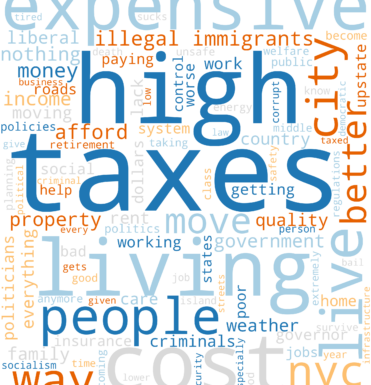
Taxes, the Cost of Living, and Feeling Ignored: Why New Yorkers Are Thinking of Leaving
FOR IMMEDIATE RELEASE ALBANY, N.Y. - New Yorkers across the political spectrum are considering leaving the state. A new finds that Republicans and independent voters most often cite taxes as the reason, while Dem Read More
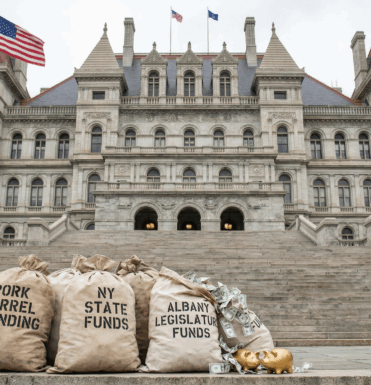
Albany Steers Nearly $100 Million in 2026 Pork Barrel Spending
Albany steered $97.2 million to 206 local projects during the first half of 2026 in the newest batch of state discretionary grants, according to. The new tranche is the latest addition to the pork-barrel grant database the Empire Center h Read More

New York’s Electricity Prices Fifth Highest in the Country
FOR IMMEDIATE RELEASE
ALBANY, N.Y. — Empire Center’s shows New York households paid the fifth‑highest residential electricity prices in the country in June 2026, trailing only Hawaii, California Read More