

Governor Cuomo’s plan to cut the estate tax is drawing praise from fiscally conservative groups, and condemnation from advocates for the poor.
Cuomo’s proposal would raise the threshold for New York’s estate tax from the current $1 million to $5.25 million, which is the current federal rate of taxation.
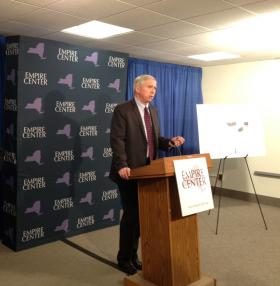
Credit Photo by Karen DeWitt
EJ McMahon, with the fiscally conservative think tank The Empire Center calls the levy the “death tax”. He says it’s about time New York got in synch with the rest of the country, where many states have already eliminated the tax altogether.
“Our death tax is an outlier,” McMahon said.
“Why would you want to do something that gives anybody any added incentive to not be in New York?”
McMahon says while the ultra wealthy can pack up and move to another state to avoid the estate tax, it’s the middle class who can’t. And he says holding one million dollars in assets that are subject to the current estate tax is not that uncommon. According to figures cited in a report by the Empire Center, six percent of New Yorkers can be defined as millionaires, when the worth of their home and investments is added together.
McMahon says even New York City Mayor Bill deBlasio is in that category, whose home’s value has increased to over $1 million, according to tax records.
McMahon says many of those millionaires are family farmers or small businesses.
Opponents of the proposal to cut the estate tax have said it unfairly benefits the wealthiest New Yorkers. Mike Durant, with the National Federation of Independent Businesses, says those accusations aren’t accurate.
“We’re very disappointed that the rhetoric on this has taken the form of the one percent, 99 percent, class warfare,” Durant said.
Ron Deutsch, with New Yorkers for Fiscal Fairness, a progressive leaning group associated with the labor unions, says the report is misleading.
He says while some in the middle class could be helped, richer people would benefit even more greatly from the changes that Cuomo is proposing.
“The lion’s share of that tax cut is going to go to the richest 150 to 200 estates in New York right now,” Deutsch said.
Deutsch says the heirs to someone with a $10 million estate could see a 50 percent reduction in the estate taxes they would pay, if New York raises the threshold for taxation to the $5.25 million now in federal law.
And he says another proposal from the governor, to lower the overall estate tax from 16 percent to 10 percent, would greatly benefit those with the largest estates.
Deutsch says New York would be better off using its budget funds to provide for New Yorkers who are struggling the hardest financially, rather than helping what amounts to a small amount of the state’s population.
“Let’s do the math,” Deutsch said “Six percent of New Yorkers could be impacted by the estate tax, 50 percent of the kids in our upstate cites are living in poverty.”
The legislature has just over a month to agree on a budget plan with Governor Cuomo. Republicans in the State Senate are supporters of the estate tax cut, and would like to immediately adopt the higher federal threshold Assembly Democrats have not specifically rejected the proposal, but have advocated for more spending on things like education, before cutting taxes.
© 2014 WBFO
You may also like

The good, the bad and the ugly in Cuomo’s budget
“We are at the early stages of what shapes up as the biggest state and city fiscal crisis since the Great Depression,” said E.J. McMahon of the Empire Center. “Borrowing and short-term cuts aside, the budget doesn’t chart any clear path out of it.” Read More
Medicaid cuts make the state budget, with some tweaks
Bill Hammond, director of health policy at the conservative-leaning think tank the Empire Center, suggested this is because the proposed cuts are meant to slow the otherwise rapid growth in Medicaid spending, which means an increase is still possible. Read More
Gov. Cuomo’s Lawsuit on Pres. Trump’s Tax Cuts Dismissed
But according to the Empire Center, a non-profit group based in Albany, the overall impact of the Trump tax cuts actually benefited most state residents. Read More
EDITORIAL: State schools continue spending more for less
As reported by the Empire Center last week, “The number of students enrolled in New York state public schools is the lowest recorded in 30 years.”
Since 2000, enrollment in public schools has declined by more than 10 percent statewide with most of it upstate as enrollment in New York City schools has increased 1.3 percent in the last 10 years. Students are not leaving to go to private or parochial schools either because they, too, are showing declines, down about 8 percent in the last decade. Read More
$1 billion semiconductor plant: ‘Flashy mega-project’ or ‘transformational investment’ for New York?
"The state is continuing its strategy of pursuing flashy mega-projects instead of making New York more attractive for all businesses. We're now in the second decade of this approach, and it's still failing to deliver the promised results," Girardin said. "This is the sort of economic development strategy that politicians turn to when they don't want to take on the tougher questions." Read More
Cuomo blames lawmakers for plate fee set by his administration
The new replacement policy, which was tucked into a press release announcing new plate designs, has been criticized as a "revenue enhancer wrapped in a public relations ploy" by E.J. McMahon of the fiscally conservative Empire Center for Public Policy. Read More
New York license plate fee increase draws criticism
"The 'current' $25 fee was for an optional plate choice," said E.J. McMahon, research director at the Empire Center for Public Policy. "The new fee will be mandatory -- the first time ever. This is a revenue grab under the guise of a PR stunt. Yes, the plates need replacement. But they don’t cost $25 apiece to manufacture." Read More
Medicaid bungle cost state $102 million over 4 years
“A little series of mistakes in a program this big can add up to a lot of money in a hurry,” Hammond told The Post. “A quarter of a million dollars is a lot of money. It’s important that the auditors are looking at this and are pointing to things that could be fixed.” Read More