

The number of New York public-sector early retirees allowed to collect both a state or local government paycheck and a full public pension benefit grew by over 4 percent from July 2018 to July 2019, according to data posted today on SeeThroughNY.net, the Empire Center’s transparency website.
At least 43 early retirees from previous state or local government jobs were approved to collect combined pay and pensions of $200,000 or more—including seven exceeding combined totals of $300,000.
The increase was largely driven by a 17 percent increase in 211 waivers granted for employees in state civil service titles—which accounted for 584 of the 973 active “double-dippers,” up from 500 in the same time period last year.
Section 211 of the state Retirement and Social Security Law requires public employees under the age of 65 to receive a special waiver in order to collect a public pension and a government paycheck simultaneously. However, public employers are required by law to conduct “extensive recruitment efforts” before invoking such a waiver as needed to attract qualified appointees. Without such a waiver, active public employees under 65 who are eligible to retire can still choose to file for pensions while they continue working, but their pension payments will be suspended once salary payments have exceeded $35,000 during a given year.
The seven individuals allowed to receive combined pensions and waivers totaling more than $300,000 are:
- Robert Sweeney, Yonkers fire commissioner, whose combined total of $394,873 includes an approved pay of up to $200,000 and a pension of $194,873;
- Thomas Krumpter, Lloyd Harbor police captain, whose combined total of $381,043 includes an approved pay of up to $238,000 and a pension of $143,043;
- Patricia Sullivan-Kriss, an expert witness for the attorney general’s office, whose combined total of $348,491 includes approved pay of up to $125,000 and a pension of $223,491;
- Anita Laremont, general counsel for the Department of City Planning in New York City, whose combined total of $319,209, includes an approved pay of up to $204,251 and a pension of $114,958;
- Helena Williams, Nassau chief deputy county executive, whose combined total of $316,875 includes an approved pay of up to $187,000 and a pension of $129,875;
- James Skopek, Suffolk County deputy commissioner of police, whose combined total of $309,461 includes an approved pay of up to $157,300 and a pension of $152,161; and
- Edward Melnick, an expert witness for the attorney general’s office, whose combined total of $306,153 includes approved pay of up to $125,000 and a pension of $181,153.
The Empire Center’s database of Section 211 waivers lets taxpayers search through more than 9,200 applications, which include details such as employee names, authorized pay and employers seeking waivers.
Among the waivers in effect on January 1:
- Over 20 percent of active waivers (199) have been granted continually since July 1, 2009, suggesting individuals are using what’s meant to be a temporary arrangement on a permanent basis;
- 320 were approved for New York City, 131 going to district attorney offices;
- 335 were approved for local governments outside New York City, with the most going to Suffolk County (34), Nassau County (33) and Schenectady County (18);
- 221 were approved for New York State agencies, including 110 at the Attorney General’s office and 44 at the State University of New York; and
- 79 were for school districts outside New York City.
The actual number of double-dippers eligible for six-figures may be considerably higher. Waivers are only required if the retiree hasn’t yet reached age 65 and authorizing entities do not report data uniformly.
The Empire Center, based in Albany, is an independent, not-for-profit, non-partisan think tank dedicated to promoting policies that can make New York a better place to live, work and raise a family.
You may also like

Switching to Electric Home Heating Could Add Thousands to Energy Bills
FOR IMMEDIATE RELEASE: ALBANY, N.Y. that heating an average home from October to March would cost approximately $790 with natural gas, compared with $1,100 with a heat pump and $3,300 with electr Read More

Poll: 64% of New Yorkers Back Eliminating the State Income Tax; 67% Say State Taxes Aren’t Delivering
Dissatisfaction spans party and regional lines as broad majorities rally behind sweeping tax reform
FOR IMMEDIATE RELEASE: ALBANY, N.Y. - New Yorkers are delivering a blunt assessment of the state’s tax system: 67% say they ar Read More
SUNY Research Foundation Payroll Tops $400 Million
Payroll records for 8,401 employees of the Research Foundation for the State University of New York (RF SUNY) for fiscal year 2026 are , the Empire Center's government transparency website.
The Research Foundation is a private, nonprofit educational co Read More

Newly Retired NYC Firefighters Average Over $177k In Pensions
New York City firefighters and fire officers retiring last year after full careers were entitled to average annual pension benefits of $177,016, according to , the Empire Center's government transparency website.
Among the 499 new retirees with at leas Read More
New York Annual Household Electricity Costs Rise $270
FOR IMMEDIATE RELEASE ALBANY, N.Y. — New York’s average residential electricity price reached 29.90 cents per kilowatt-hour (kWh) in July 2026, the fifth highest in the nation and 63.3 percent Read More
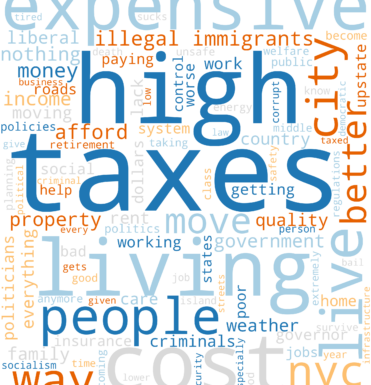
Taxes, the Cost of Living, and Feeling Ignored: Why New Yorkers Are Thinking of Leaving
FOR IMMEDIATE RELEASE ALBANY, N.Y. - New Yorkers across the political spectrum are considering leaving the state. A new finds that Republicans and independent voters most often cite taxes as the reason, while Dem Read More
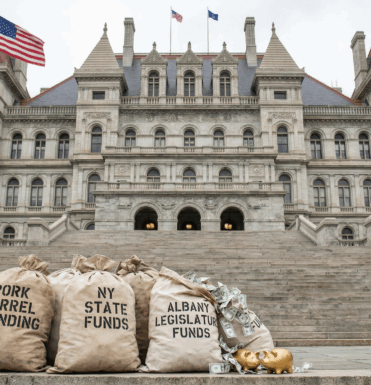
Albany Steers Nearly $100 Million in 2026 Pork Barrel Spending
Albany steered $97.2 million to 206 local projects during the first half of 2026 in the newest batch of state discretionary grants, according to. The new tranche is the latest addition to the pork-barrel grant database the Empire Center h Read More

New York’s Electricity Prices Fifth Highest in the Country
FOR IMMEDIATE RELEASE
ALBANY, N.Y. — Empire Center’s shows New York households paid the fifth‑highest residential electricity prices in the country in June 2026, trailing only Hawaii, California Read More