

Over the next few days, as Gov. Andrew M. Cuomo and the legislature negotiate the final details of a state budget for fiscal 2012-13, New Yorkers will be hearing very little about Medicaid — a subject that used to dominate the headlines out of Albany this time of year.
It’s a tribute to Cuomo’s political skills that the biggest single category of total spending in New York’s budget has become — temporarily — a nonissue, outside a few small Capitol demonstrations. By contrast, his predecessors fought some bruising (and mostly losing) battles against the powerful alliance of labor unions, hospitals and other providers benefiting from the continued growth and sustenance of the nation’s most expensive Medicaid program.
George Pataki took office as governor in 1995 with a commitment to reforming and reducing the costs of Medicaid — and, for a time, he did. But the second half of the 12-year Pataki administration featured the biggest expansion of Medicaid since Gov. Nelson Rockefeller created the state’s program in the mid-1960s.
Succeeding Pataki in 2007, Eliot Spitzer promised a whole new approach to health care policy, stressing the best interests of patients over those of providers. He ended up retreating from the relatively modest proposed Medicaid cuts in his first and only budget.
David Paterson was immediately caught up in a fiscal crisis that made it all the more urgent to curb Medicaid spending. The health care industry responded with a media campaign pummeling Paterson — including one memorable commercial in which a blind man in a wheelchair asked the legally blind governor: “Why are you doing this to me?”
Faced with a $10-billion budget gap last year, Cuomo deftly sidestepped a Medicaid fight of his own by substituting co-option for confrontation. He assigned the task of recommending nearly $2.9 billion in needed Medicaid savings to a “redesign team” whose members include lobbyists for the state’s most powerful health industry groups. He also temporarily won unprecedented discretion to reduce and restructure Medicaid reimbursement rates as part of the bargain.
With some numerical fudging, the redesign team recommendations came close to meeting the governor’s $15.3-billion target for the state-funded share of the core Medicaid budget in 2011-12. Cuomo has used his newfound administrative powers to do whatever else was necessary to hold Medicaid growth within (more or less) the 4 percent target for this year.
The next budget assumes the Medicaid program’s growth will be kept under a 4 percent cap again in 2012-13. Exactly how Cuomo will pull this off remains unclear.
Cuomo’s Medicaid managers are focused on worthy reform goals, including a transfer of chronically ill patients to better and less expensive managed care. Meanwhile, however, Medicaid enrollment has soared to a record 5 million New Yorkers, 84 percent above the 2000 level. And in a move that could cost the state more than $1 billion, the federal government wants to curb New York’s longtime reliance on Medicaid to subsidize institutional care for the mentally disabled.
The governor’s approach has bought time to implement some overdue reforms — but to the extent Cuomo has any long-term plan for controlling Medicaid, it seems to be predicated on hope that the federal government will give the state more administrative flexibility while absorbing more costs under President Barack Obama’s health care reform law. This is highly speculative, to say the least, even assuming the new law survives a U.S. Supreme Court review and the possible election of more congressional Republicans (not to mention a new president) who would like to repeal it.
You may also like
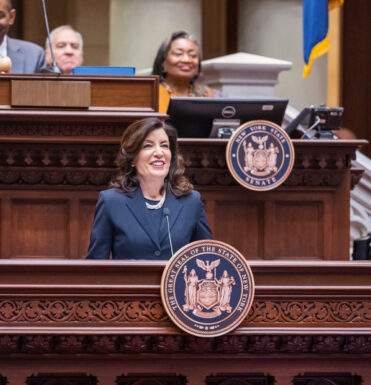
Hochul continues to bribe Big Health with reckless Medicaid spending
For the fourth year in a row, has used the word “unsustainable” to describe her own .
Give her credit for honesty — but not sound fiscal management.
Over the four annual budgets on her watch, the state’s share of Medicaid costs has soare Read More

Hochul Tells It Like It Is
Presenting her budget this week in Albany, Gov. Kathy Hochul delivered more than just a financial plan. She gave the state a refreshing dose of fiscal honesty.
“The truth is,” Hochul said, “we can’t spend like there’s no tomorrow, because tom Read More

Putting Hochul to the test: Will the governor use her budget powers to protect New York’s fiscal future?
“We will not be raising income taxes this year,” Gov. Hochul declared in January at the opening of New York’s 2023 legislative session.
Read More

NY must prune its bloated Medicaid program — and focus on improving low-quality care
The coronavirus pandemic exposed a fundamental imbalance in New York’s approach to health policy: Albany spends too much money on its bloated Medicaid plan but neglects the public-health programs that used to be the Health Department’s main focus — Read More

What Gov. Hochul must do to prevent a coming fiscal crash
The pandemic and its fiscal aftermath have given rise — temporarily — to a state budget trend unique in New York’s history. Read More

Bear market spells big trouble for NY state and city budgets
Wall Street generates an outsized share of New York’s tax revenue, so the recent drop in stock prices should worry both Gov. Kathy Hochul and Mayor Eric Adams. Read More

Calling Tax Cut “Theft,” Cuomo Continues to Push For Federal Bucks With Phony Math
The results of this week’s Georgia Senate runoffs, assuring Democrats will soon control both houses of Congress, as well as the White House, had to come as a huge relief to Gov. Andrew Cuomo. Read More

Students Need Reforms, Not HEROES
Families and businesses are watching their bottom lines and stretching each dollar. But House Democrats are pushing a plan to prevent America’s schools from doing the same thing. Read More