
Cover Image Credit: CC-BY-SA-3.0/Matt H. Wade at Wikipedia
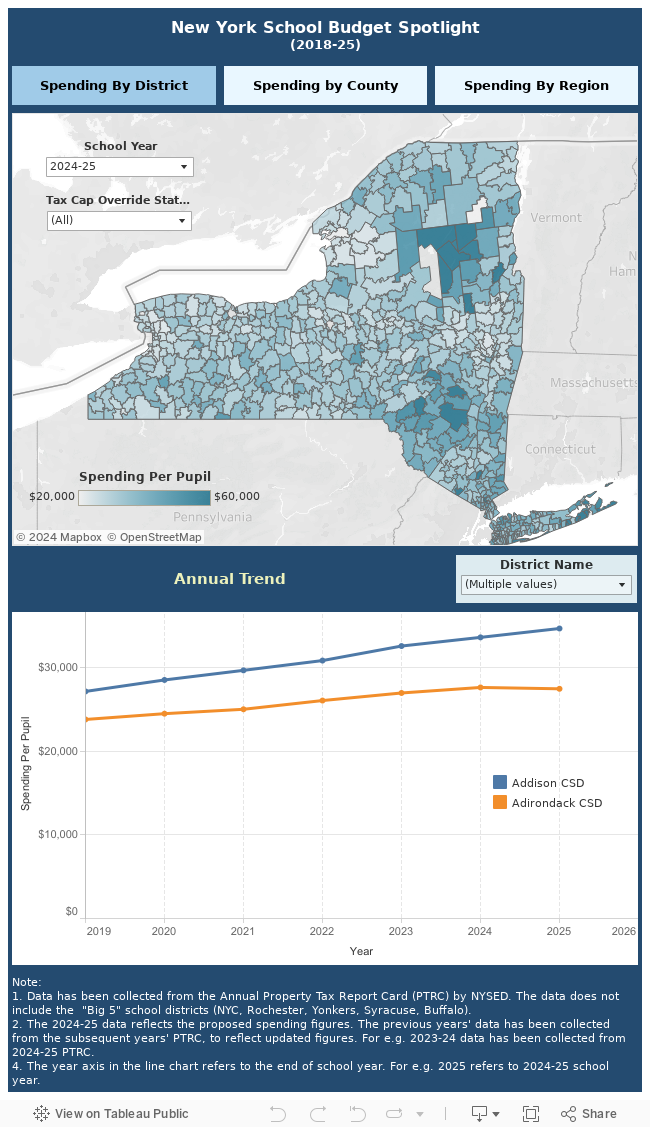
School districts presenting budgets to voters on Tuesday, May 19, plan to spend an average of $37,033 per student, up 4.9 percent from the current school year, according to new state data.
Data collected by the state Education Department and made searchable below show most districts (510) plan to increase total spending by more than core inflation (2.8 percent), even as only 179 of the 668 districts expect enrollment to increase.
The data does not include the “Big 5” school districts – Buffalo, New York City, Rochester, Syracuse, and Yonkers, which do not present budgets for voter approval.
The state’s 668 school districts (excluding the Big 5) are expecting 1.36 million students to be enrolled during the 2026-27 school year – a 1.03 percent decline from current year. Altogether, they have proposed spending $50.5 billion – a 3.85 percent increase from current year.
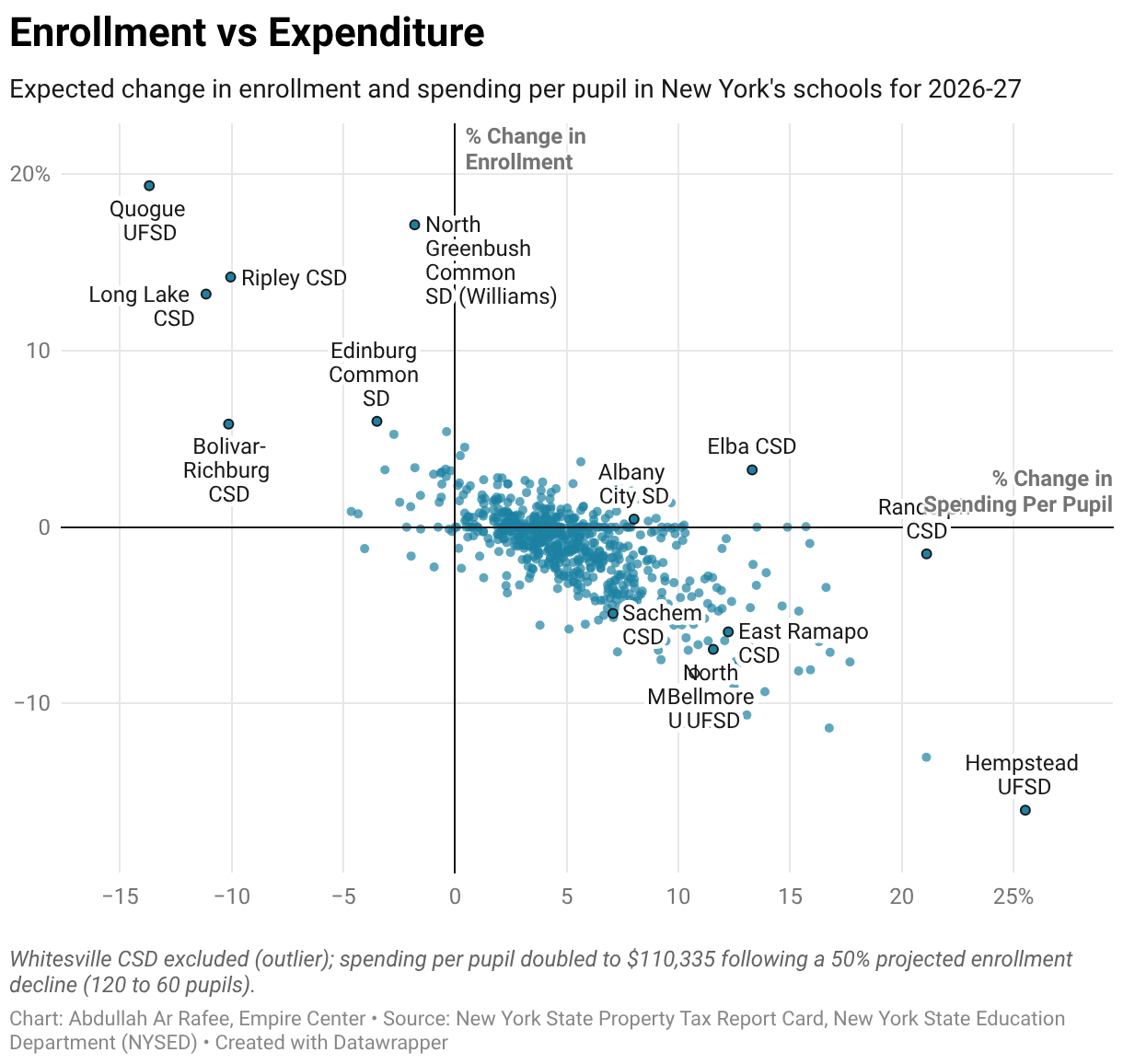
Following trends from previous years, 417 school districts (62 percent) are expecting their enrollment to decline, according to the proposed budget figures. Outside the Big Five, school districts are expecting enrollment to drop by more than 14,000 students (1.03 percent).
More than half of this proposed spending ($25.9 billion) will be raised through tax levies. New York’s property owners are expected to pay $18,979 per student in school district property taxes – a 3.8 percent increase from current year.
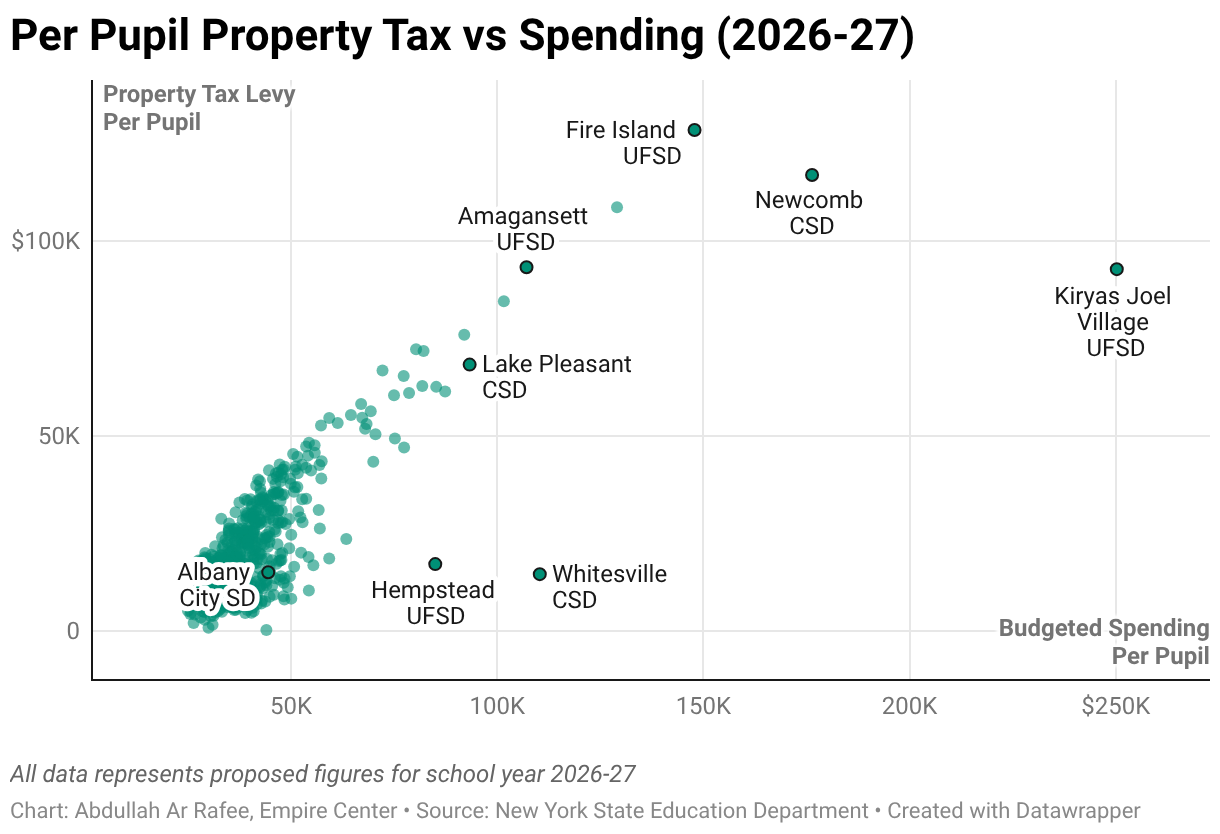
More than half of districts plan to spend at least $37,000 per student and 67 districts plan to spend more than $50,000. For comparison, US schools spent an average of $17,619 during fiscal year 2023, according to the most recent census data. Based on Nation’s Scorecard, New York’s 4th graders and 8th graders performed below U.S. average in mathematics, and close to average in reading.
Like previous years, Kiryas Joel school district in Orange County proposed the highest spending of $250,241 for each of its expected 169 pupils. The other highest spending school districts include Newcomb in the Adirondacks ($176,358 for 40 pupils), Long Island’s Fire Island ($147,860 for 42 pupils) and Bridgehampton ($129,062 for 185 pupils), and Whitesville in Western New York ($110,335 for 60 pupils).
On a regional basis, Long Island districts plan to spend the most per student ($41,934), followed by the Mid-Hudson region at $40,490. Western New York districts, the lowest among all regions, are together set to spend the least ($30,987). Per-pupil spending, measured at the county level, will exceed $28,000 in all 57 counties outside New York City. The state’s least populated county, Hamilton, proposed the highest per pupil spending at $69,446 for each of its 374 pupils.
The state’s executive budget has proposed increases to state aid to public schools to $39.3 billion – 4.3 percent increase from previous year. Despite record multi-year increases in state school aid, 274 school districts plan to also hike their property tax levies faster than core inflation. The largest planned increases are:
- Prattsburgh (40.6 percent)
- Randolph (39.8 percent)
- Owego-Apalachin (17.1 percent)
- West Canada Valley (15 percent)
- South Country (13.5 percent)
- Town of Webb (13 percent)
- Odessa-Montour (13 percent)
- Ausable Valley (12 percent)
- Cambridge (12 percent)
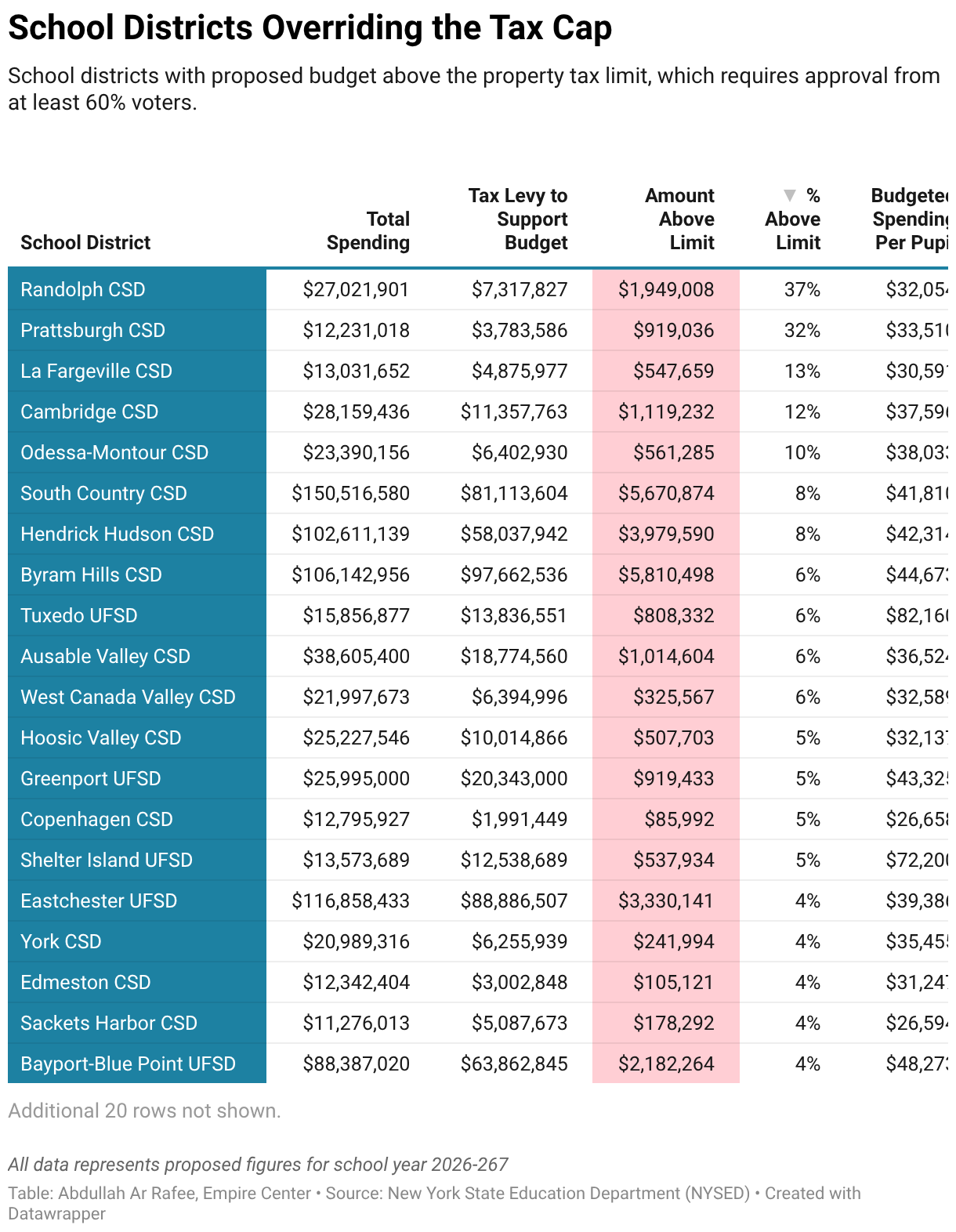
This is the 16th budget cycle since New York adopted a cap on the growth of property taxes, including school taxes. Under that law, a district can increase its tax levy no more than 2 percent in any year or the rate of inflation, whichever is lower, unless an override is approved by 60 percent of voters. This applies to all local governments and school districts except for the “Big Five” city school districts.
For the 2026-27 school year, more than half of districts (352) plan to increase property taxes by exactly as much as New York’s property tax cap allows without approval from 60 percent of voters. Forty districts plan to override their caps. Randolph CSD has proposed to exceed its cap by 37 percent while Plattsburgh CSD has proposed to override its cap by 32 percent.
Notes:
Some smaller common school districts limit local operations to primary grades and tuition out older students to minimize infrastructure overhead costs. They only include enrollment data for students attending schools within the district, while spending data includes tuition payment costs to neighboring school districts. This may inflate per pupil expenditure for these school districts.
The Empire Center, based in Albany, is an independent, non-partisan, not-for-profit think tank dedicated to promoting policies to make New York a better place to live, work and raise a family.
About the Author

You may also like
Leaving New York
Executive Summary
The desire to leave New York is strong and cuts across every demographic group measured in the survey. One-third of New Yorkers have considered leaving the state within the next five years, while another third know some Read More
Opinion Poll – Energy
Executive Summary
New York voters prioritize affordable energy and show limited support for energy and climate policies that could increase costs. The survey finds broad opposition to home-heating electrification and climate-related lawsuits aga Read More

34 MTA Workers Made $200K+ In Overtime In 2025
Thirty-four employees of the Metropolitan Transportation Authority (MTA) received more than $200,000 in overtime payments in 2025, as total annual pay surpassed half a million dollars for some, according to , the Empire Center’s governm Read More

New York at the Crossroads. WILL IT MODERNIZE LIABILITY LAW OR EXPAND IT?
Executive Summary
New York’s Litigation Environment
In a wide range of areas, New York law subjects residents and businesses to greater liability than other states. Consider, for example, that:
Unlike most other states, New York a Read More

Overtime on State Payroll Jumps 21%
104 employees made over $500k in 2025 total annual pay.
2,450 employees were paid more than Gov. Kathy Hochul's Read More

How Pension ‘Spiking’ Drives Up Costs for New York Taxpayers
Each year, hundreds of newly retired government workers across New York garner a benefit that would be unheard-of in the private sector: pensions that exceed the salaries they received while still on the job.
This is possible only because most current Read More

Energy Data Bulletin January 2026
January 2026
Summary and Insights
Electricity. In October 2025, average residential electricity price in New York was 26.95 cents per kilowatt-hour (kWh) and ranked 8th highest in the U.S., exceeding the national avera Read More

Seven Reasons Not To Raise Taxes in New York
Despite the robust growth of state revenues in recent years, many of New York's elected officials are pushing to further increase the tax burden on the state's residents and businesses.
Read More