

Newly retired1 “full career”2 members of the New York Police Department (NYPD) collected an average of $103,859, according to new data posted today at SeeThroughNY.net, the Empire Center’s transparency website.
The data, received from the New York City Police Pension Fund (PPF), has been anonymized as PPF have chosen to withhold the names of pensioners, claiming potential threats to their personal safety.3
Total pension payments to the 54,571 retired NYPD police officers climbed to $3.59 billion during the fiscal year 2025 – an eight percent increase from the FY2024 total of $3.32 billion.
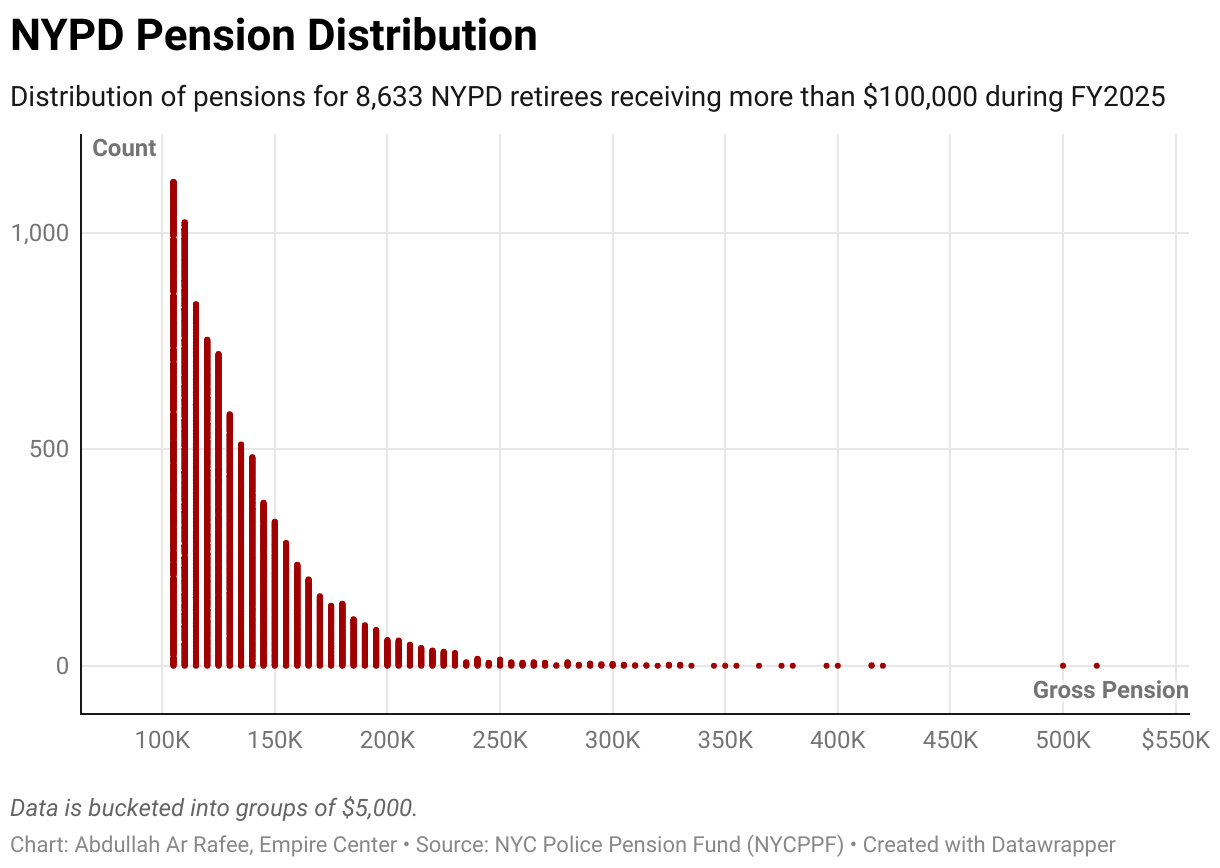
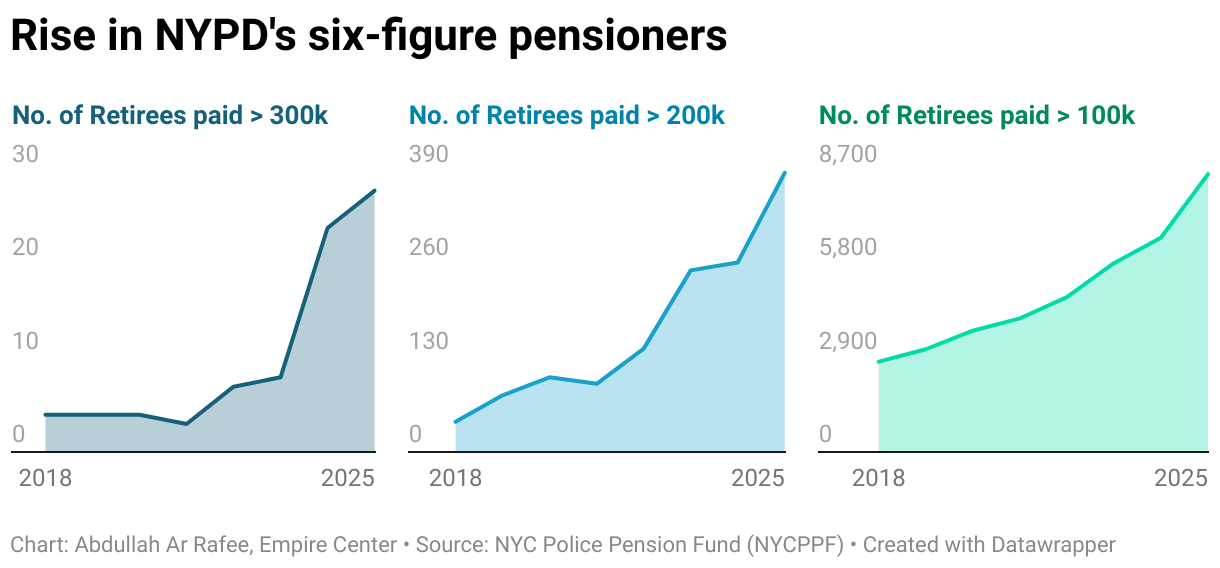
The pension plan covering the NYPD officers had a total of 28 members who received more than $300,000 in pension payments. 389 members were paid at least $200,000 — a 47 percent increase from FY2024 (264). 8,633 members were paid least $100,000 — a 30 percent increase from FY2024 (6,657).
The officer with the highest payout received $512,927, retiring on May 27, 2021, with a service credit of 40.3 years.
In addition to regular pensions, total payments may include retroactive payments from past contract settlements, reclassification of benefits due to pending disability applications at retirement, or Accident Disability Retirement benefits.
Surge in New Retiree Payments
Newly retired members—those retiring between July 1, 2023, and June 30, 2024, and collecting their first full-year pension in FY2025—included 1,502 “full career” individuals. The average “full career” new retiree pension of $103,859, was a 16 percent increase from previous fiscal year’s $89,878. Among them, three retired officers received more than $300,000; 38 received more than $200,000, and 666 received more than $100,000.
New retirees saw a surge in payments with the total amount rising to $156 million – a 63 percent increase from the previous year’s total of $106 million. Such sharp increases were last seen during the pandemic when retirements spiked as many veteran officers accelerated their exits.
One likely reason for the spike could be the surge in new retiree overtime that followed the pandemic. Staffing shortages, backlogged court operations, and event deployments all pushed overtime hours—and therefore late-career earnings—to unusually high levels. Because the pension formula uses a member’s Final Average Salary (FAS) based on the most recent three years of pay, those inflated earnings directly translated into higher lifetime benefits.
The Empire Center earlier published the New York City Government Payroll Report for FY2025, which highlighted the $1.09 billion of overtime payments made by the NYPD – the largest of any agency, and one-third of NYC’s total overtime expenditure.
Data Notes:
- Newly retired members refer to those employees who retired during FY2024 (between July 1, 2023 and June 30, 2024) and received a full year of benefits during FY2025.
- Full career employees refer to those employees who retired with 20 or more years of service credit.
- Since 2009, the Empire Center has filed FOIL requests with PPF requesting several data points, including retiree names (as is customarily given by every other state pension system) for analysis and posting at SeeThroughNY. The police pension fund has refused to provide retiree names, even after a lawsuit filed by the Empire Center and the passage of a state law its sponsors intended to make the names available.
The Empire Center, based in Albany, is an independent, not-for-profit, non-partisan think tank dedicated to promoting policies that can make New York a better place to live, work and raise a family.
You may also like

Switching to Electric Home Heating Could Add Thousands to Energy Bills
FOR IMMEDIATE RELEASE: ALBANY, N.Y. that heating an average home from October to March would cost approximately $790 with natural gas, compared with $1,100 with a heat pump and $3,300 with electr Read More

Poll: 64% of New Yorkers Back Eliminating the State Income Tax; 67% Say State Taxes Aren’t Delivering
Dissatisfaction spans party and regional lines as broad majorities rally behind sweeping tax reform
FOR IMMEDIATE RELEASE: ALBANY, N.Y. - New Yorkers are delivering a blunt assessment of the state’s tax system: 67% say they ar Read More

SUNY Research Foundation Payroll Tops $400 Million
Payroll records for 8,401 employees of the Research Foundation for the State University of New York (RF SUNY) for fiscal year 2026 are , the Empire Center's government transparency website.
The Research Foundation is a private, nonprofit educational co Read More

Newly Retired NYC Firefighters Average Over $177k In Pensions
New York City firefighters and fire officers retiring last year after full careers were entitled to average annual pension benefits of $177,016, according to , the Empire Center's government transparency website.
Among the 499 new retirees with at leas Read More
New York Annual Household Electricity Costs Rise $270
FOR IMMEDIATE RELEASE ALBANY, N.Y. — New York’s average residential electricity price reached 29.90 cents per kilowatt-hour (kWh) in July 2026, the fifth highest in the nation and 63.3 percent Read More
Taxes, the Cost of Living, and Feeling Ignored: Why New Yorkers Are Thinking of Leaving
FOR IMMEDIATE RELEASE ALBANY, N.Y. - New Yorkers across the political spectrum are considering leaving the state. A new finds that Republicans and independent voters most often cite taxes as the reason, while Dem Read More
Leaving New York
Executive Summary
The desire to leave New York is strong and cuts across every demographic group measured in the survey. One-third of New Yorkers have considered leaving the state within the next five years, while another third know some Read More

Albany Steers Nearly $100 Million in 2026 Pork Barrel Spending
Albany steered $97.2 million to 206 local projects during the first half of 2026 in the newest batch of state discretionary grants, according to. The new tranche is the latest addition to the pork-barrel grant database the Empire Center h Read More