

Local governments and school districts throughout New York State should adopt long-term financial planning as a core element of their budgeting practices, according to a report issued today by the Empire Center for Public Policy.
A report issued today by state Comptroller Thomas DiNapoli, citing a loss of federal and state aid among the financial challenges facing local governments, “only highlights the urgent need for counties, municipalities and school districts to share information on their long-term spending and revenue trends with the public,” said E.J. McMahon, Empire Center senior fellow and author of the report.
McMahon compared most current local budgets, which include past results but no projections looking further than a year ahead, to “driving your car down a rural highway at 65 mph in the steadily gathering dusk of a moonless night, with nothing more to guide you than your parking lights.”
“While localities are more fiscally stressed than ever, very few are producing long-term projections that would document the extent of their budget problems,” McMahon said.
In fact, the report found that only five of the state’s 80 largest counties, municipalities and school districts issue long-term forecasts as part of their budgets. Only one of those governments, the city of Yonkers, was not forced into long-term planning by a state financial control board. Yonkers Mayor Mike Spano recently implemented four-year budget projects on a voluntary basis.
The report notes that long-term planning is advocated by both Comptroller DiNapoli and the state Board of Regents, in addition to many government finance experts.
“Long-term planning won’t, by itself, solve fiscal problems or guarantee better results,” the Empire Center report concludes. “However, by requiring local officials to consider the long-term impacts of their short-term decisions, it will promote more responsible fiscal behavior. Beyond the numbers, it can also provide a vehicle for establishing performance goals and objectives, and for measuring a government’s progress in meeting them.”
You may also like

Poll: 64% of New Yorkers Back Eliminating the State Income Tax; 67% Say State Taxes Aren’t Delivering
Dissatisfaction spans party and regional lines as broad majorities rally behind sweeping tax reform
FOR IMMEDIATE RELEASE: ALBANY, N.Y. - New Yorkers are delivering a blunt assessment of the state’s tax system: 67% say they ar Read More
SUNY Research Foundation Payroll Tops $400 Million
Payroll records for 8,401 employees of the Research Foundation for the State University of New York (RF SUNY) for fiscal year 2026 are , the Empire Center's government transparency website.
The Research Foundation is a private, nonprofit educational co Read More

Newly Retired NYC Firefighters Average Over $177k In Pensions
New York City firefighters and fire officers retiring last year after full careers were entitled to average annual pension benefits of $177,016, according to , the Empire Center's government transparency website.
Among the 499 new retirees with at leas Read More
New York Annual Household Electricity Costs Rise $270
FOR IMMEDIATE RELEASE ALBANY, N.Y. — New York’s average residential electricity price reached 29.90 cents per kilowatt-hour (kWh) in July 2026, the fifth highest in the nation and 63.3 percent Read More
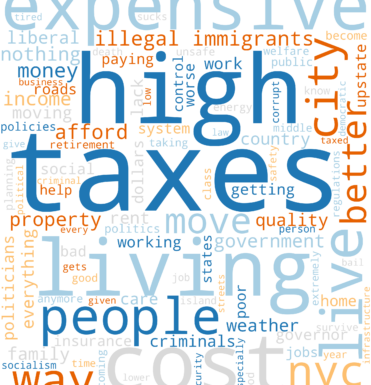
Taxes, the Cost of Living, and Feeling Ignored: Why New Yorkers Are Thinking of Leaving
FOR IMMEDIATE RELEASE ALBANY, N.Y. - New Yorkers across the political spectrum are considering leaving the state. A new finds that Republicans and independent voters most often cite taxes as the reason, while Dem Read More
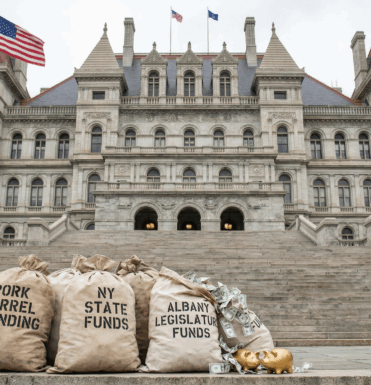
Albany Steers Nearly $100 Million in 2026 Pork Barrel Spending
Albany steered $97.2 million to 206 local projects during the first half of 2026 in the newest batch of state discretionary grants, according to. The new tranche is the latest addition to the pork-barrel grant database the Empire Center h Read More

New York’s Electricity Prices Fifth Highest in the Country
FOR IMMEDIATE RELEASE
ALBANY, N.Y. — Empire Center’s shows New York households paid the fifth‑highest residential electricity prices in the country in June 2026, trailing only Hawaii, California Read More

Nine Millionaires among NY’s Public Authorities in 2025
Nine millionaires, all healthcare executives, emerged among the 88,228 New York public authority employees, according to, the Empire Center’s transparency website.
The data includes payroll information from 385 different agen Read More