

The state Legislature should reject Governor Cuomo’s proposal to expand the family income cap for the Excelsior Scholarships and devote more money to expanding the state’s existing Tuition Assistance Program (TAP), according to the testimony submitted to the joint legislative committees today by E.J. McMahon, research director of the Empire Center for Public Policy.
Enacted in 2017, the Excelsior Scholarship program promised to eliminate State University and City University of New York tuition for undergraduates from state resident households with gross annual incomes up to $125,000. Legislation submitted with the FY 2021 Executive Budget would raise that gross annual income threshold to $135,000 in 2020-21, and to $150,000 in 2021-22, at a total additional cost of $35 million.
McMahon, however, urged the Legislature to go in a different direction.
“The proposed increase in the Excelsior Scholarship income cap would build on a program that was fundamentally flawed, wasteful and unfair to begin with,” he said. “The Legislature should reject this proposal, and instead begin phasing out the Excelsior Scholarship program, accepting no new applicants after this year. The entire proposed $146 million budget allocation for Excelsior ultimately should be redirected to fund expansion of the means-tested Tuition Assistance Program.”
McMahon’s testimony is based on the conclusions of his recent Policy Briefing paper, “Excelsior Illusion: Getting Real About ‘Free’ College in New York.”
Download the testimony and attached report here.
The Empire Center, based in Albany, is an independent, not-for-profit, non-partisan think tank dedicated to promoting policies that can make New York a better place to live, work and raise a family.
You may also like

Switching to Electric Home Heating Could Add Thousands to Energy Bills
FOR IMMEDIATE RELEASE: ALBANY, N.Y. that heating an average home from October to March would cost approximately $790 with natural gas, compared with $1,100 with a heat pump and $3,300 with electr Read More

Poll: 64% of New Yorkers Back Eliminating the State Income Tax; 67% Say State Taxes Aren’t Delivering
Dissatisfaction spans party and regional lines as broad majorities rally behind sweeping tax reform
FOR IMMEDIATE RELEASE: ALBANY, N.Y. - New Yorkers are delivering a blunt assessment of the state’s tax system: 67% say they ar Read More
SUNY Research Foundation Payroll Tops $400 Million
Payroll records for 8,401 employees of the Research Foundation for the State University of New York (RF SUNY) for fiscal year 2026 are , the Empire Center's government transparency website.
The Research Foundation is a private, nonprofit educational co Read More

Newly Retired NYC Firefighters Average Over $177k In Pensions
New York City firefighters and fire officers retiring last year after full careers were entitled to average annual pension benefits of $177,016, according to , the Empire Center's government transparency website.
Among the 499 new retirees with at leas Read More
New York Annual Household Electricity Costs Rise $270
FOR IMMEDIATE RELEASE ALBANY, N.Y. — New York’s average residential electricity price reached 29.90 cents per kilowatt-hour (kWh) in July 2026, the fifth highest in the nation and 63.3 percent Read More
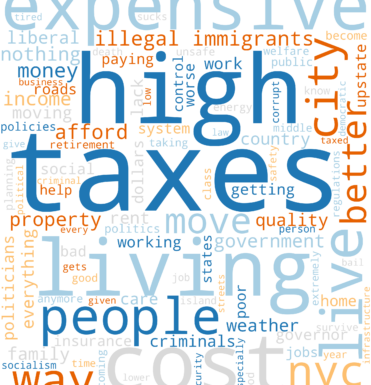
Taxes, the Cost of Living, and Feeling Ignored: Why New Yorkers Are Thinking of Leaving
FOR IMMEDIATE RELEASE ALBANY, N.Y. - New Yorkers across the political spectrum are considering leaving the state. A new finds that Republicans and independent voters most often cite taxes as the reason, while Dem Read More
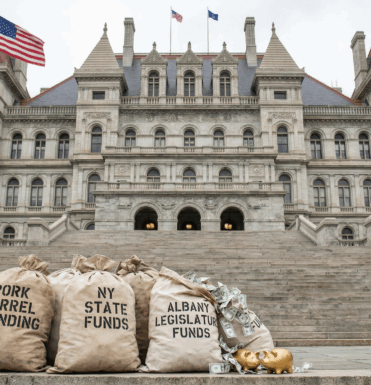
Albany Steers Nearly $100 Million in 2026 Pork Barrel Spending
Albany steered $97.2 million to 206 local projects during the first half of 2026 in the newest batch of state discretionary grants, according to. The new tranche is the latest addition to the pork-barrel grant database the Empire Center h Read More

New York’s Electricity Prices Fifth Highest in the Country
FOR IMMEDIATE RELEASE
ALBANY, N.Y. — Empire Center’s shows New York households paid the fifth‑highest residential electricity prices in the country in June 2026, trailing only Hawaii, California Read More