
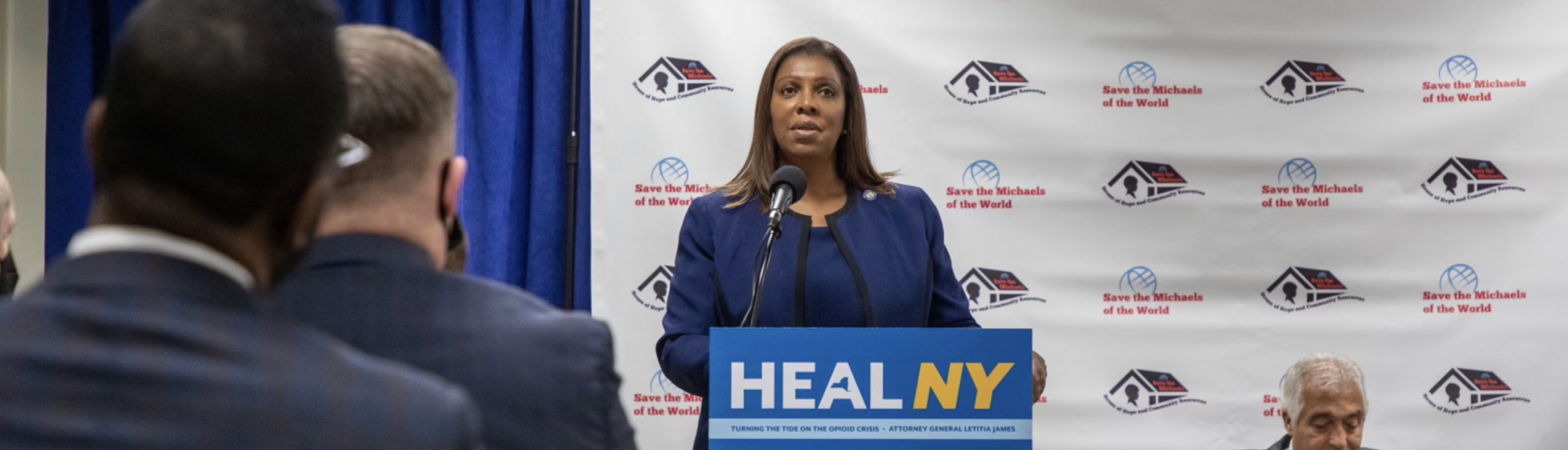
Attorney General Letitia James’ latest fight with the Trump administration focuses on New York’s Medicaid Fraud Control Unit, a federally funded agency housed in James’ office.
On Tuesday, the inspector general of the U.S. Department of Health and Human Services, T. March Bell, accused the unit, known as a MFCU, of doing a poor job of enforcement and suspended its funding for at least three months.
In response, James asserted that her office is “leading the nation in anti-fraud efforts” and vowed to fight what she called an “outrageous” attack.
A review of the available statistics, however, suggests that Bell’s criticism is well founded.
The performance of James’ MFCU – when adjusted for the scale of New York’s $124 billion Medicaid program – ranks among the worst in the U.S. on a range of benchmarks.
Calculations using federal data during James’ term as attorney general, from 2019 to 2025, show that New York was 49th for investigations per billion spent, 51st for indictments per billion and 51st for convictions per billion (see table).
(Note: The U.S. averages in this table have been updated to correct a calculation error. The figures in the second and fourth columns were not affected.)
In his letter to James on Tuesday, Bell noted that New York consistently produced far fewer criminal indictments and convictions than the other large MFCUs – in California, Texas, Florida and Ohio – as well as much smaller units in Indiana and Arizona.
He also criticized the unit for its lack of activity on patient abuse and neglect:
The Unit receives more than 2,000 patient abuse and neglect referrals a year, has a staff of more than 270 people, and oversees a Medicaid program that covers 7 million individuals. Yet it has secured only one or two convictions in each of the last 3 years, and no more than five in any of the last 6 years. That outcome does not demonstrate that the Unit is effective in investigating and prosecuting patient abuse and neglect cases.
Bell said that “a major factor explaining the unit’s results was a deliberate leadership choice to focus on civil fraud cases.” He acknowledged that several recent cases had “held nursing homes accountable for systemic neglect and fraud.”
Bell added, however, that those results do not “outweigh the sustained poor outcomes for the Unit’s criminal fraud cases”:
Had the Unit’s strategic plan produced civil results that were well above its similar-sized peers or at least commensurate with the size of the New York Medicaid program, that may have provided evidence that the Unit’s leadership strategy was effectively combating fraud. Instead, the Unit has sacrificed its ability to effectively fight criminal fraud to obtain civil recoveries that are largely in line with its peers and rank it third out of five among similar-sized Units over the last 5 years for combined recoveries.
In response to the federal action, James’ office cited a statistic from March 2026 report by Bell’s office:
The Trump administration’s own Inspector General for the Department of Health and Human Services (HHS) has recognized New York as a national leader in fraud recoveries. In its 2025 report on states’ MFCU performance, HHS highlighted that New York was one of the four states that accounted for half of the total civil recoveries in fiscal year 2025.
This defense is misleading in several ways.
First, the statistic she cited is about civil recoveries. As discussed above, the inspector general was mostly faulting New York for inadequate criminal enforcement.
Second, the statistic was based on gross dollar amounts, without adjusting for the fact that New York operates the second-costliest Medicaid program in the country. As percentage of spending, the state’s civil recoveries in 2025 ranked 10th and its criminal recoveries ranked 38th.
Third, the statistic covered only a single year. For James’ whole term in office, from 2019 through 2025, New York’s civil recoveries as a percentage of spending ranked 16th and its criminal recoveries sat near the bottom at 49th.
As noted by Bell’s letter, the New York MFCU’s investigative activity has declined sharply since 2020, James’ second year in office. From 2020 to 2025, investigations of all types – civil and criminal – dropped by 50 percent in New York, compared to a 19 percent dip nationwide.
About the Author

You may also like

New York’s Health Premiums Stayed at the Top in 2025
New Yorkers and their employers paid the highest health premiums in the lower 48 states in 2025, and their costs moved further above the U.S. average, according to recently released federal data.
Read More

NY’s Medicaid Fraud Watchdog Shows Declining Performance
Enforcement by the New York's Office of Medicaid Inspector General has dropped in recent years across a range of benchmarks – a sign that the state's anti-fraud efforts have slackened even as its Medicaid spending soared. Read More
Healthcare Revelations in the Enacted Budget Financial Plan
The state financial plan published on June 10 disclosed key information about healthcare revenue and spending that lawmakers had not made public when approving the annual budget two weeks before.
Read More
Federal Suit Traces Medicaid Fraud to the Top of NYS Government
The Trump administration's latest salvo against Medicaid fraud takes aim at a different kind of target – two high-ranking New York officials along with a major state contractor.
A Read More

Healthcare Highlights in the New State Budget
Governor Hochul's focus on affordability seems to have skipped over the healthcare portions of the new state budget.
The deal finalized May 27 Read More

Lawmakers Consider Hiking Fees for Filling Prescriptions
UPDATE: The proposal discussed below passed the Assembly Friday evening by an unofficial vote of 133-0. Having previously been approved by the Senate, the bill will head to Governor Hochul's desk for her signature or ve Read More
Budget Deal Reportedly Earmarks $100M for 1199 and Extends MCO Tax
As Governor Hochul and legislative leaders rush to finalize the overdue state budget, outlines of some healthcare-related deals have begun to emerge from the closed-door negotiations.
Read More

Albany Wavers on Shutting Down a Medicaid Racket
As Washington threatens to crack down on fraud and abuse in New York's Medicaid program, state legislators are doing their best to demonstrate why federal intervention is needed.
A Read More