

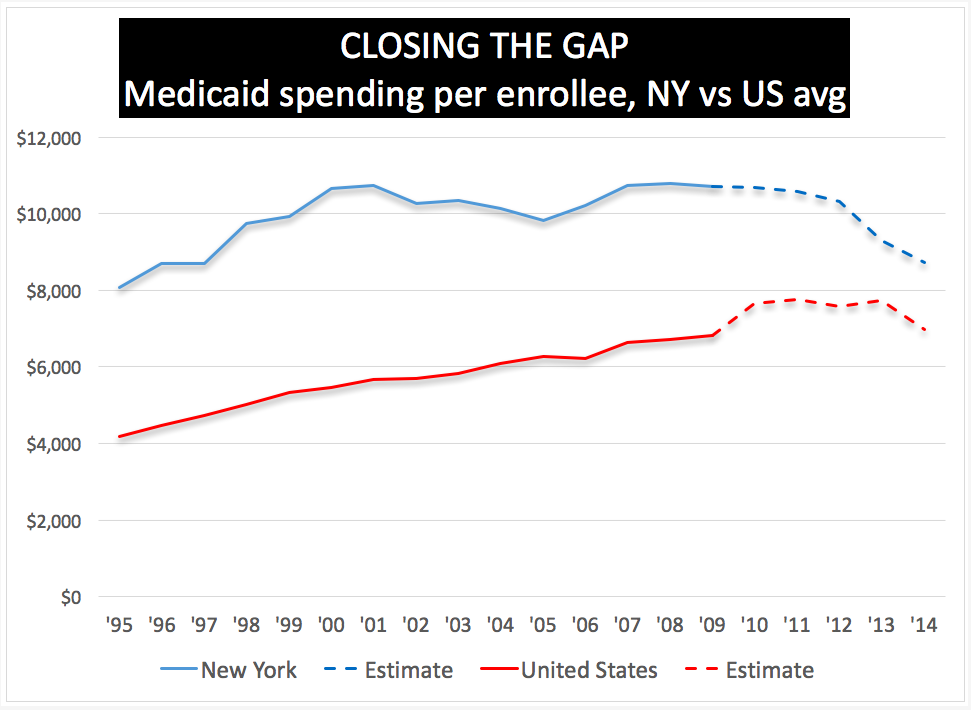
Per-recipient spending by New York’s Medicaid program has long far exceeded the national norm, a telling symptom of inefficiency in the state’s health plan for the poor. But the gap appears to have narrowed significantly during Governor Andrew Cuomo’s term, with New York’s spending rate falling at about twice the national average between 2010 and 2014.
The state’s Medicaid director, Jason Helgerson, has called spending per recipient the “gold standard” for cost-effectiveness in Medicaid, and highlighted New York’s declining rate in a recent speech to the Citizens Budget Commission. He added that it’s hard to know how the state’s performance compares to the national trend because officials at the U.S. Centers for Medicare & Medicaid Services haven’t updated their per-recipient spending figures since 2009.
“I can’t wait to see how we rank in the more recent rankings that the federal government eventually publishes,” Helgerson said. “I think our ranking will improve substantially.”
Pending release of the official numbers, however, it’s possible to fill in the blanks by combining data from other sources.
Total Medicaid spending by state is available from CMS’ financial management reports, which are up to date through 2014. Enrollment figures for 2013 and 2014 can be drawn from monthly CMS reports on the progress of the Affordable Care Act. Enrollment for 2010 through 2012 are found in a study by the Kaiser Commission on Medicaid and the Uninsured, which in turn gathered its numbers from the 50 states and the District of Columbia.
Using these data, the Empire Center derived approximations of the rates that CMS has yet to compile.
The analysis found that New York’s Medicaid spending per recipient dropped from $10,684 to $8,731, or 18 percent, between 2010 and 2014. The national average fell 9 percent, from $7,645 to $6,987.
As a result, the gap between New York’s spending rate and the national norm narrowed from 40 percent to 25 percent, and the state’s ranking on the measure went from sixth-highest in the country to 10th. (The figures behind these calculations are presented in a spreadsheet here.)
A major driver of New York’s high Medicaid costs has been substandard care delivery. Patients with chronic diseases, such as diabetes and asthma, often wind up in the hospital for lack of proper preventive care. Others resort to emergency rooms for routine ailments for lack of access to a family doctor. Many experts believe that better care and lower costs can go hand in hand.
Nationwide, the figures show that Medicaid enrollment has risen faster than spending in nearly every state, causing per-recipient outlays to drop across the board. The trend is at least partly explained by demographics: Most of sickest low-income people signed up for Medicaid years ago, meaning that newer enrollees tend to be healthier and less expensive to cover.
Historically, New York’s Medicaid program has been a high-cost outlier, with per-recipient spending that was more than double the national average in the early 1990s. The rate dipped during a previous enrollment spike during Governor George Pataki’s third term, then climbed again to highest in the nation as of 2007. Its current decline began during the Great Recession under Governor David Paterson and became more steep under Cuomo.
Helping make New York’s program less of an outlier is the ACA. While New York formerly had some of the broadest eligibility rules and most generous benefits in the nation, President Obama’s health reforms encouraged other states to move in the same direction, with the federal government picking up most of the additional cost.
Another factor is New York’s recent push to control cost. Among other steps, Cuomo and the Legislature have capped the growth of overall Medicaid spending at the medical inflation rate and eliminated automatic annual increases in provider payments. Also, a Medicaid Redesign Team made up of state officials and stakeholder representatives has proposed and implemented dozens of program changes, including shifting most recipients into managed care plans.
Despite those efforts, the program is expected to cost more than $63 billion in federal, state, and local funds this fiscal year—second only to California, although New York is now the fourth-largest state.
It will be interesting to see if New York can continue the trend toward cost-efficiency in Medicaid, because there is plenty of room for further improvement.
About the Author

You may also like

New York’s Health Premiums Stayed at the Top in 2025
New Yorkers and their employers paid the highest health premiums in the lower 48 states in 2025, and their costs moved further above the U.S. average, according to recently released federal data.
Read More

NY’s Medicaid Fraud Watchdog Shows Declining Performance
Enforcement by the New York's Office of Medicaid Inspector General has dropped in recent years across a range of benchmarks – a sign that the state's anti-fraud efforts have slackened even as its Medicaid spending soared. Read More

The Attorney General’s MFCU SNAFU
Attorney General Letitia James' latest fight with the Trump administration focuses on New York's Medicaid Fraud Control Unit, a federally funded agency housed in James' office.
On T Read More
Healthcare Revelations in the Enacted Budget Financial Plan
The state financial plan published on June 10 disclosed key information about healthcare revenue and spending that lawmakers had not made public when approving the annual budget two weeks before.
Read More
Federal Suit Traces Medicaid Fraud to the Top of NYS Government
The Trump administration's latest salvo against Medicaid fraud takes aim at a different kind of target – two high-ranking New York officials along with a major state contractor.
A Read More

Healthcare Highlights in the New State Budget
Governor Hochul's focus on affordability seems to have skipped over the healthcare portions of the new state budget.
The deal finalized May 27 Read More

Lawmakers Consider Hiking Fees for Filling Prescriptions
UPDATE: The proposal discussed below passed the Assembly Friday evening by an unofficial vote of 133-0. Having previously been approved by the Senate, the bill will head to Governor Hochul's desk for her signature or ve Read More
Budget Deal Reportedly Earmarks $100M for 1199 and Extends MCO Tax
As Governor Hochul and legislative leaders rush to finalize the overdue state budget, outlines of some healthcare-related deals have begun to emerge from the closed-door negotiations.
Read More