

[See update at end of item.]
Buried in one of the nine state budget bills now pending in Albany is what looks like a $1 billion federal stimulus aid slush fund, which could be “suballocated” by the governor to “to any state department, agency or public authority” consistent with the purposes set forth by Congress in the stimulus law (officially entitled as the American Recovery and Reinvestment Act of 2009).
Below is a screen shot of the budget language in question, which can be found on page 319 of the hard copy of the Public Protection and General Government budget bill.
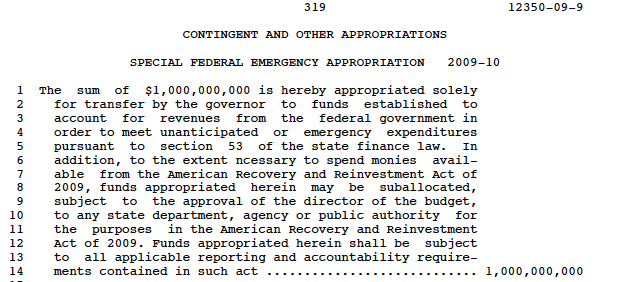
The first sentence of that paragraph is boilerplate emergency appropriations language found in previous New York State budget bills. However, the last two sentences are new and unusual.
In the absence of an updated financial plan to back up the budget bills, there has been no detailed accounting of how the agreed-upon package would distribute a reported $5 billion in federal stimulus aid over which state officials still have some discretion. However, in previous public statements and news releases, Governor Paterson and legislative leaders have announced they will use about $3.3 billion in stimulus money to (a) restore school aid; (b) undo some of Paterson’s proposed Medicaid “savings” actions, including the controversial proposal to tax sugared sodas; and (c) eliminate some of Paterson’s other proposed sales tax hikes.
That would seem to leave $1.7 billion in stimulus aid not specifically spoken for.
Stay tuned.
UPDATE
An official at DOB sends this response:
“The approp you are referencing is a contingency appropriation to ensure we are able to accept federal funding if we have not put in sufficient approp authority in every other place. As you note, it is in there every year, we are just reference ARRA in case more funding comes in that area.
“It is not a slush fund. There is no cash in there.”
You may also like

Four Problems with a Statewide Pied-à-Terre Tax
Soon after Governor Hochul floated the idea of a "pied-à-terre" tax in New York City, Albany Sen. Patricia Fahy proposed to expand the concept to the rest of the state.
As with H Read More

Budget Update Paints Less Alarming Picture of Federal Health Cuts
A new fiscal report from the state Budget Division suggests federal funding cuts will hit New York's health-care budget less severely than officials have previously warned.
A relea Read More

How Immigrants Became a Cash Cow for New York’s Essential Plan
The Hochul administration's move to shrink the Essential Plan in response to federal budget cuts has exposed a surprising reality:
For the past decade, immigrants have been a cash c Read More

How Washington’s Budget Bill Will Affect Health Care in New York
UPDATE: The final version of the federal budget bill omitted a handful of provisions that had been included in earlier drafts. One would have penalized states that use their own money to provide coverage for undocumente Read More

Two Dozen School Districts Are Returning to the Polls for Budget Revotes
Voters in 24 New York school districts return to the polls on Tuesday for school budget revotes. Last month, voters in 96 percent of school districts outside New York City conducting votes approved their school budgets for the upcoming year.
The 683 sc Read More

New York’s Proposed ‘MCO Tax’ Would Generate a Fraction of What Lawmakers Expected
The Hochul administration's proposed "MCO tax" would generate far less than the $4 billion in extra federal aid anticipated by state lawmakers when they approved the concept this spring, according to documents obtained by t Read More

How 1199 Earns its Reputation as Albany’s No. 1 Labor Power Broker
For the fourth time in six years, the president of New York's largest health-care union, George Gresham of 1199SEIU, has won the top spot on the "Labor Power 100" list from City &am Read More

New York Runs Away from the Pack on Medicaid Spending
New York's per capita Medicaid spending jumped 14 percent in 2023, moving it further ahead of the rest of the country, recently released nationwide data show.
In the federal fiscal year that ended last September, New York spent $94.6 billion Read More