

The Hochul administration’s move to shrink the Essential Plan in response to federal budget cuts has exposed a surprising reality:
For the past decade, immigrants have been a cash cow for New York’s health-care system.
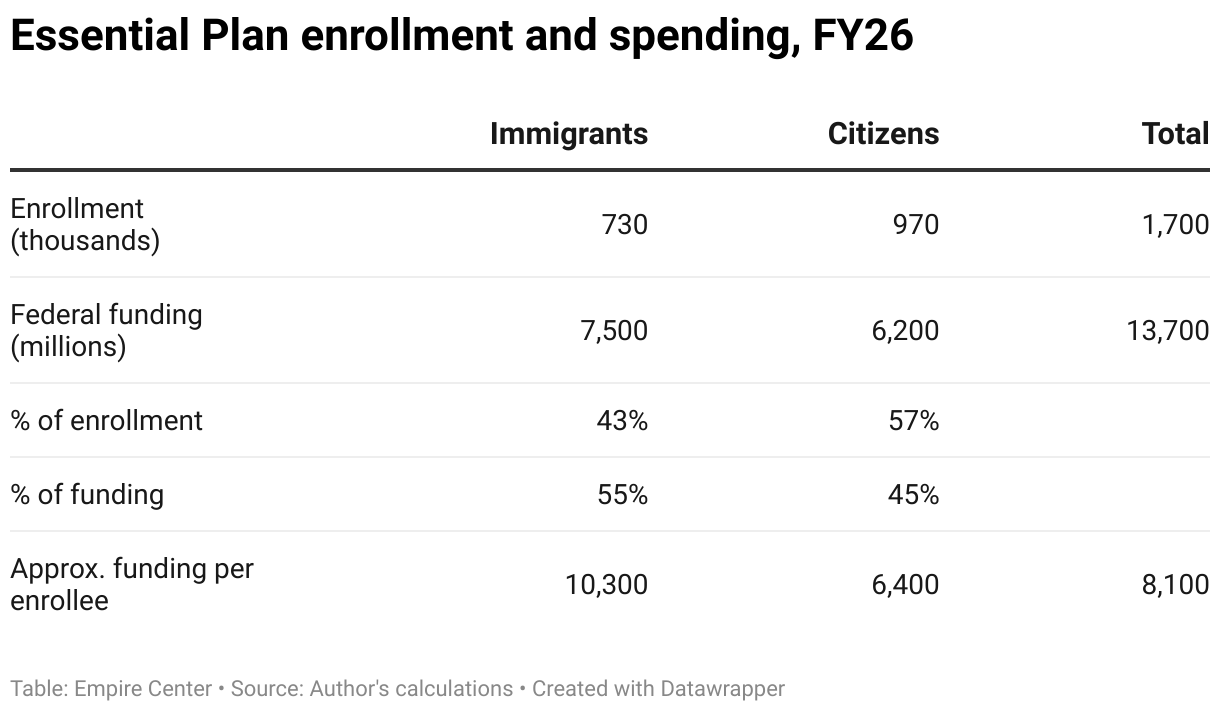
After Washington lawmakers cut off federal aid for legally present immigrants in the plan, state officials estimated they would lose $7.5 billion – which is about 55 percent of the program’s funding.
At the same time, officials said the program was covering 730,000 immigrants, which is 43 percent of the program’s enrollment.
These figures reveal that immigrants have been drawing a disproportionate amount of federal funding – an average of about $10,300 per person, compared to $6,400 for citizen enrollees, as shown in the table below.
In effect, the plan’s immigrants have been subsidizing its coverage for its citizens. They’ve also helped generate extra money that officials have used to boost hospital fees – to more than double the rates paid by Medicaid – and eliminate premiums.
Even so, the plan has repeatedly run nine- and 10-figure annual surpluses, leaving $8.9 billion in its trust fund as of May 2025, according to the comptroller’s office.
The explanation for this cash bonanza – which is now coming to an end – appears to lie in the interplay of an over-generous federal funding formula and a 2001 ruling by New York’s highest court.
In Aliessa v. Novello, the Court of Appeals ruled that New York is constitutionally obliged to provide legally present immigrants with the same Medicaid coverage as citizens, despite their ineligibility for federal matching funds. For the first 14 years after that ruling, the state paid the full cost of Medicaid coverage for several hundred thousand people in the so-called Aliessa population.
In 2015, however, the state launched the Essential Plan, which invoked a little-used provision of President Obama’s Affordable Care Act. The new plan covered residents just above the income cut-off for Medicaid, from 138 percent to 200 percent of the poverty level, and originally charged premiums of no more than $20 per month.
The federal government contributed funding equal to 95 percent of the ACA tax credits and other subsidies enrollees otherwise would have received if they had purchased commercial coverage. Unlike Medicaid, this program made federal funding available to legally present immigrants, including those below the poverty level.
The Cuomo administration estimated at the time that shifting the Aliessa population from state-funded Medicaid to the federally subsidized Essential Plan would save the state $645 million – which was one of its primary motivations for launching the program.
The financial advantages for the state turned out to be far larger than officials realized – because the federal funding formula unexpectedly generated more money than the program’s costs.
Even as enrollment soared, the state’s share of the Essential Plan’s medical expenses dropped to zero. Unspent federal aid for the program – which legally could be spent on nothing else – accumulated by the billions in the program’s trust fund.
It’s now evident that the Aliessa population helped to drive this overflow. Because their incomes are below 138 percent of the poverty rate, they are treated as if they qualify for the maximum ACA tax credits and thus draw the maximum amount of federal Essential Plan funding.
Immigrants went from being a burden on state finances to a source of billions in extra cash.
State officials spent down part of the extra funds by eliminating premiums and hiking payments to hospitals. Then, in 2024, the state obtained a federal waiver allowing it to raise the plan’s income eligibility threshold from 200 percent to 250 percent of the federal poverty level, which caused its rolls to grow by another 415,000 452,000 to a total of 1.7 million – with the federal government paying the entire bill.
This move also worked to the advantage of the labor union 1199 SEIU. It arranged to enroll lower-income home health workers in the newly expanded Essential Plan, which eased a financial crunch for one of its union-affiliated health benefit funds.
Washington’s budget-cutting is bringing an end to this lavish arrangement – not by fixing the dysfunctional funding formula, but by ending eligibility for immigrants who are legally authorized to be in the country.
This includes green card holders – i.e., legal immigrants – who have lived in the U.S. less than five years. Also affected, according to the Congressional Budget Office, are:
People with pending asylum applications, those who have been granted asylum, and parolees;
People with temporary protected status and those granted deferred action, including recipients under Deferred Action for Childhood Arrivals (DACA);
People granted statutory withholding of removal;
Temporary workers;
Nonimmigrants (including student exchange visitors and others admitted as nonimmigrants under the Immigration and Nationality Act);
Trafficking victims and refugees; and
Cuban and Haitian entrants.
Among Essential Plan enrollees, this cut-off is due to take effect in two stages: Some 500,000 people in the Aliessa population are to lose their eligibility this coming January. For another 224,000 immigrant enrollees above 138 percent of the poverty level, the effective date is January 2027.
The Hochul administration initially warned that this would force them to move Aliessa enrollees back to Medicaid at full state expense, which was expected to cost $3 billion annually.
On Wednesday, however, the Hochul administration announced an alternative plan. Officials are seeking to reverse the 2024 expansion – which was done under a Medicaid waiver – and go back to operating the plan under its original ACA rules. They reportedly hope that this maneuver, if approved by the Trump administration, would allow them keep Aliessa enrollees in the Essential Plan for the time being, while drawing down $8.9 billion in surplus funds to pay for their care.
They have said they also intend to keep hospital fees at their current elevated level of 225 percent of Medicaid rates.
This rollback would come at the expense of 415,000 people above 200 percent of the poverty level, who would be bumped from the plan in the middle of 2026. Their alternative would be to buy coverage through the New York State of Health insurance exchange, which would be subsidized through tax credits rather than premium-free.
It remains to be seen whether the Trump administration will authorize this plan, which could be seen as an end-run around the limits on funding for immigrants that Congress just approved.
It is also, at best, a temporary solution. At the Essential Plan’s current spending rates, the state is likely to burn through the surplus in a matter of two or three years.
About the Author

You may also like

New York’s Health Premiums Stayed at the Top in 2025
New Yorkers and their employers paid the highest health premiums in the lower 48 states in 2025, and their costs moved further above the U.S. average, according to recently released federal data.
Read More

NY’s Medicaid Fraud Watchdog Shows Declining Performance
Enforcement by the New York's Office of Medicaid Inspector General has dropped in recent years across a range of benchmarks – a sign that the state's anti-fraud efforts have slackened even as its Medicaid spending soared. Read More

The Attorney General’s MFCU SNAFU
Attorney General Letitia James' latest fight with the Trump administration focuses on New York's Medicaid Fraud Control Unit, a federally funded agency housed in James' office.
On T Read More
Healthcare Revelations in the Enacted Budget Financial Plan
The state financial plan published on June 10 disclosed key information about healthcare revenue and spending that lawmakers had not made public when approving the annual budget two weeks before.
Read More
Federal Suit Traces Medicaid Fraud to the Top of NYS Government
The Trump administration's latest salvo against Medicaid fraud takes aim at a different kind of target – two high-ranking New York officials along with a major state contractor.
A Read More

Healthcare Highlights in the New State Budget
Governor Hochul's focus on affordability seems to have skipped over the healthcare portions of the new state budget.
The deal finalized May 27 Read More

Lawmakers Consider Hiking Fees for Filling Prescriptions
UPDATE: The proposal discussed below passed the Assembly Friday evening by an unofficial vote of 133-0. Having previously been approved by the Senate, the bill will head to Governor Hochul's desk for her signature or ve Read More
Budget Deal Reportedly Earmarks $100M for 1199 and Extends MCO Tax
As Governor Hochul and legislative leaders rush to finalize the overdue state budget, outlines of some healthcare-related deals have begun to emerge from the closed-door negotiations.
Read More