

Governor Paterson is reportedly close to striking a deal with state employee labor unions under which the governor will drop his plan to layoff off over 7,000 state workers in exchange for the unions’ acquiescence to (a) a $20,000-per-person targeted severance payment as an inducement to workers to retire, and (b) enactment of the governor’s proposed “Tier V” public pension changes.
If these are, indeed, the terms the governor has agreed to, it’s This is a bad deal for taxpayers. It means New York State’s unionized state workers will keep their recent pay hikes, sacrificing nothing in the midst of a severe recession characterized by a flat Consumer Price Index and falling tax receipts, which have led to pay reductions for government workers in other major states.
Contrary to his claims, Governor Paterson neither sought nor won real “significant pension reform,” although he did get permission from the unions to hand what amounts to a $20,000 exit bonus to roughly 7,000 4,500 state employees who were already in position to collect retirement benefits far more generous than those available to taxpayers.
Consider the chart below comparing key elements of the current Tier IV pension–which covers all state and local employees other than police and firefighters–with the Governor’s proposal:
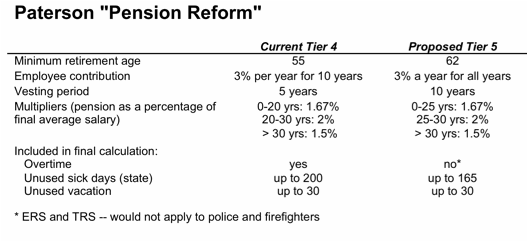
These pension changes will only affect newly hired employees, not current workers. Now consider what will survive of the traditional system even in the new tier:
- Pensions remain taxpayer-guaranteed and exempt from taxation under the state Constitution
- Retirement age with full benefits set three five years before earliest eligibility age for undiminished Social Security benefits (which is 67 for those born in 1960 or later)
- Guaranteed benefit as a share of final average salary will be 50 percent after 25 years; 60 percent after 30 years; and 75 percent after 40 years — considerably more, in each case, than the vast majority of private-sector employees could ever expect under any form of retirement plan
- Pensions remain partially indexed to inflation
- No offsetting reductions to reflect Social Security benefits, once retirees begin collecting them
- No reduction or reform of retiree health benefits, now an unfunded liability of $60 billion (and growing) for state taxpayers alone
Just this week, the governor expanded his pension proposal to include a less expensive police and firefighter retirement plan as an option for the state and its local governments. But it’s unclear at this writing whether police and fire pensions are wrapped up in the deal with state unions. (UPDATE: They’re not.)
In any event, the unions can be expected to dedicate themselves over the next few years to clawing back the marginal benefits reductions in the Tier V plan, one by one, until it looks pretty much like Tier IV. And if the past is any guide, they will succeed.
Meanwhile, adoption of the governor’s Tier V will barely make a dent in the scary cost spiral now faced by New York’s state and local retirement system–which, like its counterparts throughout the country, has been systematically understating the true value of its future liabilities and obligations. Thanks to the pension systems’ risky investment strategies and the recent meltdown in equities markets, the nation’s long-awaited public pension bomb is now about to explode. Worst of all, there’s little state officials can do about it in the short term.
True pension reform would be to close the traditional defined-benefit system to new entrants once and for all, and to shift new workers to a defined-contribution plan like the one offered by SUNY and CUNY for 45 years. And even then, the legacy costs of our pension promises to current employees will remain a massive headache for decades to come.
2:45 PM UPDATE: The just-posted news release from the Governor’s office indicates: (1) The retirement incentive will target 4,500 workers, not 7,000. Those positions, and 2,500 vacant others, will be permanently abolished–indicating they weren’t essential to begin with. (2) Paterson’s original Tier V plan has been revised to cap at $10,000 the amount of discretionary overtime that can be used to calculate pension benefits, rather than eliminate overtime from the computation entirely. So in that respect, the plan represents even less of a change than the governor originally proposed. (3) Unions also have agreed to allow the state to set a two-year, $156 million savings target to result from “voluntary” work scheduled reductions–i.e., voluntary time off without pay. This is an exceedingly modest target–and again, of course, it’s voluntary.
You may also like

Healthcare Highlights in the New State Budget
Governor Hochul's focus on affordability seems to have skipped over the healthcare portions of the new state budget.
The deal finalized May 27 Read More

Four Problems with a Statewide Pied-à-Terre Tax
Soon after Governor Hochul floated the idea of a "pied-à-terre" tax in New York City, Albany Sen. Patricia Fahy proposed to expand the concept to the rest of the state.
As with H Read More

Albany Should Listen to Jamie Dimon
In his annual message to shareholders, JP Morgan Chase's chief executive, Jamie Dimon, offered a timely and pointed warning for New York policymakers.
It's worth , with emphasis add Read More

Mamdani Gets an Important Tax Fact Wrong
At a hearing in Albany last week, New York City Mayor Zohran Mamdani lobbied state lawmakers to help him balance the city's finances with a two-percentage-point hike in the city's income tax on people making over $1 million Read More
Parsing the Impact of Mamdani’s Tax Hike Plans
The front-running candidate for New York City mayor, Zohran Mamdani, has said he can finance his costly campaign promises – including free buses and universal child care – by taxing only a sliver of the city's residents Read More

Why New York’s Health Premiums Keep Going Up
New Yorkers continue to face some of the costliest health premiums in the U.S., and the insurance industry's recently finalized rate applications shed light on why that is.
In summa Read More

Two Dozen School Districts Are Returning to the Polls for Budget Revotes
Voters in 24 New York school districts return to the polls on Tuesday for school budget revotes. Last month, voters in 96 percent of school districts outside New York City conducting votes approved their school budgets for the upcoming year.
The 683 sc Read More

Even With Federal Cuts, New York’s Health Funding Would Remain High
New York's health-care industry stands to lose billions of dollars in federal funding under the major budget bill being debated in Washington – a rare and jarring turn of events for a sector accustomed to steadily increas Read More