

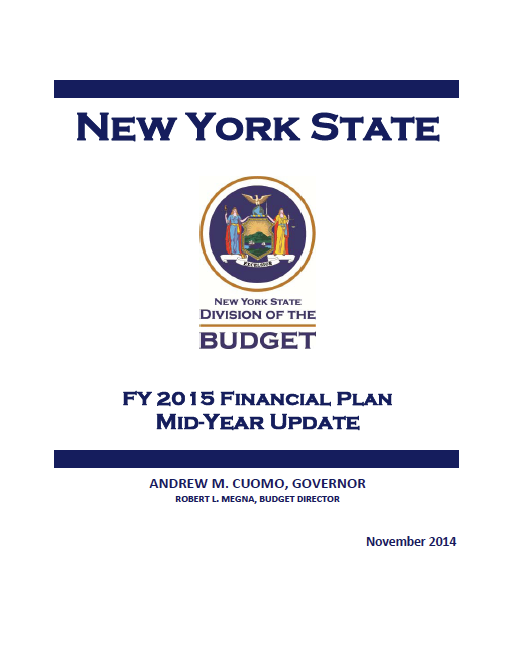
 New York’s state government pension costs could be nearly $1.6 billion above previously projected levels over the next four years, according to the Mid-Year Financial Plan Update that was finally issued today—11 days behind schedule, and nearly a week after Election Day—by Governor Andrew Cuomo’s Division of the Budget (DOB).
Instead of making its fully required pension payment, the state effectively has borrowed a total of $2.5 billion in pension contributions over the past five years, as it was given the option of doing under a 2010 law proposed by Comptroller Thomas DiNapoli and signed by former Governor David Paterson.
DiNapoli’s pension “amortization” plan, which also is open to local governments, has capped the growth in pension contribution rates at one percentage point of salary base per year since 2010. The difference between the “normal” rate and the capped rate each year must be paid back, with interest currently set at just above 3 percent, in annual installments over a 10-year period. As of 2015, the capped rates of 13.5 percent for members of the Employee Retirement System and 21.5 percent for members of the Police and Fire Retirement System are both about seven percentage points below the normal rate – i.e., the full rate the state would be paying if it wasn’t deferring some of the bill.
Cuomo’s enacted budget as well as his first quarterly financial plan update for fiscal 2015 assumed the state would make one more deferral of nearly $743 million this year and then resume making its full required contributions, as well as scheduled payments on past deferrals, starting in fiscal 2016. But according to the Mid-Year Update, the new mortality table used in the state actuary’s revised assumptions has pushed future contribution rates above the levels DOB calculated as recently first quarter update in July.
As a result, this year’s deferral will be a little less at $713 million, but the state will defer $1 billion more than it previously had planned between fiscal 2016 through fiscal 2020. Total pension contributions are slated to increase by $1.6 billion over the next four years and by a whopping $9.8 billion between 2015 and 2028. On an annual basis, net of deferrals, pension costs will be about $41 million lower than previously projected in fiscal 2016 (the upcoming budget), but will exceed previous projections by $259 million in 2017, $552 million in 2018 and $815 million in 2019, the Mid-Year plan indicates.
Cuomo repeatedly has pledged to hold spending growth to 2 percent a year in his next term, which is just above half the growth trend projected under current laws as of the first quarter update. The higher pension costs will increase the difficulty of reaching that target.
PS – During the recent gubernatorial campaign, Cuomo repeatedly noted that Moody’s Investor Service had reduced its previously AAA credit rating of Westchester County by a notch during the tenure of his Republican opponent, Westchester County Executive Robert Astorino. Ironically, Moody’s based its action on Westchester’s decision to defer pension contributions — just as the state has done under Cuomo and, it emerged today, the governor now plans to continue doing over the next five years.
PPS – It should be emphasized that it is possible Cuomo won’t need to defer nearly as much as the financial update projects. For example, if tax revenues come in well above estimates he could choose to spend that money on pensions and reduce the long term impact of the increase in the contribution rate.
You may also like
The Attorney General’s MFCU SNAFU
Attorney General Letitia James' latest fight with the Trump administration focuses on New York's Medicaid Fraud Control Unit, a federally funded agency housed in James' office.
On T Read More
Healthcare Revelations in the Enacted Budget Financial Plan
The state financial plan published on June 10 disclosed key information about healthcare revenue and spending that lawmakers had not made public when approving the annual budget two weeks before.
Read More
Federal Suit Traces Medicaid Fraud to the Top of NYS Government
The Trump administration's latest salvo against Medicaid fraud takes aim at a different kind of target – two high-ranking New York officials along with a major state contractor.
A Read More

It Is Time to Rethink the Regional Greenhouse Gas Initiative
Before budget negotiations, Gov. Hochul warned that unless New York changes its climate plans, New Yorkers could face a $2.26-per-gallon increase in gasoline prices. The reason is the so-called “cap-and-invest” scheme, under which energy companies wou Read More

Healthcare Highlights in the New State Budget
Governor Hochul's focus on affordability seems to have skipped over the healthcare portions of the new state budget.
The deal finalized May 27 Read More

Lawmakers Consider Hiking Fees for Filling Prescriptions
UPDATE: The proposal discussed below passed the Assembly Friday evening by an unofficial vote of 133-0. Having previously been approved by the Senate, the bill will head to Governor Hochul's desk for her signature or ve Read More

Lack of Common Sense on Energy in the Budget
Lack of Common Sense on Energy in the Budget
Anyone hoping the governor would make even modest, common-sense changes to New York’s disastrous energy policies will be disappointed. The energy portion of the budget is out, and the nons Read More
Budget Deal Reportedly Earmarks $100M for 1199 and Extends MCO Tax
As Governor Hochul and legislative leaders rush to finalize the overdue state budget, outlines of some healthcare-related deals have begun to emerge from the closed-door negotiations.
Read More