

The proposed Capital Projects (S.2004-D) for the 2018 state fiscal year appropriates a total of $1.64 billion for the State and Municipal Facilities Program, including a new appropriation of $385 million and a re-appropriation of $1.25 billion.
Throughout the existence of the program, created in 2013, Governor Cuomo and legislative leaders have been uncharacteristically silent about its purposes. However, their intentions can be deduced from the evolving appropriations language attached to the growing pot of money allocated for the SMFP.
What follows are excerpts from the Capital Projects budget explaining the purposes for which the money is to be spent, and the entities eligible to apply for it:
For payment of the capital costs of construction, improvement, rehabilitation or reconstruction of facilities owned by eligible entities; the acquisition of capital facilities and assets by eligible entities, including fixed capital assets; the acquisition by eligible entities of equipment and other capital assets, including vehicles, in support of health, safety, technology, or innovation; the acquisition by an eligible entity of capital assets with a useful life of not less than ten years purchased for the sole purpose of preserving and protecting infrastructure that is owned, controlled or appurtenant to an eligible entity, including but not limited to heavy duty road maintenance and construction vehicles, pavers, snow plows, street sweepers and heavy duty fire, emergency response and law enforcement vehicles; economic development projects sponsored by the state or municipal corporations, as defined in section 2 of the general municipal law, that will create or retain jobs in New York state as certified by the commissioner of the department of economic development; or environmental projects sponsored by the state or municipal corporations as defined in section 2 of the general municipal law. Eligible entities shall consist of the state; municipal corporations as defined in section 2 of the general municipal law; water and sewer districts; the Metropolitan Transportation Authority; a college or university established pursuant to section 352 of the education law, section 6203 of the education law or section 6302 of the education law; an independent not-for-profit institution of higher education as defined in subdivision 2 of section 6401 of the education law; public school districts; public housing authorities; public libraries and library systems chartered by the regents of the state of New York or established by an act of the legislature; public park conservancies or not for profit corporations organized for the purpose of investing in parks owned by the state or municipal corporations, as defined in section 2 of the general municipal law; not for profit fire districts, fire commissions, fire companies, fire departments, volunteer rescue and ambulance squads; and special act school districts, schools for the blind and deaf and other students with disabilities subject to article 85 of the education law, and private schools for students with disabilities authorized pursuant to chapter 853 of the laws of 1976. Costs may include, but shall not be limited to engineering services, construction, project management, right-of-way acquisition, and work appurtenant and ancillary thereto. No funds from this appropriation may be used as a required match or be considered a local share to other state programs or to leverage state aid or grants including but not limited to the apportionment of aid under the education law. Notwithstanding any provision of law to the contrary, funds appropriated herein may, subject to the approval of the director of the budget, be: (i) interchanged, (ii) transferred from this appropriation to any other appropriation of any state department, agency or public benefit corporation, or (iii) suballocated to any other state department, agency or public benefit corporation, to achieve this purpose (SM0117SM)
About the Author

You may also like

Switching to Electric Home Heating Could Add Thousands to Energy Bills
FOR IMMEDIATE RELEASE: ALBANY, N.Y. that heating an average home from October to March would cost approximately $790 with natural gas, compared with $1,100 with a heat pump and $3,300 with electr Read More
Hochul’s Energy Infrastructure Plan Gets the Diagnosis Right but Offers No Prescription
Editor’s note: Roger Caiazza is an adjunct fellow at the Empire Center. He has a long and deep private industry background in environmental regulatory analysis and compliance. His frequently updated personal blog on New York State environmental poli Read More

Poll: 64% of New Yorkers Back Eliminating the State Income Tax; 67% Say State Taxes Aren’t Delivering
Dissatisfaction spans party and regional lines as broad majorities rally behind sweeping tax reform
FOR IMMEDIATE RELEASE: ALBANY, N.Y. - New Yorkers are delivering a blunt assessment of the state’s tax system: 67% say they ar Read More
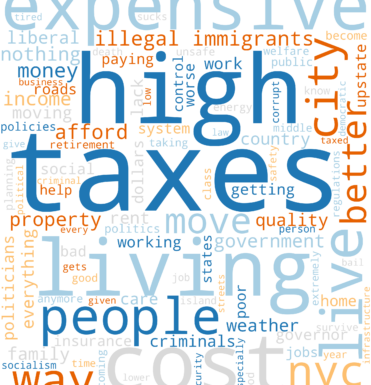
New Yorkers Want to Eliminate the Income Tax
Summary
New Yorkers have reached a clear verdict: The state’s tax system is not delivering. A full 67% say they are not getting good value for their tax dollars, while 64% support eliminating the state income tax. Read More
SUNY Research Foundation Payroll Tops $400 Million
Payroll records for 8,401 employees of the Research Foundation for the State University of New York (RF SUNY) for fiscal year 2026 are , the Empire Center's government transparency website.
The Research Foundation is a private, nonprofit educational co Read More

Newly Retired NYC Firefighters Average Over $177k In Pensions
New York City firefighters and fire officers retiring last year after full careers were entitled to average annual pension benefits of $177,016, according to , the Empire Center's government transparency website.
Among the 499 new retirees with at leas Read More
New York Annual Household Electricity Costs Rise $270
FOR IMMEDIATE RELEASE ALBANY, N.Y. — New York’s average residential electricity price reached 29.90 cents per kilowatt-hour (kWh) in July 2026, the fifth highest in the nation and 63.3 percent Read More
Energy Data Bulletin September 2026
September 2026
Summary and Insights
Electricity. In June 2026, New York had the nation's fifth-highest residential electricity price at 29.49 cents per kilowatt-hour (kWh), 60.8 percent above the U.S. average. Prices d Read More