

 Upstate New York’s largest metro areas experienced little or no job growth during the year ending in June, according to the latest state Labor Department employment report.
New York’s long-term trend of regionally uneven growth—with job gains downstate and very little growth north of the mid-Hudson Valley—was even more accentuated in the June payroll data (which, as always should be noted, will be subject to “re-benchmarking” early next year).
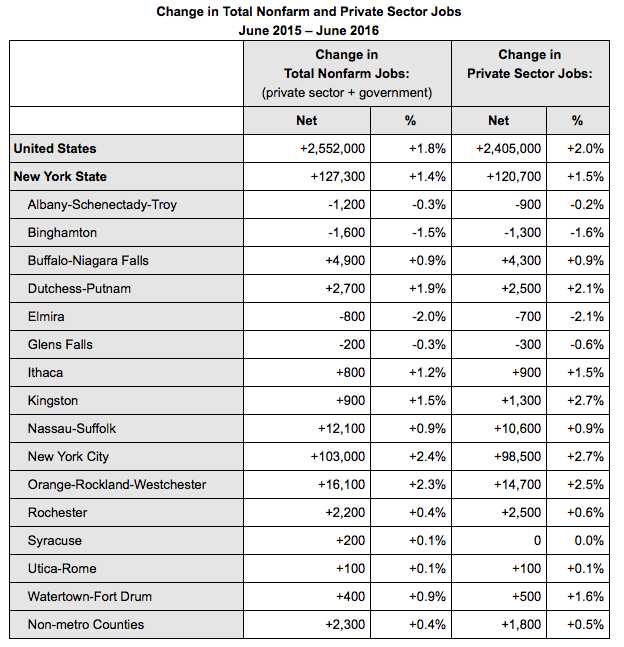
The state as a whole gained 120,700 private jobs, a 1.5 percent rate of increase during a period when employment in the nation as a whole grew by 2.1 percent. But as shown in the Labor Department summary table at the bottom of this post, virtually all of the added jobs were created downstate: in New York City (+98,500 jobs, or 2.7 percent), Long Island (+10,600 jobs, or 0.9 percent), and the lower Hudson Valley (up a combined 17,300 jobs).
The Albany-Schenectady-Troy area, boosted in recent years by massive state investments in high tech projects, lost 900 private jobs (-0.2 percent) on a year-to-year basis. Buffalo and Rochester registered relatively small gains of 4,300 jobs (0.9 percent) and 2,500 jobs (0.6 percent), respectively. Syracuse private employment was unchanged.
New York’s worst-performing region remains the Southern Tier, where the Binghamton area was estimated to have lost 1,300 private jobs—or more than twice the number that will be created by a new Dick’s Sporting Goods distribution center announced by Governor Andrew Cuomo earlier this week. Elmira’s decrease 0f 700 jobs was even larger in percentage terms (-2.1 percent). Glens Falls, north of the Albany-Schenectady-Troy region, also had a job decrease.
During the same period, there were jobs gains in the smaller metros of Ithaca, Kingston and Watertown.
You may also like

New York’s Health Premiums Stayed at the Top in 2025
New Yorkers and their employers paid the highest health premiums in the lower 48 states in 2025, and their costs moved further above the U.S. average, according to recently released federal data.
Read More

NY’s Medicaid Fraud Watchdog Shows Declining Performance
Enforcement by the New York's Office of Medicaid Inspector General has dropped in recent years across a range of benchmarks – a sign that the state's anti-fraud efforts have slackened even as its Medicaid spending soared. Read More
The Attorney General’s MFCU SNAFU
Attorney General Letitia James' latest fight with the Trump administration focuses on New York's Medicaid Fraud Control Unit, a federally funded agency housed in James' office.
On T Read More
Healthcare Revelations in the Enacted Budget Financial Plan
The state financial plan published on June 10 disclosed key information about healthcare revenue and spending that lawmakers had not made public when approving the annual budget two weeks before.
Read More
Federal Suit Traces Medicaid Fraud to the Top of NYS Government
The Trump administration's latest salvo against Medicaid fraud takes aim at a different kind of target – two high-ranking New York officials along with a major state contractor.
A Read More

It Is Time to Rethink the Regional Greenhouse Gas Initiative
Before budget negotiations, Gov. Hochul warned that unless New York changes its climate plans, New Yorkers could face a $2.26-per-gallon increase in gasoline prices. The reason is the so-called “cap-and-invest” scheme, under which energy companies wou Read More

Healthcare Highlights in the New State Budget
Governor Hochul's focus on affordability seems to have skipped over the healthcare portions of the new state budget.
The deal finalized May 27 Read More

Lawmakers Consider Hiking Fees for Filling Prescriptions
UPDATE: The proposal discussed below passed the Assembly Friday evening by an unofficial vote of 133-0. Having previously been approved by the Senate, the bill will head to Governor Hochul's desk for her signature or ve Read More