

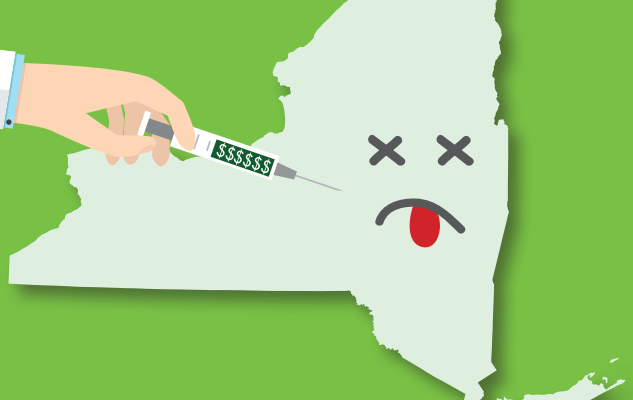
 The biggest-ticket revenue action in Governor Cuomo’s budget proposal was not extending the so-called millionaire tax, but renewing the Health Care Reform Act, which imposes a hidden tax on New Yorkers of all incomes.
Continuing HCRA’s surcharges on health insurance through 2020 will bring about $13.3 billion to state coffers over the next three years.
That’s $700 million more than Cuomo’s announced three-year extension of the income tax surcharge on million-dollar earners, which is projected to reap $12.6 billion.
Unlike the millionaires’ tax, however, the HCRA extension went unmentioned on Tuesday.
The governor didn’t bring it up during his Executive Mansion press conference. Nor was it spelled out in key budget documents, which simply took for granted that HCRA revenue would continue flowing at about $4.4 billion a year.
The one formal acknowledgement of this consequential step came in one of Cuomo’s 14 draft budget bills, which changed the expiration dates of various HCRA provisions from December 31, 2017, to December 31, 2020.
The Health Care Reform Act, which took effect 20 years ago this month, abolished the state’s complicated and counterproductive system of price controls for hospitals. To smooth the transition, it imposed two surcharges on health insurance and used the money to subsidize hospitals for providing free care for the poor and uninsured and for training new physicians.
As the Empire Center documented in a report this month, HCRA has since morphed into little more than a mechanism for raising cash.
Rather than phase out the surcharges, lawmakers have hiked them or added new ones 14 times over the past two decades – tripling their dollar value and leaving them as the state’s third-largest tax.
Though hidden from public view, the taxes add an estimated 6.2 percent to the cost of a typical New York City health plan. They make no allowance for ability to pay, taking a bigger percentage bite from middle income New Yorkers than from the wealthy. One of the surcharges varies radically from one part of the state to another, costing $10.24 per person in Utica, but $202.82 in New York City – a difference of 1,800 percent.
HCRA spending has also drifted from its original purposes. Now, two-thirds of the money simply flows into the Medicaid budget – which traditionally was financed with general, broad-based tax revenues. Much of the rest is dedicated to questionable or mismanaged programs.
The law’s expiration at the end of 2017 gave Cuomo the opportunity to start weaning state government away from its addiction to health taxes. Phasing out the surcharges could have saved hundreds of dollars a year for every New Yorker with health insurance.
Instead, he has proposed to continue the dysfunctional status quo.
About the Author

You may also like

New Poll Shows New Yorkers Want Cheaper Energy — RGGI’s Price Record Shows They Aren’t Getting It
Editor's note: Roger Caiazza is an adjunct fellow at the Empire Center. He has a long and deep private industry background in environmental regulatory analysis and compliance. His frequently updated personal blog on New York Read More

New York’s Health Premiums Stayed at the Top in 2025
New Yorkers and their employers paid the highest health premiums in the lower 48 states in 2025, and their costs moved further above the U.S. average, according to recently released federal data.
Read More

NY’s Medicaid Fraud Watchdog Shows Declining Performance
Enforcement by the New York's Office of Medicaid Inspector General has dropped in recent years across a range of benchmarks – a sign that the state's anti-fraud efforts have slackened even as its Medicaid spending soared. Read More
The Attorney General’s MFCU SNAFU
Attorney General Letitia James' latest fight with the Trump administration focuses on New York's Medicaid Fraud Control Unit, a federally funded agency housed in James' office.
On T Read More
Healthcare Revelations in the Enacted Budget Financial Plan
The state financial plan published on June 10 disclosed key information about healthcare revenue and spending that lawmakers had not made public when approving the annual budget two weeks before.
Read More
Federal Suit Traces Medicaid Fraud to the Top of NYS Government
The Trump administration's latest salvo against Medicaid fraud takes aim at a different kind of target – two high-ranking New York officials along with a major state contractor.
A Read More

It Is Time to Rethink the Regional Greenhouse Gas Initiative
Before budget negotiations, Gov. Hochul warned that unless New York changes its climate plans, New Yorkers could face a $2.26-per-gallon increase in gasoline prices. The reason is the so-called “cap-and-invest” scheme, under which energy companies wou Read More

Healthcare Highlights in the New State Budget
Governor Hochul's focus on affordability seems to have skipped over the healthcare portions of the new state budget.
The deal finalized May 27 Read More