

Governor Cuomo frequently has cited a decrease in unemployment rates as evidence that his economic development policies are working. But the unemployment rate, in particular, can be greatly misleading as an indicator of economic growth—or the lack of it. To understand why, it’s important to consider how these statistics are gathered and calculated.
The U.S. Bureau of Labor Statistics estimates New York’s unemployment rate based on a statistical regression model that primarily relies on the Current Population Survey (CPS). Conducted in-person or via telephone, the CPS reaches about 3,100 households in New York State every month. Respondents are asked a series of questions to determine how many persons in their household are employed in a paid job, and how many are jobless and looking for a job but unemployed. The labor force is the sum of employed and unemployed persons, and the unemployment rate is percentage of the total who are unemployed. In terms of geographic distribution, resident employment and unemployment statistics are based on where workers live, while “payroll” employment statistics are based on where jobs are located.
The following charts are derived from the latest available state Labor Department estimates of the labor force, the number of employed residents, and the number of unemployed residents for New York’s regional labor markets. The data are not seasonally adjusted; however, minimizing seasonal variations, all estimates are for the same month (August).
Since their summer 2012 peak, the upstate and downstate unemployment rates have both moved sharply downward—but for sharply different reasons.
Downstate, the drop in unemployment during the recovery period under Governor Cuomo has been driven by an increase in resident employment (the red line), even while the number of people seeking work (the blue line) was also rising. Specifically, according to New York’s Local Area Unemployment Statistics, the downstate resident labor force increased by 289,000 people from August 2010 to August 2018—but the number of employed people in the region increased almost twice as much, by 576,000.

But the picture is quite different upstate, where the same government data indicate that resident employment in 48 counties (the red line) dropped by a combined total of 87,500 from August 2010 to August 2018. The unemployment rate nonetheless decreased because the labor force in those counties (blue line) decreased by 210,100 people.

You may also like

Switching to Electric Home Heating Could Add Thousands to Energy Bills
FOR IMMEDIATE RELEASE: ALBANY, N.Y. that heating an average home from October to March would cost approximately $790 with natural gas, compared with $1,100 with a heat pump and $3,300 with electr Read More
Hochul’s Energy Infrastructure Plan Gets the Diagnosis Right but Offers No Prescription
Editor’s note: Roger Caiazza is an adjunct fellow at the Empire Center. He has a long and deep private industry background in environmental regulatory analysis and compliance. His frequently updated personal blog on New York State environmental poli Read More

Poll: 64% of New Yorkers Back Eliminating the State Income Tax; 67% Say State Taxes Aren’t Delivering
Dissatisfaction spans party and regional lines as broad majorities rally behind sweeping tax reform
FOR IMMEDIATE RELEASE: ALBANY, N.Y. - New Yorkers are delivering a blunt assessment of the state’s tax system: 67% say they ar Read More
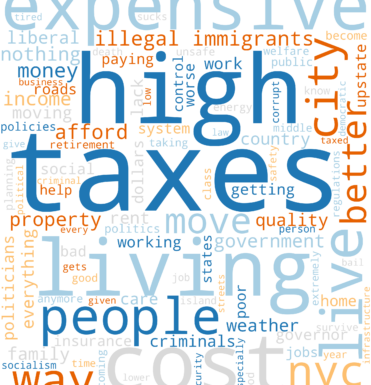
New Yorkers Want to Eliminate the Income Tax
Summary
New Yorkers have reached a clear verdict: The state’s tax system is not delivering. A full 67% say they are not getting good value for their tax dollars, while 64% support eliminating the state income tax. Read More
SUNY Research Foundation Payroll Tops $400 Million
Payroll records for 8,401 employees of the Research Foundation for the State University of New York (RF SUNY) for fiscal year 2026 are , the Empire Center's government transparency website.
The Research Foundation is a private, nonprofit educational co Read More

Newly Retired NYC Firefighters Average Over $177k In Pensions
New York City firefighters and fire officers retiring last year after full careers were entitled to average annual pension benefits of $177,016, according to , the Empire Center's government transparency website.
Among the 499 new retirees with at leas Read More
New York Annual Household Electricity Costs Rise $270
FOR IMMEDIATE RELEASE ALBANY, N.Y. — New York’s average residential electricity price reached 29.90 cents per kilowatt-hour (kWh) in July 2026, the fifth highest in the nation and 63.3 percent Read More
Energy Data Bulletin September 2026
September 2026
Summary and Insights
Electricity. In June 2026, New York had the nation's fifth-highest residential electricity price at 29.49 cents per kilowatt-hour (kWh), 60.8 percent above the U.S. average. Prices d Read More