

Data released at the first meeting of the governor’s Medicaid Redesign Team on Tuesday provided an updated picture of the program’s long-term care costs, and the results were eye-opening.
The numbers showed a particularly striking trend for “personal assistance,” which refers to non-medical care, such as bathing and feeding, provided to people with disabilities, typically by aides with little or no training.
According to the data shared on Tuesday, state-funded spending on this type of care has more than doubled in just the past four years, to $5.7 billion – or about $11.4 billion with federal matching aid included.
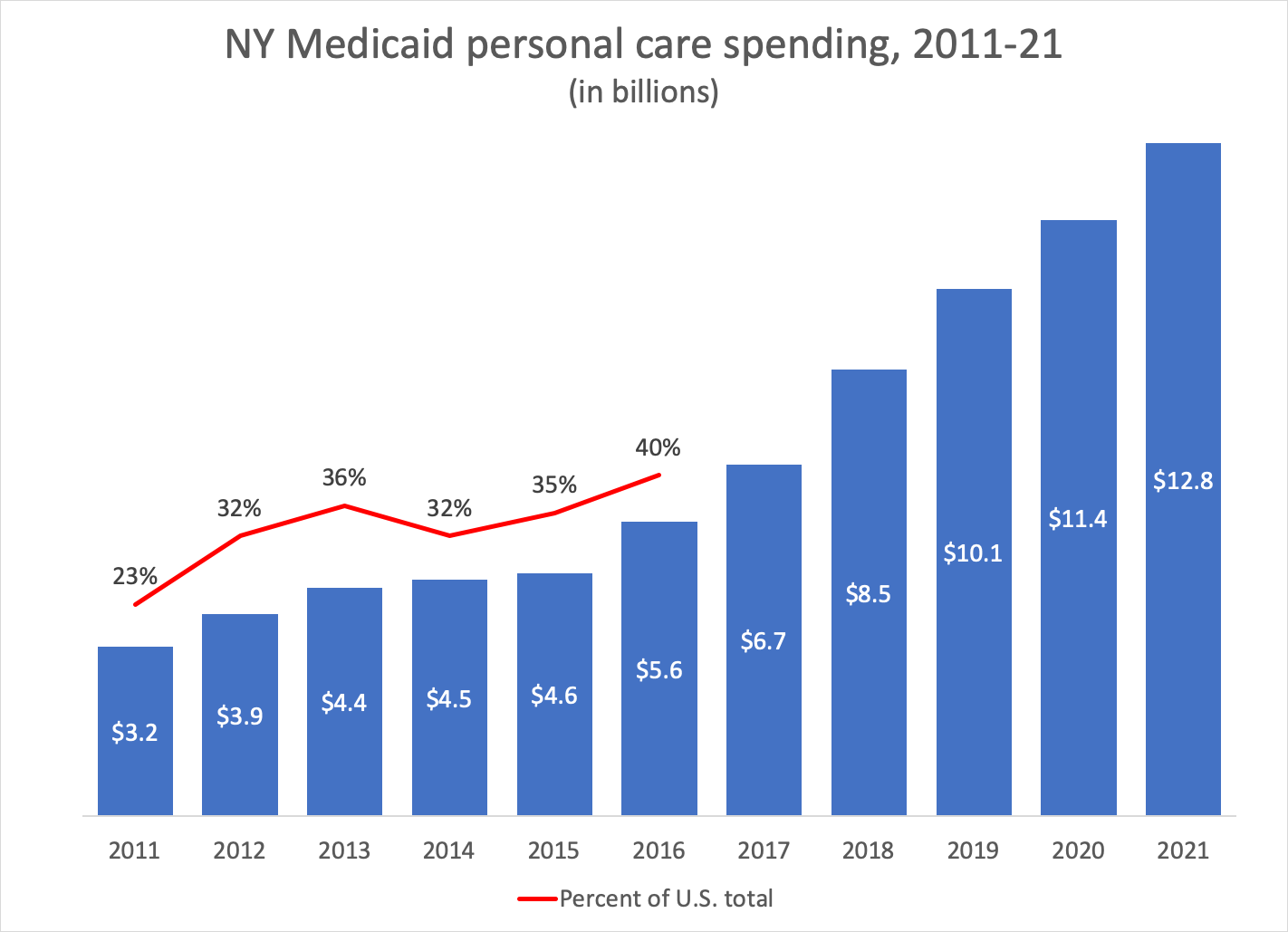
New York has long been an outlier with respect to this benefit, which is optional under federal Medicaid rules. Although it’s covered by 33 states, New York alone accounted for 40 percent of national Medicaid spending on personal assistance as of 2016.
Recent data on the other 32 states is not available, but that 40 percent ratio has no doubt increased significantly in the four years since.
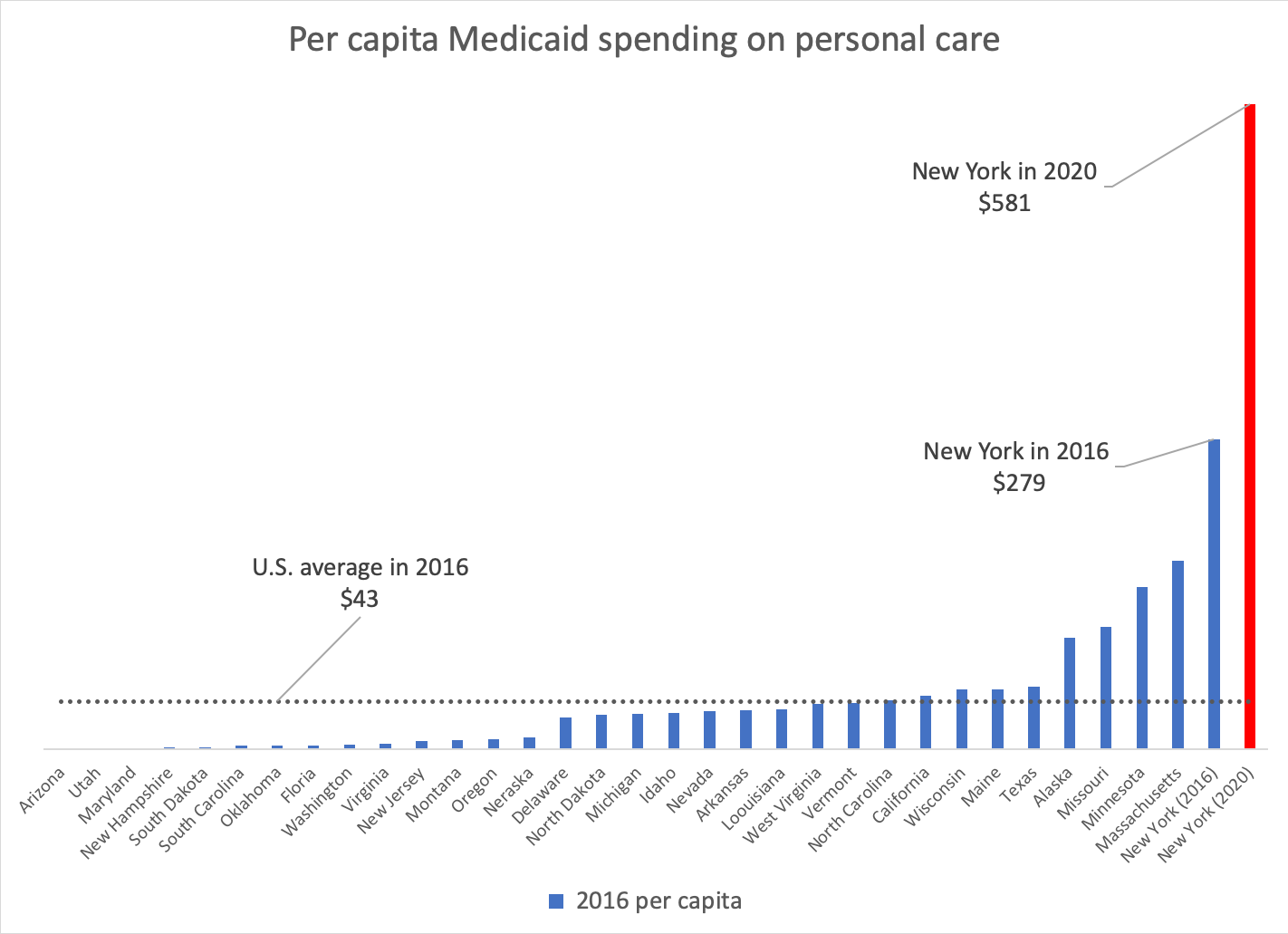
Another benchmark of New York’s outlier status is per capita spending (total spending divided by total population). As of 2016, the per capita rate for personal assistance was $279, which was six-and-a-half times higher than the U.S. average and 65 percent more than the No. 2 state, which was Massachusetts.
Based on the new numbers released Tuesday, that already high figure has more than doubled – to $581 as of 2020.
Traditionally, personal assistance was provided through home-care organizations, which would hire and train the aides and assign them to Medicaid recipients on behalf of the state. Most of the recent growth, however, has been in the Consumer-Directed Personal Assistance Program, or CDPAP, a variant in which recipients hire and train their own caregivers, who can be family members or friends.
According to numbers shared at Tuesday’s meeting, New York’s CDPAP spending has soared by more than 800 percent over five years, from $287 million in fiscal year 2016 to a projected $2.8 billion in 2021. Spending on agency-provided personal assistance also increased during that same period by 44 percent, from $2.5 billion to $3.6 billion.
These unusually fast growth rates were highlighted by state officials as among the major reasons that Medicaid spending has run billions of dollars over budget in recent years, opening a $4 billion deficit in fiscal year 2020 and a $3.1 billion projected gap for 2021.
Little wonder, then, that CDPAP and long-term care appeared at the top of a priority list for “course correction” at Tuesday’s meeting.
Governor Cuomo recently appointed the Medicaid Redesign Team to find $2.5 billion in cost savings to help balance the state budget due by April 1. The panel’s co-chairman, Northwell Health CEO Michael Dowling, said he hoped to publish recommendations by mid-March.
About the Author

You may also like

Hochul’s Energy Infrastructure Plan Gets the Diagnosis Right but Offers No Prescription
Editor’s note: Roger Caiazza is an adjunct fellow at the Empire Center. He has a long and deep private industry background in environmental regulatory analysis and compliance. His frequently updated personal blog on New York State environmental poli Read More
New Poll Shows New Yorkers Want Cheaper Energy — RGGI’s Price Record Shows They Aren’t Getting It
Editor's note: Roger Caiazza is an adjunct fellow at the Empire Center. He has a long and deep private industry background in environmental regulatory analysis and compliance. His frequently updated personal blog on New York Read More

New York’s Health Premiums Stayed at the Top in 2025
New Yorkers and their employers paid the highest health premiums in the lower 48 states in 2025, and their costs moved further above the U.S. average, according to recently released federal data.
Read More

NY’s Medicaid Fraud Watchdog Shows Declining Performance
Enforcement by the New York's Office of Medicaid Inspector General has dropped in recent years across a range of benchmarks – a sign that the state's anti-fraud efforts have slackened even as its Medicaid spending soared. Read More
The Attorney General’s MFCU SNAFU
Attorney General Letitia James' latest fight with the Trump administration focuses on New York's Medicaid Fraud Control Unit, a federally funded agency housed in James' office.
On T Read More
Healthcare Revelations in the Enacted Budget Financial Plan
The state financial plan published on June 10 disclosed key information about healthcare revenue and spending that lawmakers had not made public when approving the annual budget two weeks before.
Read More
Federal Suit Traces Medicaid Fraud to the Top of NYS Government
The Trump administration's latest salvo against Medicaid fraud takes aim at a different kind of target – two high-ranking New York officials along with a major state contractor.
A Read More

It Is Time to Rethink the Regional Greenhouse Gas Initiative
Before budget negotiations, Gov. Hochul warned that unless New York changes its climate plans, New Yorkers could face a $2.26-per-gallon increase in gasoline prices. The reason is the so-called “cap-and-invest” scheme, under which energy companies wou Read More