

The state Legislature should join Governor Cuomo in resisting and rejecting proposals to further increase state taxes on New York’s highest earners, E.J. McMahon of the Empire Center testified to the joint legislative fiscal committees today.
McMahon, the Center’s founder and research director, also encouraged lawmakers to expand Cuomo’s proposed enhancement of the child credit. He said the state should double the maximum credit, from $333 to $666, and pay for the change by repealing the $110 sales tax exemption on clothing and footwear purchases.
On other Cuomo initiatives, McMahon urged rejection of Cuomo’s proposal to extend for one more year, through 2025, the state’s $420 million in annual tax subsidies for film and TV productions made in the state. “It’s high time to call a ‘wrap’ on the film tax credit program in its entirety,” he testified.
Turning to various proposals for raising taxes on high earners, McMahon cited data showing that New York’s base of resident income millionaires increased more slowly than the national average from 2008-2016, during the first eight years affected by a supposedly temporary “millionaire tax” rate that has been repeatedly extended at a slightly lower level under Cuomo.
There was a striking difference in the incomes of New York’s highest earners, which rose only 16 percent during the period, compared to 26 percent for millionaires nationally. But “nonresident” taxpayers, who cannot be taxed by New York on labor and investment income earned in other states, expanded very rapidly, McMahon noted.
“From 2008 to 2016, New York State’s tax base added more than 15,000 nonresident filers, an increase of 53 percent, according to state tax data,” McMahon said. “Total nonresident gross incomes rose from $125 billion to $222 billion, and their average incomes increased by 16 percent, from $4.3 million to $5 million. How much of that increase consisted of former New York residents who had moved away to escape our tax burden? The data don’t tell us. But the pattern certainly does not indicate that higher rates don’t matter, or that New York can raise “millionaire taxes” with impunity.”
McMahon noted that New York is one of only a dozen states still imposing its own tax on the estates of wealthy residents. “There is little double that as long as we impose our own estate tax, we are providing a strong incentive for wealthy households—including owners of businesses in New York—to sell their assets here and move to any one of the 38 states that will not subject them to added tax,” he said.
Roughly 40 percent of the state’s income tax is generated by the highest-earning one percent of taxpayers, whose incomes are much more volatile and subject to disruption during recessions and stock market downturns, McMahon said, concluding: “Raising taxes on the highest incomes to raise revenues in the short term will only accelerate the erosion of our tax base in the long run, ultimately undermining funding for the very programs the Legislature wants to protect.”
You can read the full testimony here.
The Empire Center, based in Albany, is an independent, not-for-profit, non-partisan think tank dedicated to promoting policies that can make New York a better place to live, work and raise a family.
You may also like

Switching to Electric Home Heating Could Add Thousands to Energy Bills
FOR IMMEDIATE RELEASE: ALBANY, N.Y. that heating an average home from October to March would cost approximately $790 with natural gas, compared with $1,100 with a heat pump and $3,300 with electr Read More

Poll: 64% of New Yorkers Back Eliminating the State Income Tax; 67% Say State Taxes Aren’t Delivering
Dissatisfaction spans party and regional lines as broad majorities rally behind sweeping tax reform
FOR IMMEDIATE RELEASE: ALBANY, N.Y. - New Yorkers are delivering a blunt assessment of the state’s tax system: 67% say they ar Read More
SUNY Research Foundation Payroll Tops $400 Million
Payroll records for 8,401 employees of the Research Foundation for the State University of New York (RF SUNY) for fiscal year 2026 are , the Empire Center's government transparency website.
The Research Foundation is a private, nonprofit educational co Read More

Newly Retired NYC Firefighters Average Over $177k In Pensions
New York City firefighters and fire officers retiring last year after full careers were entitled to average annual pension benefits of $177,016, according to , the Empire Center's government transparency website.
Among the 499 new retirees with at leas Read More
New York Annual Household Electricity Costs Rise $270
FOR IMMEDIATE RELEASE ALBANY, N.Y. — New York’s average residential electricity price reached 29.90 cents per kilowatt-hour (kWh) in July 2026, the fifth highest in the nation and 63.3 percent Read More
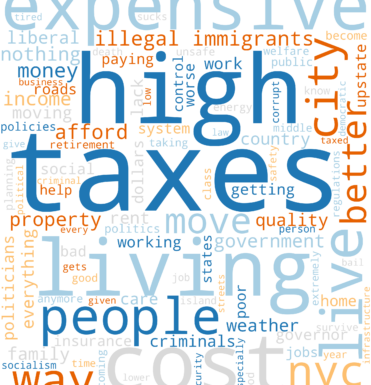
Taxes, the Cost of Living, and Feeling Ignored: Why New Yorkers Are Thinking of Leaving
FOR IMMEDIATE RELEASE ALBANY, N.Y. - New Yorkers across the political spectrum are considering leaving the state. A new finds that Republicans and independent voters most often cite taxes as the reason, while Dem Read More
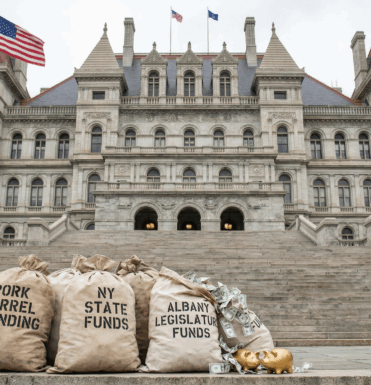
Albany Steers Nearly $100 Million in 2026 Pork Barrel Spending
Albany steered $97.2 million to 206 local projects during the first half of 2026 in the newest batch of state discretionary grants, according to. The new tranche is the latest addition to the pork-barrel grant database the Empire Center h Read More

New York’s Electricity Prices Fifth Highest in the Country
FOR IMMEDIATE RELEASE
ALBANY, N.Y. — Empire Center’s shows New York households paid the fifth‑highest residential electricity prices in the country in June 2026, trailing only Hawaii, California Read More