

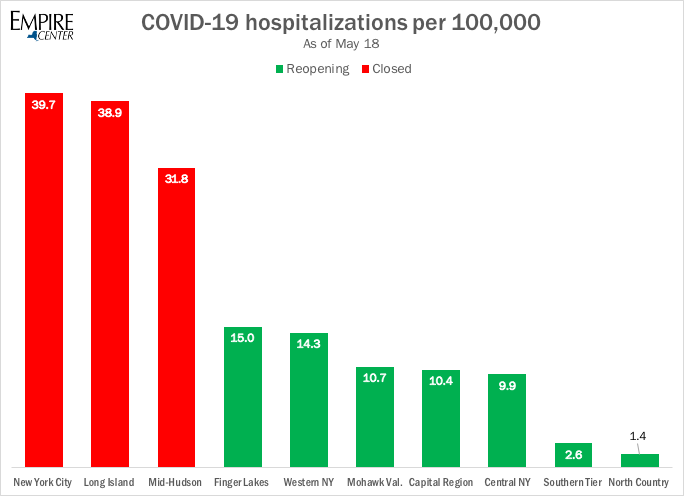
Coronavirus hospitalizations are surging in parts of upstate, including three regions that the Cuomo administration authorized to begin reopening today.
Over the two-week period from May 5 to May 19, hospitalizations for COVID-19 increased by 39 patients or 30 percent in the Finger Lakes, by 40 patients or 91 percent in Central New York, and by 10 patients or 48 percent in the Mohawk Valley, according to state figures (see first chart below).
For the Finger Lakes and Central New York, the May 18th numbers were the highest since the outbreak began.
This is an installment in a special series of #NYCoronavirus chronicles by Empire Center analysts, focused on New York’s state and local policy response to the Coronavirus pandemic.
The population-adjusted hospitalization rate in each of those regions remains low compared to downstate hot spots, and statewide hospitalizations have fallen by more than two-thirds since their mid-April peak (see second chart).

However, the local upward trends suggest that the outbreak is not yet abating in all parts of the state – and raise questions about the coherence of the state’s reopening plan.
That plan, known as New York Forward, spells out seven criteria that each region must meet before beginning a phased rollback of social-distancing restrictions. The criteria are based in part on federal reopening guidelines from the Centers for Disease Control and Prevention – one of which calls for a “downward trajectory (or near-zero incidence) of documented cases over a 14-day period.”
Echoing that standard, one of the state’s criteria lays out a two-part test: A region must either show “a sustained decline in the three-day rolling average of total net hospitalizations … over the course of a 14-day period,” or it must show that its hospitalizations have not increased by more than 15 in a single day.
The second part seemed like an escape valve for low-virus areas, but it has turned out to be pivotal for almost all of upstate New York.
Of the seven regions authorized for reopening, only the least affected area, the North Country, has achieved a sustained decline over 14 days. The other six qualified based on not having had an increase greater than 15 in a single day.
Originally, the rule said regions must never have had such a spike from the onset of the pandemic, which initially disqualified the Capital Region and Western New York. Last week, the Cuomo administration abruptly changed that rule so that it applied only to spikes that happened since May 15, which allowed all seven upstate regions to reopen.
In four of those seven, including the Capital Region and Western New York, hospitalization rates were generally trending down, some more steadily than others. But the Finger Lakes, Central New York and the Mohawk Valley were given the green light even though their hospitalization rates were clearly surging.
There’s room for disagreement about where state officials should draw the line for reopening, and a case to be made for leniency in enforcing those guidelines. Other states that have relaxed restrictions have not yet seen the feared spikes in infections or deaths.
By moving forward in areas with rising hospitalization rates, however, the Cuomo administration is taking a calculated risk – and should be clearer about its thinking, especially with residents of the affected areas.
Among the factors to be weighed is that hospitalizations are a lagging indicator. The people being admitted have likely been sick for several days, and were probably exposed days before that. The number of people in the hospital is also the tip of a much larger iceberg of infections, which in some parts of the state has clearly been growing.
Another thing to watch is the number of positive tests. This metric is not currently part of the state’s reopening criteria, and it can be unreliable because it tends to rise and fall based on how many tests are performed. That said, there are only three regions where the number of positive tests increased over the past two weeks – and the Finger Lakes is one of them (see third chart).

About the Author

You may also like

New York’s Health Premiums Stayed at the Top in 2025
New Yorkers and their employers paid the highest health premiums in the lower 48 states in 2025, and their costs moved further above the U.S. average, according to recently released federal data.
Read More

NY’s Medicaid Fraud Watchdog Shows Declining Performance
Enforcement by the New York's Office of Medicaid Inspector General has dropped in recent years across a range of benchmarks – a sign that the state's anti-fraud efforts have slackened even as its Medicaid spending soared. Read More
The Attorney General’s MFCU SNAFU
Attorney General Letitia James' latest fight with the Trump administration focuses on New York's Medicaid Fraud Control Unit, a federally funded agency housed in James' office.
On T Read More
Healthcare Revelations in the Enacted Budget Financial Plan
The state financial plan published on June 10 disclosed key information about healthcare revenue and spending that lawmakers had not made public when approving the annual budget two weeks before.
Read More
Federal Suit Traces Medicaid Fraud to the Top of NYS Government
The Trump administration's latest salvo against Medicaid fraud takes aim at a different kind of target – two high-ranking New York officials along with a major state contractor.
A Read More

Healthcare Highlights in the New State Budget
Governor Hochul's focus on affordability seems to have skipped over the healthcare portions of the new state budget.
The deal finalized May 27 Read More

Lawmakers Consider Hiking Fees for Filling Prescriptions
UPDATE: The proposal discussed below passed the Assembly Friday evening by an unofficial vote of 133-0. Having previously been approved by the Senate, the bill will head to Governor Hochul's desk for her signature or ve Read More
Budget Deal Reportedly Earmarks $100M for 1199 and Extends MCO Tax
As Governor Hochul and legislative leaders rush to finalize the overdue state budget, outlines of some healthcare-related deals have begun to emerge from the closed-door negotiations.
Read More