

A new report from the Empire Center shows New York public schools are on track to experience the largest decline in enrollment since 1981, with 66,424 fewer K-12 students—a 2.6 percent drop—as compared to the 2019-20 school year.
“Though public school enrollment in New York has been gradually declining since 2011, the reduction in enrollment between this year and last marks a significant acceleration of that trend,” Empire Center fellow Ian Kingsbury noted.
The report, based on preliminary data released by the New York State Department of Education, shows the vast majority of enrollment losses from 2019-20 to 2020-21 occurred in grades K-6.
Changes in enrollment varied significantly according to a student’s economic status. Enrollment among students classified as economically disadvantaged decreased by 3.9 percent. However, among students not categorized as economically disadvantaged, enrollment increased by 2.9 percent. There were also substantial changes in enrollment according to school type. Charter school enrollment increased by 7.4 percent, while traditional public school enrollment decreased by 3.2 percent.
A significant number of students are persistently absent from virtual learning, meaning the real number of students that have functionally exited New York public schools is likely higher than the preliminary estimate provided by the State Education Department.
“Preliminary enrollment data indicate that the Covid-19 pandemic and related school closures have accelerated recent trends in declining enrollment,” Kingsbury added. “While these numbers are historic, they likely fail to capture the true number of students to have functionally exited the New York public education system.”
Read the full report here.
The Empire Center, based in Albany, is an independent, not-for-profit, non-partisan think tank dedicated to promoting policies that can make New York a better place to live, work and raise a family.
You may also like

Switching to Electric Home Heating Could Add Thousands to Energy Bills
FOR IMMEDIATE RELEASE: ALBANY, N.Y. that heating an average home from October to March would cost approximately $790 with natural gas, compared with $1,100 with a heat pump and $3,300 with electr Read More

Poll: 64% of New Yorkers Back Eliminating the State Income Tax; 67% Say State Taxes Aren’t Delivering
Dissatisfaction spans party and regional lines as broad majorities rally behind sweeping tax reform
FOR IMMEDIATE RELEASE: ALBANY, N.Y. - New Yorkers are delivering a blunt assessment of the state’s tax system: 67% say they ar Read More
SUNY Research Foundation Payroll Tops $400 Million
Payroll records for 8,401 employees of the Research Foundation for the State University of New York (RF SUNY) for fiscal year 2026 are , the Empire Center's government transparency website.
The Research Foundation is a private, nonprofit educational co Read More

Newly Retired NYC Firefighters Average Over $177k In Pensions
New York City firefighters and fire officers retiring last year after full careers were entitled to average annual pension benefits of $177,016, according to , the Empire Center's government transparency website.
Among the 499 new retirees with at leas Read More
New York Annual Household Electricity Costs Rise $270
FOR IMMEDIATE RELEASE ALBANY, N.Y. — New York’s average residential electricity price reached 29.90 cents per kilowatt-hour (kWh) in July 2026, the fifth highest in the nation and 63.3 percent Read More
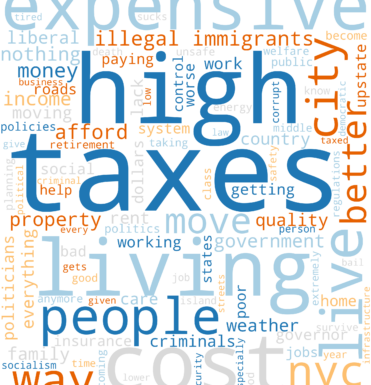
Taxes, the Cost of Living, and Feeling Ignored: Why New Yorkers Are Thinking of Leaving
FOR IMMEDIATE RELEASE ALBANY, N.Y. - New Yorkers across the political spectrum are considering leaving the state. A new finds that Republicans and independent voters most often cite taxes as the reason, while Dem Read More
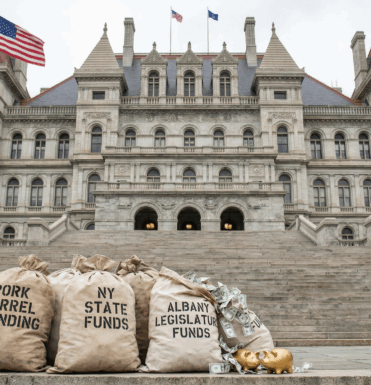
Albany Steers Nearly $100 Million in 2026 Pork Barrel Spending
Albany steered $97.2 million to 206 local projects during the first half of 2026 in the newest batch of state discretionary grants, according to. The new tranche is the latest addition to the pork-barrel grant database the Empire Center h Read More

New York’s Electricity Prices Fifth Highest in the Country
FOR IMMEDIATE RELEASE
ALBANY, N.Y. — Empire Center’s shows New York households paid the fifth‑highest residential electricity prices in the country in June 2026, trailing only Hawaii, California Read More