

A puzzling pattern has emerged from New York’s latest wave of the pandemic: Downstate hospitals are dealing with the lion’s share of COVID patients, but upstate hospitals are the ones running out of beds.
The paradox was highlighted on Tuesday when Governor Hochul ordered a halt to elective procedures in the Finger Lakes, Central New York and the Mohawk Valley, where the recent omicron surge has been relatively mild so far, because hospitals in those regions had collectively exceeded 90 percent of their capacity.
Meanwhile, hospitals in the areas hit hardest by omicron – New York City and its surrounding suburbs – are reporting occupancy rates low enough to remain fully operational under Hochul’s policy (see first chart).
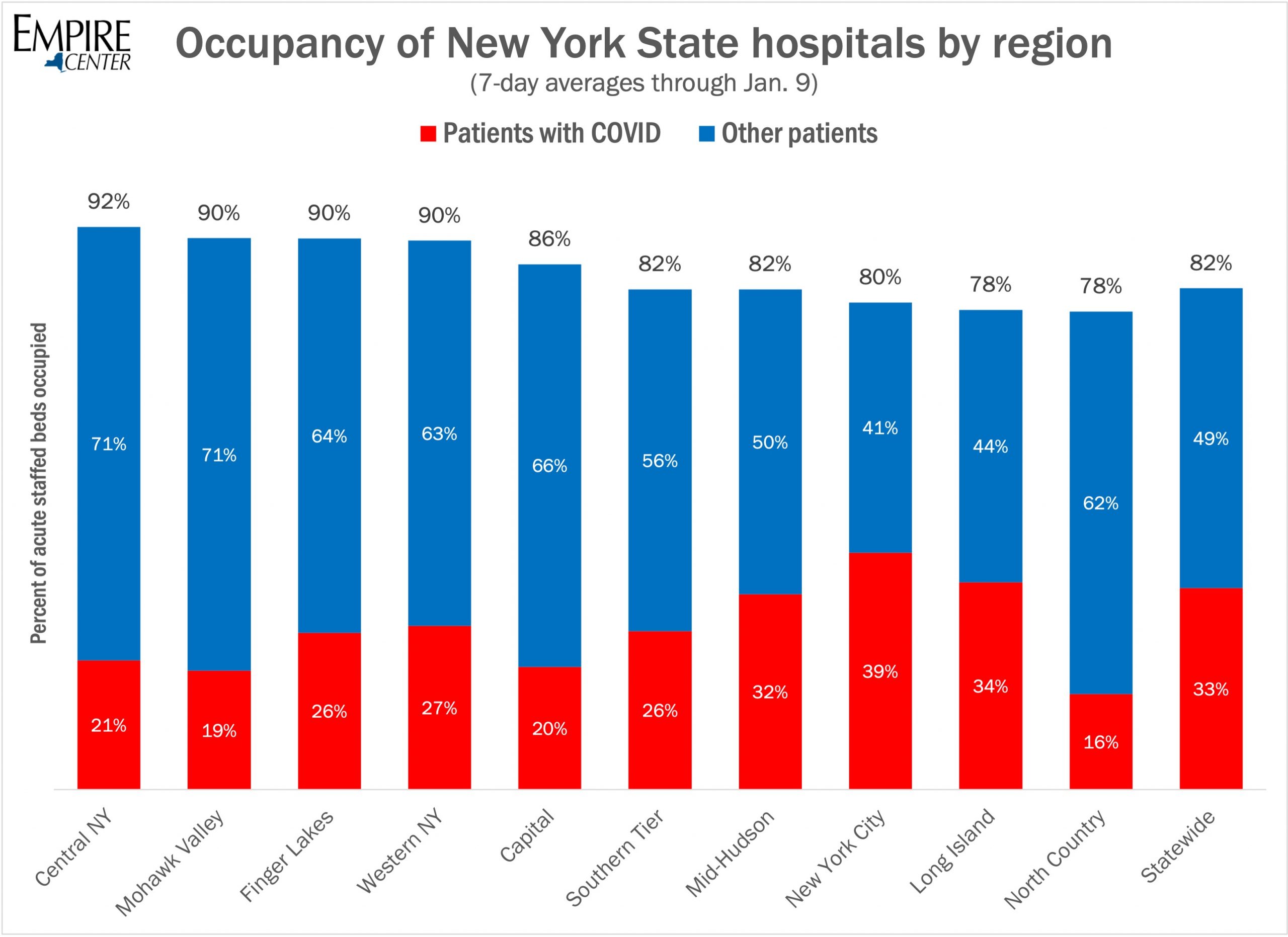
Source: NYS Department of Health
The contrast raises questions about the usefulness and accuracy of the metrics the state is using to track the pandemic in hospitals.
Among the many data points collected by the state, hospitals are required to report on a daily basis both the number of “staffed acute care beds” they have available, and how many of those beds are occupied by patients, whether diagnosed with COVID or not.
When more than 90 percent of beds fill up – either for an individual hospital or in aggregate for all hospitals in a region – the Hochul administration’s policy calls for them to suspend non-emergency procedures as a precaution against running out of space. This can be financially costly for hospitals, because elective procedures are an important source of revenue.
The capacity data from different regions have shown a stark contrast. Upstate, COVID hospitalizations have remained relatively low and there has been no significant increase in the overall number of patients. What appears to have caused the capacity crunch is a 23 percent drop in the number of available beds, which hospital officials attribute to a loss of staff (see second chart).
Downstate, meanwhile, COVID hospitalizations have spiked dramatically, but the state’s data indicate that the number of available beds has held relatively stable and occupancy rates have remained comfortably below 90 percent in most institutions (see third chart).

Source: NYS Department of Health

Source: NYS Department of Health
One possible factor behind these regional differences could be the state-imposed vaccine mandate for health-care workers, which was ordered by former Governor Andrew Cuomo and implemented by Hochul – and which might have been less popular upstate than downstate.
However, the number of upstate beds started its noticeable downward trend on July 25, three days before Cuomo announced an initial mandate for employees of state-operated hospitals.
That said, some workers later left their jobs rather than accept vaccination, and upstate hospital officials warned that requiring workers to get a vaccine booster – as a state panel voted to do on Tuesday – could exacerbate their staffing shortages.
There also could be regional differences in how hospitals report their data to the Health Department. According to hospital workers quoted in Crain’s New York Business this week, some New York City institutions have been overstating how many empty beds they have available – possibly to avoid triggering a shutdown of elective procedures.
Another possible issue is the growing number of patients who test positive for COVID-19 after entering the hospital for another reason. These “incidental” cases – which account for more than 40 percent of the state’s COVID inpatients – would have made New York City’s hospitalization surge appear bigger than it really was.
About the Author

You may also like

New Poll Shows New Yorkers Want Cheaper Energy — RGGI’s Price Record Shows They Aren’t Getting It
Editor's note: Roger Caiazza is an adjunct fellow at the Empire Center. He has a long and deep private industry background in environmental regulatory analysis and compliance. His frequently updated personal blog on New York Read More

New York’s Health Premiums Stayed at the Top in 2025
New Yorkers and their employers paid the highest health premiums in the lower 48 states in 2025, and their costs moved further above the U.S. average, according to recently released federal data.
Read More

NY’s Medicaid Fraud Watchdog Shows Declining Performance
Enforcement by the New York's Office of Medicaid Inspector General has dropped in recent years across a range of benchmarks – a sign that the state's anti-fraud efforts have slackened even as its Medicaid spending soared. Read More
The Attorney General’s MFCU SNAFU
Attorney General Letitia James' latest fight with the Trump administration focuses on New York's Medicaid Fraud Control Unit, a federally funded agency housed in James' office.
On T Read More
Healthcare Revelations in the Enacted Budget Financial Plan
The state financial plan published on June 10 disclosed key information about healthcare revenue and spending that lawmakers had not made public when approving the annual budget two weeks before.
Read More
Federal Suit Traces Medicaid Fraud to the Top of NYS Government
The Trump administration's latest salvo against Medicaid fraud takes aim at a different kind of target – two high-ranking New York officials along with a major state contractor.
A Read More

It Is Time to Rethink the Regional Greenhouse Gas Initiative
Before budget negotiations, Gov. Hochul warned that unless New York changes its climate plans, New Yorkers could face a $2.26-per-gallon increase in gasoline prices. The reason is the so-called “cap-and-invest” scheme, under which energy companies wou Read More

Healthcare Highlights in the New State Budget
Governor Hochul's focus on affordability seems to have skipped over the healthcare portions of the new state budget.
The deal finalized May 27 Read More