

The push in Albany to boost wages for home health aides is seemingly disconnected from the larger realities of the state’s long-term care system.
As they lobby for a big increase in Medicaid funding, officials in the home care industry are warning that the state faces an “extreme shortage” of in-home caregivers due to low pay.
What they don’t mention is that New York’s home care workforce is extraordinarily large and well-funded by national standards – and growing at an explosive rate.
Any labor shortages that still exist are a sign of deeper problems in the state’s home-care program that a wage hike alone could not fix.
At issue is the Fair Pay for Home Care Act (S. 5374 (May)/A. 6329 (Gottfried), , which would require that home health aides be paid at least 50 percent more than the minimum wage, plus an allotment for benefits.
The additional cost to the state’s Medicaid program, which finances most home care, has been estimated at $4 billion a year. That’s enough to cover a year’s tuition and living expenses for 154,000 SUNY students, buy health insurance for 488,000 individuals or pay the salaries of 50,000 schoolteachers.
The bill is a top priority of the health-care workers union 1199 SEIU, which is one of Albany’s most influential interest groups, and has broad, bipartisan support in both houses of the Legislature.
Before moving forward, lawmakers should consider the following context from the Bureau of Labor Statistics:
- New York’s per capita employment of home health and personal care aides is 140 percent higher than the national average and 30 percent higher than that of any other state (see chart).
- New York’s home health workforce grew by 230,000 over the past decade, almost doubling in size, making it one of the fastest-growing jobs in the state.
- Unlike the state’s overall job count, home health employment has fully bounced back from its losses during the pandemic and stands almost 16,000 higher now than it was in March 2020.
- Although wages are low, they have not been static. The average hourly pay of home health aides in New York was $15.45 in 2020, an increase of 43 percent since 2010.
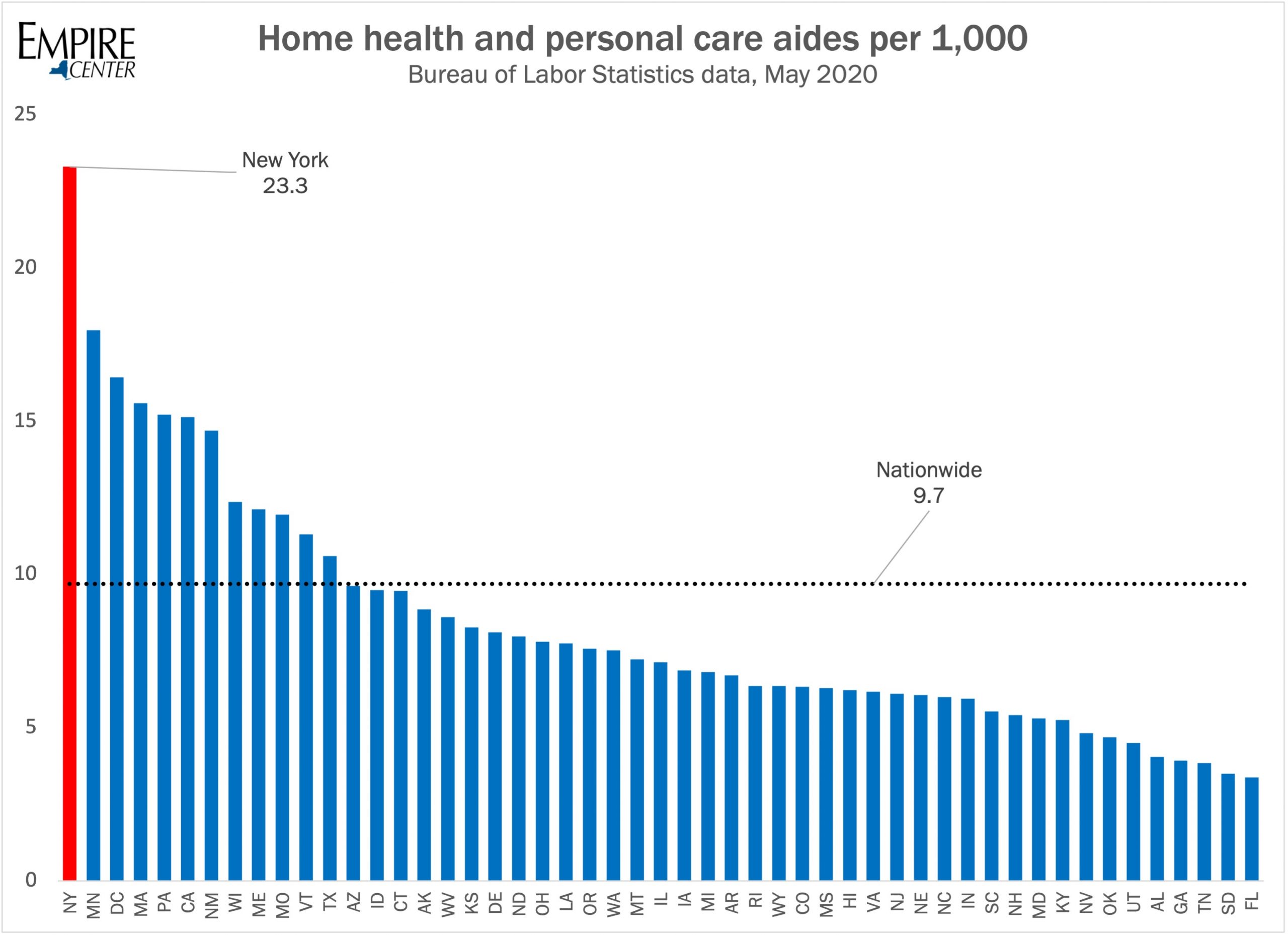
New York’s spending on home care is also skyrocketing. Over the past decade, Medicaid expenditures on the services known as personal assistance, which are the bulk of home care, quadrupled from $3.2 billion to $12.8 billion. As of 2019, the last year for which national data are available, New York’s per capita spending on personal care was almost eight times higher than the national average and almost three times higher than any other state.
The growth rates of spending and employment far exceed the increase in the state’s over-65 population, which rose 30 percent from 2010 to 2020.
The state’s home care program is heavily concentrated in New York City. In the two relevant job categories, there are roughly three workers for every 10 city residents over age 65, which is almost four times the national average. Outside New York City, the employment rate is slightly lower than the national average (see chart).

Industry officials report that the minimum wage hike enacted in 2016 has made it harder for them to compete for workers with fast-food chains and retail stores. According to labor data, however, home care employment has continued growing at a robust pace since 2016, even as the number of fast-food and retail jobs has declined (see chart).
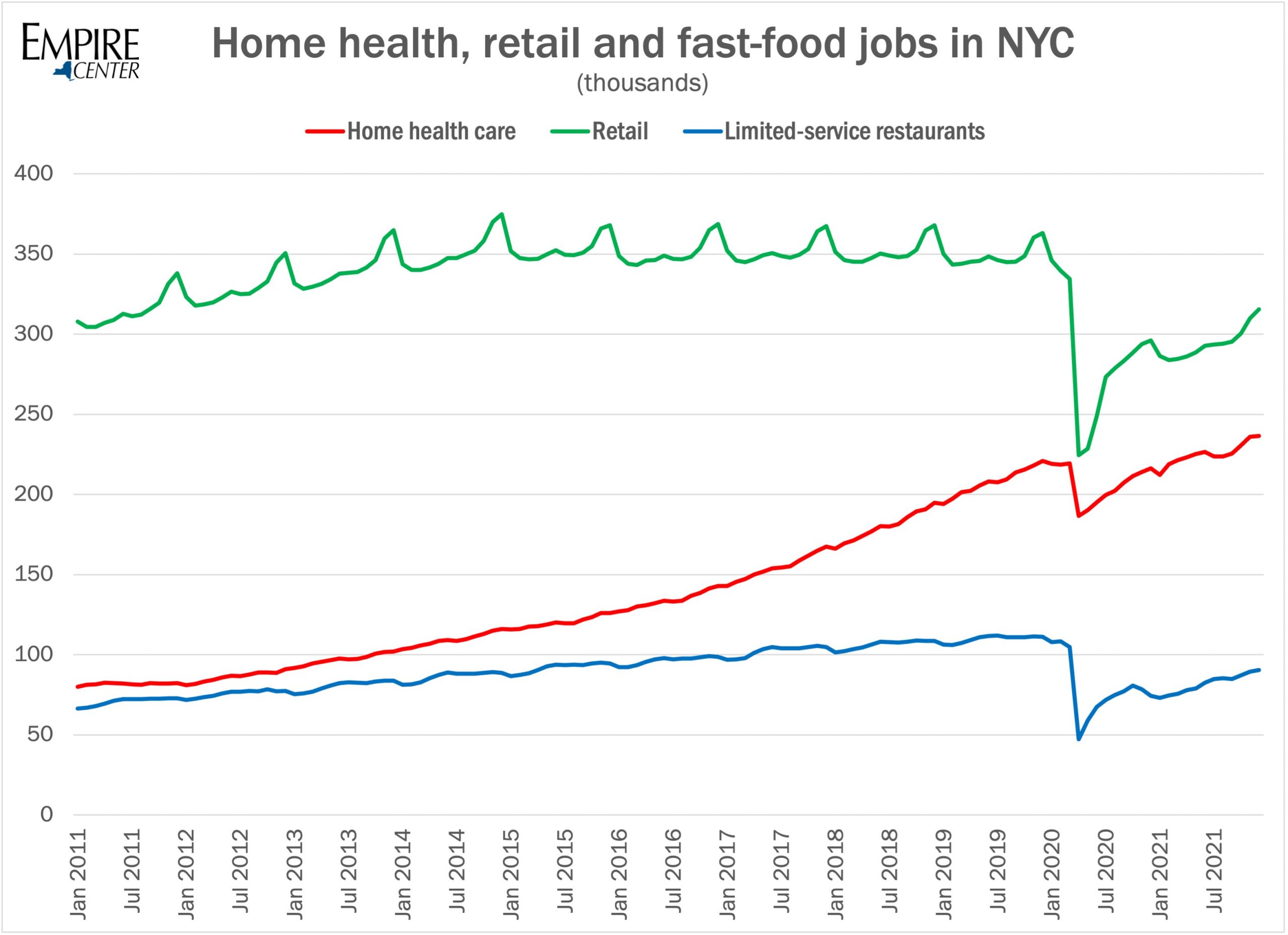
These trends suggest that any shortage of labor in the home care industry is driven not by low wages, but by a level of demand that is unusually high by national standards – especially in New York City – and continues to rise to unprecedented heights.
Rather than simply pouring more money into an extraordinarily expensive program, lawmakers should focus on what appears to be excessive utilization of home care services – by tightening eligibility rules and screening procedures, allocating resources more even-handedly around the state, and improving enforcement against abuse and fraud.
About the Author

You may also like

NY’s Medicaid Fraud Watchdog Shows Declining Performance
Enforcement by the New York's Office of Medicaid Inspector General has dropped in recent years across a range of benchmarks – a sign that the state's anti-fraud efforts have slackened even as its Medicaid spending soared. Read More
The Attorney General’s MFCU SNAFU
Attorney General Letitia James' latest fight with the Trump administration focuses on New York's Medicaid Fraud Control Unit, a federally funded agency housed in James' office.
On T Read More
Healthcare Revelations in the Enacted Budget Financial Plan
The state financial plan published on June 10 disclosed key information about healthcare revenue and spending that lawmakers had not made public when approving the annual budget two weeks before.
Read More
Federal Suit Traces Medicaid Fraud to the Top of NYS Government
The Trump administration's latest salvo against Medicaid fraud takes aim at a different kind of target – two high-ranking New York officials along with a major state contractor.
A Read More

Healthcare Highlights in the New State Budget
Governor Hochul's focus on affordability seems to have skipped over the healthcare portions of the new state budget.
The deal finalized May 27 Read More
Budget Deal Reportedly Earmarks $100M for 1199 and Extends MCO Tax
As Governor Hochul and legislative leaders rush to finalize the overdue state budget, outlines of some healthcare-related deals have begun to emerge from the closed-door negotiations.
Read More

Four Problems with a Statewide Pied-à-Terre Tax
Soon after Governor Hochul floated the idea of a "pied-à-terre" tax in New York City, Albany Sen. Patricia Fahy proposed to expand the concept to the rest of the state.
As with H Read More

Albany Should Listen to Jamie Dimon
In his annual message to shareholders, JP Morgan Chase's chief executive, Jamie Dimon, offered a timely and pointed warning for New York policymakers.
It's worth , with emphasis add Read More