

ALBANY, NY — Despite persistent claims to the contrary, New York’s legislative employees are not eligible to unionize under the state’s sweeping public-sector collective bargaining law, commonly known as the Taylor Law, according to a new report from the Empire Center.
In “Hemmed Out: Why Legislative Employees Can’t Unionize Under the Taylor Law,” Empire Center fellow Ken Girardin looks at the law’s history, revealing that lawmakers had no intention of applying it to themselves, and by extension, their own staff.
Employers covered by the Taylor Law—including executive branch agencies, public authorities, local governments and school districts—are required to recognize and bargain with unions and bound to contract terms negotiated under rules policed by the state Public Employment Relations Board (PERB). But the Legislature didn’t originally intend Taylor Law coverage to extend to its own employees, and has not since chosen to put them under its umbrella.
“Legislative employees have a constitutionally protected right to form an association and petition state lawmakers for better working conditions,” Girardin explained, “but the facts simply don’t support their claim that state lawmakers passed the Taylor Law in 1967 thinking it would apply to them.”
A group of state senate employees contended earlier this year that the Taylor Law applied to the Legislature. City & State reported earlier today that 25 of the 63 senators and senators-elect poised to take office in January had signed a “statement of solidarity” endorsing the unionization effort. “The Taylor Law is the single most onerous unfunded mandate that Albany inflicts on local governments and school districts. It might be fitting for senators and assemblymembers to have to live under it for a time, but history indicates that was never meant to be the case,” Girardin continued.
The report concludes with an explanation on how the Legislature could address concerns raised by employees within its existing rules without running into the practical or constitutional issues that would come with working under the Taylor Law.
Read the full report here.
The Empire Center, based in Albany, is an independent, not-for-profit, non-partisan think tank dedicated to promoting policies that can make New York a better place to live, work and raise a family.
You may also like
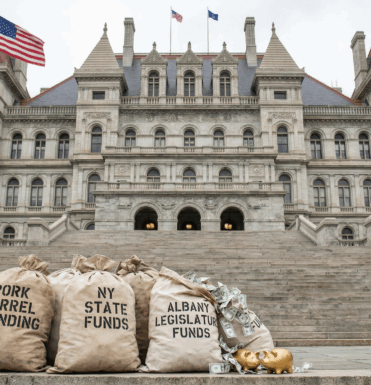
Empire Center Breaks Down Albany’s Pork Barrel Spending
Albany legislators steered over $83 million in grants to 293 local projects between April and December 2025 , according to under a Freedom of Information Law request.
The governor and state legislators hand-picked the grantees for mor Read More

State Lawmakers Spend $268 Million on Legislative Operations
Spending by state lawmakers on office personnel and administrative costs varies widely, with some paying out nearly twice as much as others on their office operations, according to the most recent reported, posted to SeeThroughNY.net.
Read More

Teacher Pensions Added to SeeThroughNY Include 26 Over $300k
New York’s two teacher pension systems last year had 26 retirees eligible to collect pensions of more than $300,000, according to , the Empire Center’s government transparency website.
Data reported from Teachers’ Retirement System of the City of Read More

The Empire Center Comments on the Budget Deal in Albany
As Governor Hochul and legislative leaders belatedly released details of their agreement on a state budget for fiscal year 2026, the Empire Center released a statement from its Senior Fellow for Health Policy, Bill Hammond: Read More

Five Years After Janus, Union Membership Sinks in NY State Agencies
About 15 percent of unionized New York state government workers chose not to pay union dues last year, up from 10 percent in 2020, according to a new research report from the Empire Center. Read More

Empire Center Issues State Policy Guide
The Empire Center for Public Policy has released a policy guide and briefing book focused on the most important issues confronting New York. Read More

Legislative Spending Unevenly Divided Among Members
Spending by state lawmakers on office personnel and administrative costs varies widely, with some paying out nearly twice as much as others Read More

Budget Testimony: Tax Outmigration Set to Accelerate
Governor Hochul’s executive budget risks accelerating the trend of high-earning New Yorkers fleeing the state. Read More