

Contact: 518.434.3100
New York’s public-sector employees have been promised $250 billion in post-retirement health benefits that the state and its local governments have set aside no money to pay for, according to updated figures released today by the Empire Center for Public Policy. These obligations have increased by $45 billion since the Empire Center first reported on them in 2010.
Like defined-benefit pensions, retiree health coverage is a form of deferred compensation commonly available to government employees — but not to the vast majority of private-sector workers, the report says. Unlike pensions, which are at least partially pre-funded through large investment pools, retiree healthcare is financed out of annual government budgets on a “pay as you go” basis. Benefits differ by employer, with most allowing their retirees to remain in the employee health insurance plan, paying only a fraction of the premium, after just five to 15 years of service. A new government accounting standard, known as GASB 45, is requiring the state and local governments to calculate and disclose the long-term costs of keeping all of their retiree health care promises.
The Empire Center report—entitled “Iceberg Ahead: The Hidden Cost of Public-Sector Retiree Health Benefits in New York”— provides the first statewide survey of unfunded retiree health care liabilities for New York State and its largest counties, cities, towns, villages and school districts. Liabilities detailed in the report include:
$73 billion for New York State, including the State University of New York and City University of New York;
$84 billion for New York City;
$17 billion for the state’s 20 largest counties;
$7.4 billion for the 20 largest school districts;
$5.5 billion for the state’s 15 largest cities outside New York City;
$2.9 billion for the state’s 15 largest towns;
$819 million for 11 of the state’s largest villages; and
$19 billion for New York’s five largest public authorities.
GASB 45 liabilities for all other New York governments bring the total to $250 billion, the report estimates. “The retiree health care iceberg is getting bigger and more dangerous with each passing year,” said author E.J. McMahon, a senior fellow with the Empire Center and the Manhattan Institute. “If elected officials don’t act soon to shrink this problem, it could eventually sink us.”
The report concludes with a series of recommendations for curbing costs, including:
Preserve health benefits for employees who have already retired, but require them to pay a larger share of their own premiums.
Reserve the greatest benefit to those who have worked the longest.
Allow trust funds to cover adjusted OPEB liabilities, but calculate required contributions to these funds based on assumed returns from conservative, low-risk investment strategies.
Eliminate retiree health insurance coverage for new hires and for employees who have been on the payroll for less than 10 years, and shift these workers into retirement medical trusts.
Click here for a PDF version of this release.
You may also like
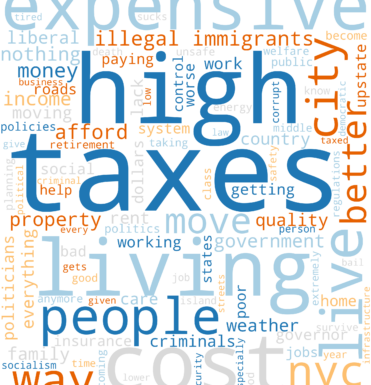
Taxes, the Cost of Living, and Feeling Ignored: Why New Yorkers Are Thinking of Leaving
FOR IMMEDIATE RELEASE ALBANY, N.Y. - New Yorkers across the political spectrum are considering leaving the state. A new finds that Republicans and independent voters most often cite taxes as the reason, while Dem Read More
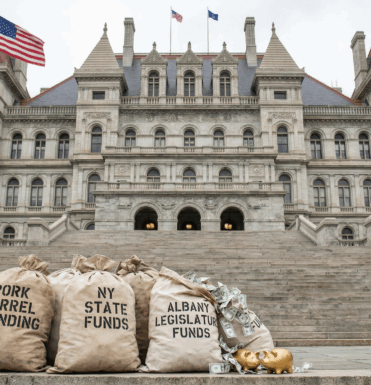
Albany Steers Nearly $100 Million in 2026 Pork Barrel Spending
Albany steered $97.2 million to 206 local projects during the first half of 2026 in the newest batch of state discretionary grants, according to. The new tranche is the latest addition to the pork-barrel grant database the Empire Center h Read More

New York’s Electricity Prices Fifth Highest in the Country
FOR IMMEDIATE RELEASE
ALBANY, N.Y. — Empire Center’s shows New York households paid the fifth‑highest residential electricity prices in the country in June 2026, trailing only Hawaii, California Read More

Nine Millionaires among NY’s Public Authorities in 2025
Nine millionaires, all healthcare executives, emerged among the 88,228 New York public authority employees, according to, the Empire Center’s transparency website.
The data includes payroll information from 385 different agen Read More
132 NYSLRS Retirees Receive Pensions Over $200K in FY2026
A total of 132 retirees from the New York State and Local Retirement System (NYSLRS) were eligible to collect $200,000 or more in pensions during the 2026 fiscal year, according to , the Empire Center’s government transparency website.
Among the 132 Read More
Empire Center Poll: Just 4 Percent Approve of New York’s Education System
ALBANY, N.Y. — New Yorkers gave the state’s education system a sweeping vote of no confidence: 47 percent said the state should improve student performance, 41 percent said it should improve performance while spending less, and only 4 Read More
New York’s electricity prices climb to third highest in the U.S.
FOR IMMEDIATE RELEASE
ALBANY, N.Y. — Empire Center’s shows New York households paid the third-highest residential electricity prices in the country in May 2026, trailing only Hawaii and California.
The latest U.S. Energy Information Administra Read More
Port Authority Payroll Passes $1.2B as 20 Employees Collect $400k+
Twenty Port Authority of New York and New Jersey (PANYNJ) employees collected more than $400,000 each in total pay last year, while average pay agencywide rose three percent, according to , the Empire Center’s government transparency website.
The Por Read More