

CONTENTS
Why we fight
How we win
What we focus on
Taxes
Energy
Education
Spending taxpayer money
Healthcare
Doing business in New York
DONATE
WHY WE FIGHT
I grew up in the Soviet Union. I saw government-run grocery stores firsthand. I never imagined I would one day have to make the case against them in New York City, of all places. But here we are.
Socialists are using New York taxpayers’ resources to promote socialism as an idea and turn socialist policies into law. They are not merely invoking phrases like taking over the “means of production”— language lifted straight from Marx.
They want government ownership of the means of production. Their belief that government should run nearly everything, even grocery stores, is a perfect example of that vision.
They are already talking about waiving rent and exempting government grocery stores from taxes—a massive subsidy that would tilt the playing field. Despite railing against “big business,” these stores would compete directly with small businesses and corner shops.
If you think government grocery stores will simply collapse under the weight of their own incompetence—and there will be plenty of incompetence—I would not bet on it.
Previous failed experiments with government grocery stores across the U.S. had narrower aims: revitalizing downtowns, expanding access to healthy options, or filling gaps in underserved areas.
They were not built to prove an ideology.
The goal in NYC is different: to prove that government ownership of the means of production works.
No taxpayer resources will be spared to prop up these stores, and every failure will be recast as evidence of success. Government grocery stores lose money? That will be cited as proof they are not “price gouging.”
Stores are closed on weekends or during hours convenient for shoppers? That will be framed as proof they do not exploit workers.
Subsidized government stores drive corner shops out of business? That will be treated as proof that the government model is superior.
Even the most mundane occurrence—a discount on a single item, for example—will be trumpeted as an extraordinary triumph.
Expect Orwellian spin from a taxpayer-funded media operation. Expect activists rallying in your town for government groceries.
This is not about groceries. It is about a fundamental question: who should make decisions in this country—the people or the bureaucrats? Who should set the price of eggs—the shopkeepers or City Hall?
If you believe this question matters, then we are allies in the fight for the future of this state—and this country.
We have not lost yet.
Many New Yorkers oppose this agenda. We can stop it.
We will fight these bad ideas in public debate. We will provide reporters with facts and figures. We will track and expose bad bills in the legislature. We will give lawmakers the research and facts they need to see that more government is not the answer.
We will pitch reform packages for taxes, energy, education, and other areas where New York performs dismally.
We will show why our ideas are better.
When I joined Empire Center, I said that I don’t want to just document the decline of New York – I want to do something about it. I have not changed my mind.
HOW WE WIN
Persuasion is our lever for change.
We do not vote on bills, run agencies, or bus crowds to Albany. But we do contribute to what lawmakers, reporters, and voters understand to be true, urgent, and right.
Changing New York starts with showing New Yorkers that there is a better way than what Albany offers. That is the Empire Center’s role: we bring clear ideas, hard facts, and reliable data into the public debate—and make sure the media, lawmakers, and the public cannot ignore them.
We often play defense, which means stopping bad ideas before they become laws. We track harmful bills, expose their costs, contact legislators and reporters, and make sure Albany’s bad ideas do not move quietly. Our job is to make destructive proposals harder to defend, ignore, and pass.
But we also go on offense, which means expanding what is politically possible in New York. We find data, craft research, shape media coverage, and give legislators usable proposals. Our goal is not merely to react to Albany’s agenda, but to challenge the assumption that New York is doomed to bigger government, higher taxes, and powerless citizens.
Our Energy Dashboard shows that work in action. It gives New Yorkers clear evidence that electricity prices here are rising, that most other states are doing better, and that Albany’s excuses do not hold up. The problem is not data centers, the federal government, foreign conflicts, or other outside forces. It is New York’s own energy policy.
Highlight: How our research on electricity prices rippled through Albany
We’ve been fact-checked and argued with, but our message is breaking through. Energy Data Bulletin has been covered by news outlets across the state and has helped legislators to argue for policy change.
Public opinion is moving in the same direction. Our latest poll found that two-thirds of New Yorkers oppose paying higher energy prices to reduce greenhouse gas emissions. We will make sure that this message is heard by candidates this election year.
WHAT WE FOCUS ON
TAXES
Many New Yorkers resent high taxes, and many choose to leave rather than keep paying them. Yet New York’s political class treats higher taxes as inevitable.
The debate centers on high taxes vs. even higher taxes. We will change that.
First, our research and media work will show how high taxes punish families, drive away businesses, weaken the economy, and make New York less competitive. We will make high taxes a major public concern.
Second, we will track every bill that raises taxes, call it out publicly, and make sure lawmakers and reporters know why that bill is a bad idea. No hike will move quietly.
Third, we will craft proposals to lower taxes. Even if they do not pass immediately, they will present an alternative to Albany’s groupthink. We will gather support, and force Albany’s tax-hike coalition to play defense.
Explore more of our work in TAXES
ENERGY
Energy is expensive, and New York does not have enough of it. The state is already saying “no” to new businesses because it lacks generation and transmission capacity. The one-year ban on new data centers looks like the first step toward energy rationing.
Our monthly Energy Data bulletin already shows that other states are meeting energy challenges more effectively than New York. Our analysis and legislative memos will dismantle bills that drive up prices and reduce choice. Our polling will warn legislators that voters do not want expensive, radical policies.
Public dissatisfaction with New York’s energy policy is already measurable. We will continue to highlight the consequences of current policies and make the case for reforms.
We are expanding our collaboration with research partners and legislators and crafting our own legislative proposals for the 2027 session.
Explore more of our work in ENERGY
EDUCATION
New York spends more per pupil than any other state and more than many countries, yet is outperformed by Mississippi and Alabama, not to mention Massachusetts.
Worse, most New Yorkers do not know how poorly the system performs, and many believe their children receive a high-quality education.
Our polling shows that 97 percent of New Yorkers support major reforms once they understand the gap between what taxpayers spend and what students receive. That creates a powerful opening for action.
We will bring the truth about New York’s schools to parents, taxpayers, and local leaders in every district. We will show what schools spend, what students achieve, and how better alternatives can deliver stronger results at lower cost. Our K-12 SOS reports will give New Yorkers the facts and drive change.
Explore more of our work in EDUCATION
SPENDING TAXPAYER MONEY
Albany’s budget process is so opaque that even the people who vote for it do not see it until the last minute.
New York’s budget is roughly double Florida’s, despite Florida’s larger population. Some public-sector employees game the system and collect half a million dollars per year.
Consider what this means: some public-sector employees, whose wages are paid by taxpayers, take home more in a single year than many taxpayers’ homes are worth. This is a complete failure of New York’s government to manage taxpayers’ money. It justifies outrage, and it demands change.
Our SEETHROUGHNY database, with millions of spending records, is trusted by reporters and investigators. We will supercharge it with AI and expose government waste across New York. We will confront legislators and candidates with one question: What have you done to stop taxpayer-funded employees from taking home half a million dollars a year?
Explore for of our work in SPENDING TAXPAYER MONEY
HEALTHCARE
Healthcare is already complicated, and New York government interference makes it worse. Safety-net health plans should focus on helping the poor and disabled, but New York has expanded them to cover nearly 40 percent of the state’s population, including many people above the poverty level.
At the same time, New York creates systems that are easy to cheat and then fails to prosecute fraud. Taxpayers and employers pay for that negligence.
Worse, Albany has only one answer — more government in healthcare. We will expose how New York’s healthcare programs shift costs onto taxpayers and employers, document where the money goes, and challenge the assumption that government-run healthcare failures require still more government control.
Explore more of our work in HEALTHCARE
DOING BUSINESS IN NEW YORK
Business is difficult to begin with, but New York’s government makes it borderline impossible.
If you are trying to make a living without dipping into the taxpayers’ purse, the state seems determined to hinder you.
New York businesses must compete with places that have lower taxes, wages, and energy costs, while also dealing with harmful regulations not found elsewhere. Beyond our everyday work defending private enterprise, we will launch special research projects, starting with a reform package for New York’s over-litigious business environment.
Explore more of our work in DOING BUSINESS IN NEW YORK
Highlight: Why New York’s Scaffold Law needs to be changed
New York enacted the Scaffold Law, N.Y. Labor Law § 240, in 1885 to safeguard construction workers who found themselves subject to increased danger while working on the city’s skyscrapers and other projects. The law intended to reduce height-related deaths and injuries by mandating the use of safety equipment. Occupational Safety and Health Administration regulations now largely serve this function.
New York Court of Appeals has interpreted the statute to impose “absolute liability” for elevation- or gravity-related risk, such as falls and falling objects, on construction sites, including buildings, bridges, or elevated highways. Over time, courts have vastly expanded this liability.
The Scaffold Law applies in situations that most people would not consider an elevation-related construction risk. Examples include falls from a sixteen-inch tall boulder on a basement floor, a flatbed truck, a ladder when installing carpeting on the walls of a recording studio, and a ladder while disassembling a chupah, a canopy for a Jewish wedding, at a catering hall, and… falls from a sixteen-inch tall boulder on a basement floor
Property owners and contractors named in Scaffold Law claims can defend themselves on the basis that the worker was the sole proximate cause of the accident, but that is an extraordinarily high standard to meet. A worker may be 99% responsible for his or her own accident, but the owner or contractor must still pay 100% of the damages. (read full study here or get the pdf version)
About the Author

You may also like

The fatal flaw in New York’s climate Superfund law
In 2024, the New York state Legislature decided the state needed some money — $75 billion, to be exact — for “comprehensive adaptation to the effects of in New York state.”
The Legislature thought it had found Read More

Long Islanders and Empire Center Debate Homeschooling
Greater Long Island’s recent into the rise of homeschooling sparked quite a debate. Hundreds of readers on Facebook, weighing in on everything from academics and socialization to parental rights, teacher qualifications, a Read More
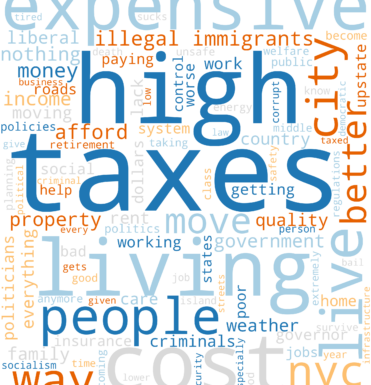
Taxes, the Cost of Living, and Feeling Ignored: Why New Yorkers Are Thinking of Leaving
FOR IMMEDIATE RELEASE ALBANY, N.Y. - New Yorkers across the political spectrum are considering leaving the state. A new finds that Republicans and independent voters most often cite taxes as the reason, while Dem Read More
Leaving New York
Executive Summary
The desire to leave New York is strong and cuts across every demographic group measured in the survey. One-third of New Yorkers have considered leaving the state within the next five years, while another third know some Read More
N.Y. fails education despite spending big
New York’s schools are spending more than ever, but student performance keeps falling.
Unsurprisingly, Empire Center’s latest opinion poll shows with how education is run. They want better results, less spending, and more choice — something th Read More
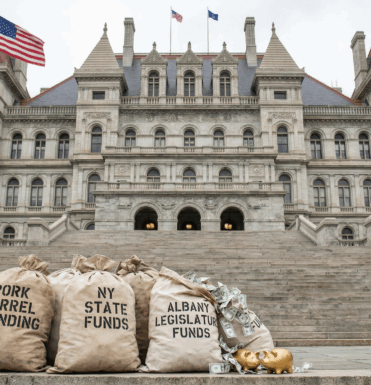
Albany Steers Nearly $100 Million in 2026 Pork Barrel Spending
Albany steered $97.2 million to 206 local projects during the first half of 2026 in the newest batch of state discretionary grants, according to. The new tranche is the latest addition to the pork-barrel grant database the Empire Center h Read More

New York’s Electricity Prices Fifth Highest in the Country
FOR IMMEDIATE RELEASE
ALBANY, N.Y. — Empire Center’s shows New York households paid the fifth‑highest residential electricity prices in the country in June 2026, trailing only Hawaii, California Read More
New Poll Shows New Yorkers Want Cheaper Energy — RGGI’s Price Record Shows They Aren’t Getting It
Editor's note: Roger Caiazza is an adjunct fellow at the Empire Center. He has a long and deep private industry background in environmental regulatory analysis and compliance. His frequently updated personal blog on New York Read More