

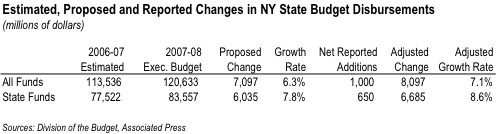
The “state funds” share of New York’s next budget could rise by about 8.6 percent under the preliminary deal announced by Governor Spitzer and legislative leaders. This would rank among the top 10 budget increases in this category over the last 40 years. Including federal funds, the total state budget would grow by more than 7 percent.
These percentage growth estimates are based on the statement released by Governor Spitzer and legislative leaders on Tuesday night, and on news reports containing a few more details of the agreement.
The broad outlines: $850 million will be added to the budget ($350 million in Medicaid, and $500 million in school aid) and about $200 million will be subtracted from state-subsidized property-tax rebates. News reports suggest that the net state-funds spending addition might be as much as $800 million, but there are no official details backing up that figure. Assuming the true total for added spending is the lower figure — $650 million — here is a back-of-the-envelope calculation on how those changes would affect the growth rates originally proposed by the governor:
Adjusting for inflation, the percentage increase in fiscal 2007-08 would come to about 5.9 percent. This would rank ninth among the 10 largest state-funded spending increases in New York since 1968, as shown in the table below.
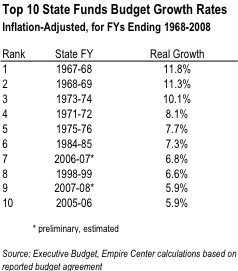
Most of the estimated 2007-08 growth reflects Spitzer’s own Executive Budget proposal. A net legislative spending addition of $650 million, or less than 1 percent of what the governor proposed, would be relatively small by historical standards.
Of course, many details of the budget remain unknown, if not unsettled. The budget negotiation process has, if anything, been murkier than the norm established during George Pataki’s final term.
For the time being, however, here are two observations on the latest turn of events:
- Only $450 million out of the $1.4 billion Medicaid “savings” proposed by the governor involved actual reductions in otherwise scheduled payments to hospitals, nursing homes and other providers. Out of that amount, the most crucial sum was the $73 million to be gained in 2007-08 (growing to $120 million by 2009-10) from “redirecting” subsidies so that more money flows to those institutions that are actually serving the most Medicaid patients. If the final budget includes Spitzer’s changes in this area, he can justifiably cite it as a significant achievement with important implications for future changes in health care finance, even though the amount of money involved is relatively small.
- School aid is the area in which the governor appears to be on the verge of scoring his most significant political victory in the budget. Sources close to the negotiations say the $500 million aid restoration for more affluent suburban districts will largely take the form of “bullet aid” — non-recurring appropriations made on a district-by-district basis, which are not part of the permanent, statutory school-aid formula.
Spitzer’s budget represented the down payment on a four-year, $7 billion expansion of aid and a rewriting of the aid formula in a way that will target the largest future aid increases to districts serving the most “high-needs” pupils. If the final budget contains Spitzer’s “foundation aid” formula, even while allowing $500 million in one-time aid additions for 2007-08, the governor will have succeeded in “breaking shares” in the formula – i.e., departing from the traditional regional distribution of school aid. This is a goal that eluded each of his three predecessors. This also will (a) minimize the impact on future budget gaps, while (b) setting the stage for another big fight next year with the same suburban legislators who fought for more aid for their schools this year. Today’s Gannett News Service report on the budget deal makes this important point on the big picture:
The deal to increase education aid will bring the total hike going to public schools next year to a whopping $1.9 billion, by far the biggest hike in history, that will bring total state spending on public education to just under $20 billion, a hike of 10.6 percent over what’s being spent this year.
About the Author

You may also like

132 NYSLRS Retirees Receive Pensions Over $200K in FY2026
A total of 132 retirees from the New York State and Local Retirement System (NYSLRS) were eligible to collect $200,000 or more in pensions during the 2026 fiscal year, according to , the Empire Center’s government transparency website.
Among the 132 Read More
Port Authority Payroll Passes $1.2B as 20 Employees Collect $400k+
Twenty Port Authority of New York and New Jersey (PANYNJ) employees collected more than $400,000 each in total pay last year, while average pay agencywide rose three percent, according to , the Empire Center’s government transparency website.
The Por Read More
Fourteen NYC Educators Receive Over Half a Million Dollars in Pensions
Fourteen retired New York City educators received more than $500,000 in pension benefits in 2025, according to , the Empire Center’s government transparency website.
The data was obtained from the New York City Teachers’ Retirement Read More

34 MTA Workers Made $200K+ In Overtime In 2025
Thirty-four employees of the Metropolitan Transportation Authority (MTA) received more than $200,000 in overtime payments in 2025, as total annual pay surpassed half a million dollars for some, according to , the Empire Center’s governm Read More

Healthcare Highlights in the New State Budget
Governor Hochul's focus on affordability seems to have skipped over the healthcare portions of the new state budget.
The deal finalized May 27 Read More

Overtime on State Payroll Jumps 21%
104 employees made over $500k in 2025 total annual pay.
2,450 employees were paid more than Gov. Kathy Hochul's Read More

Four Problems with a Statewide Pied-à-Terre Tax
Soon after Governor Hochul floated the idea of a "pied-à-terre" tax in New York City, Albany Sen. Patricia Fahy proposed to expand the concept to the rest of the state.
As with H Read More
Albany Should Listen to Jamie Dimon
In his annual message to shareholders, JP Morgan Chase's chief executive, Jamie Dimon, offered a timely and pointed warning for New York policymakers.
It's worth , with emphasis add Read More