

(Corrected on Aug. 27: The original version of this post inappropriately combined “scale scores” calculated by the Albany Times Union for the past three years with “cut scores” posted by the Education Department through 2022. The text, charts and tables below have been updated to correct this error.)
This month’s release of 2024-25 math and reading test results from the Education Department reopened a nagging question:
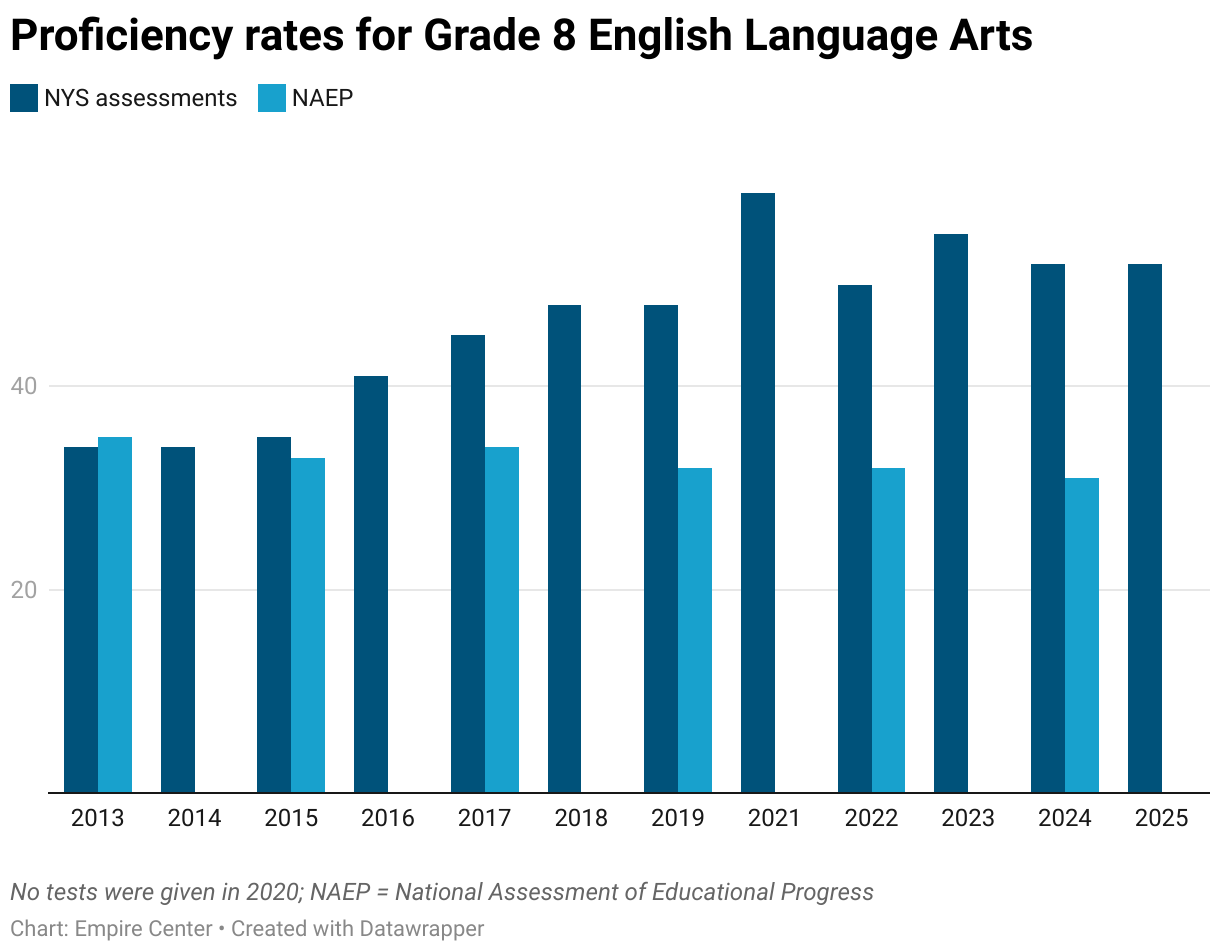
Why are New York’s public school students showing steadily higher proficiency levels on state-administered tests when their scores on federal tests have been getting worse?
Part of the answer seems to lie in the Education Department’s grading methods. For most of the past dozen years, the department has been gradually lowering “cut scores” – the minimum number of questions students have to answer correctly in order to be considered proficient at each grade level.
Officials have said these changes were necessary to adjust for the varying difficulty of test questions from year to year. In any given year the state raises some cut scores, lowers others and leaves some unchanged.
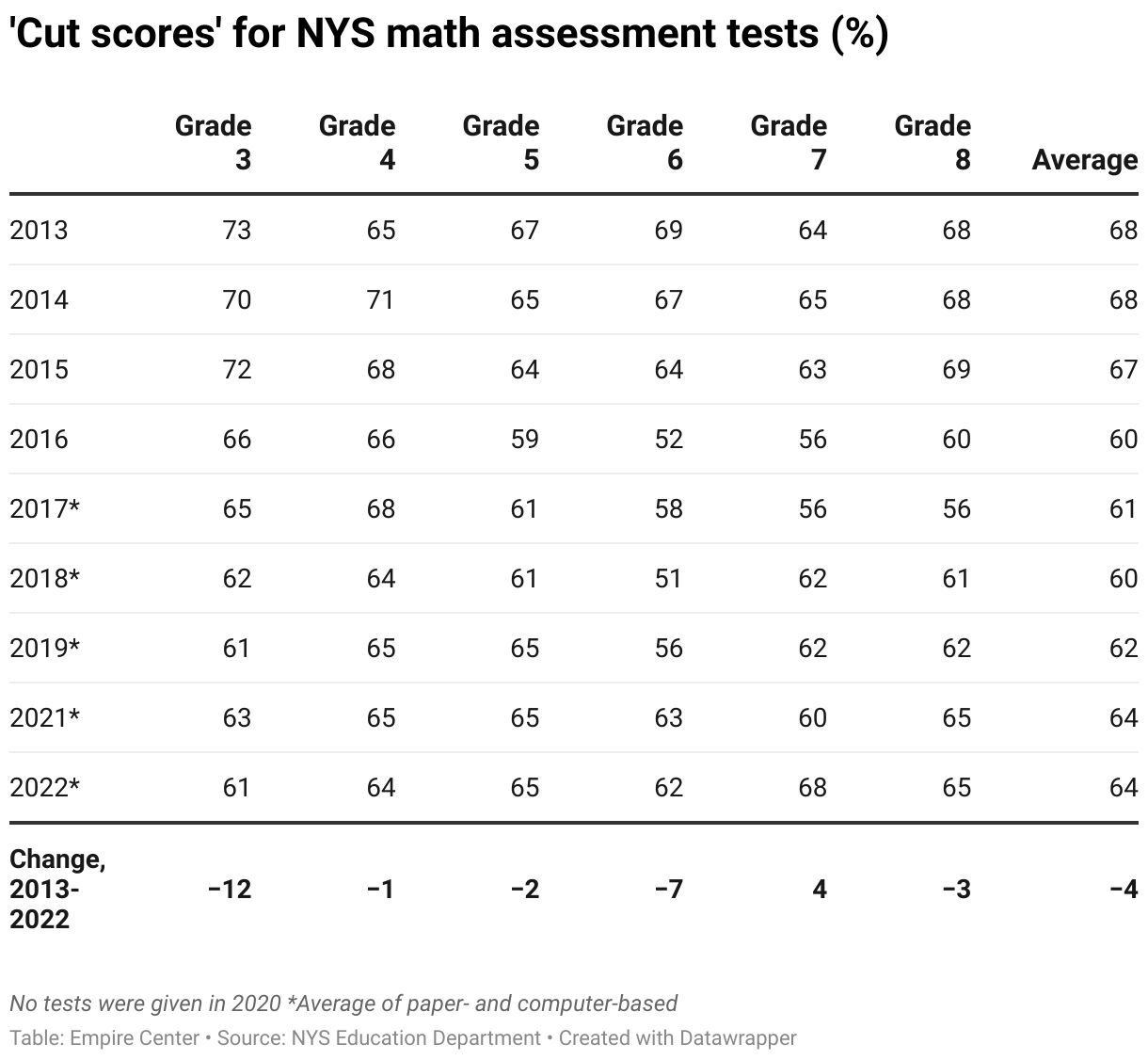
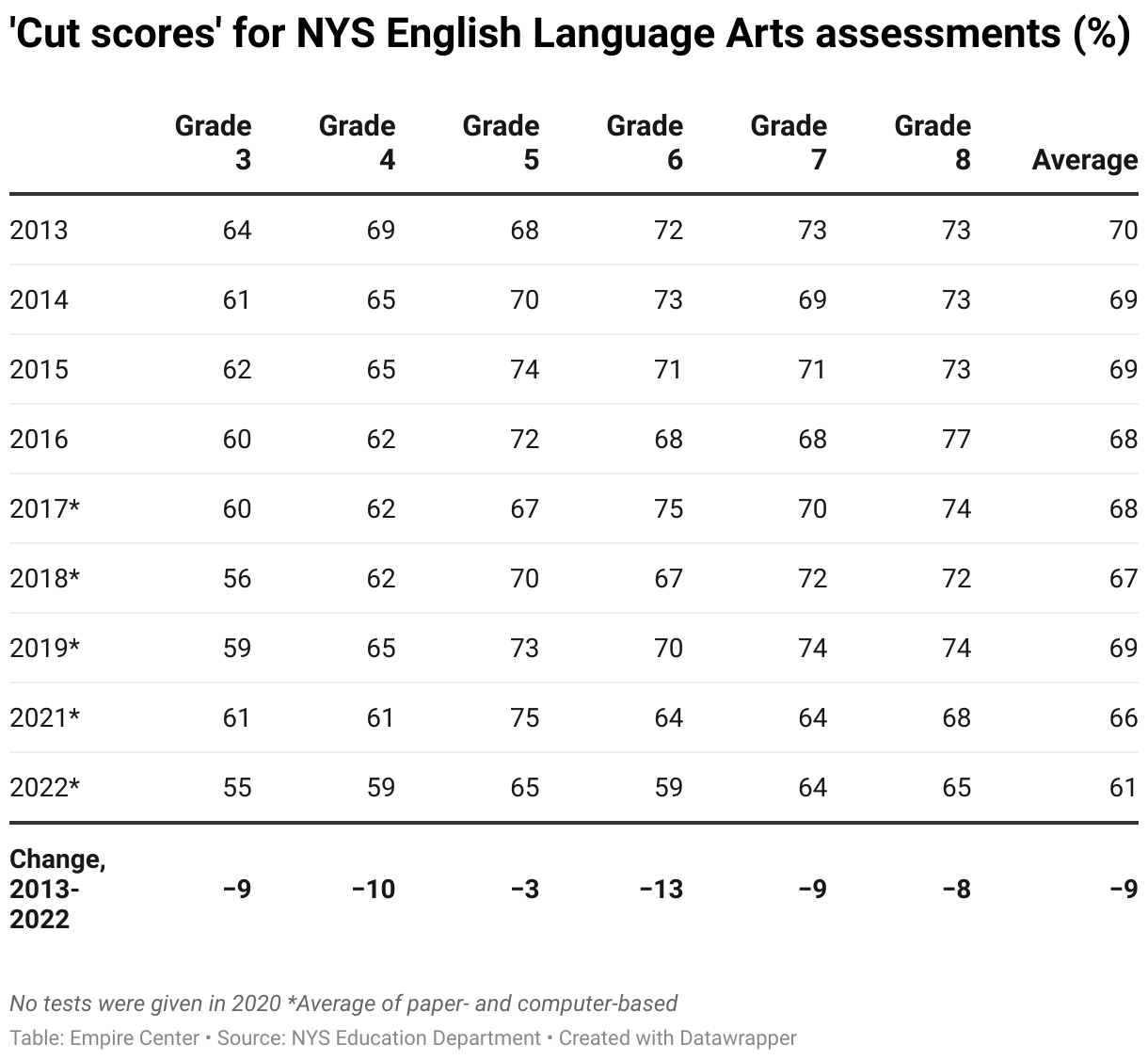
However, a review of state records from 2013 to 2022 over the past dozen years shows a clear trend: Since adopting the Common Core Learning Standards in 2013, downward changes to cut scores have outweighed the upward ones for 11 of the 12 all 12 of the math and reading tests administered in grades 3 through 8.
The average cut score for math tests dropped 4 points, from 68 percent in 2018 to 64 percent in 2022. The average cut score for the reading tests (known as English Language Arts) was down 9 points, from 70 percent to 61 percent.
The average cut score for the math tests has dropped 16 points, from 68 percent in 2013 to 52 percent in 2025. The average cut score for the reading tests (known as English Language Arts) is down 11 points, from 70 percent to 59 percent.
During those same years, state-reported proficiency levels were generally rising – up by an average of 16 points 22 points in reading and 10 points 24 points in math.

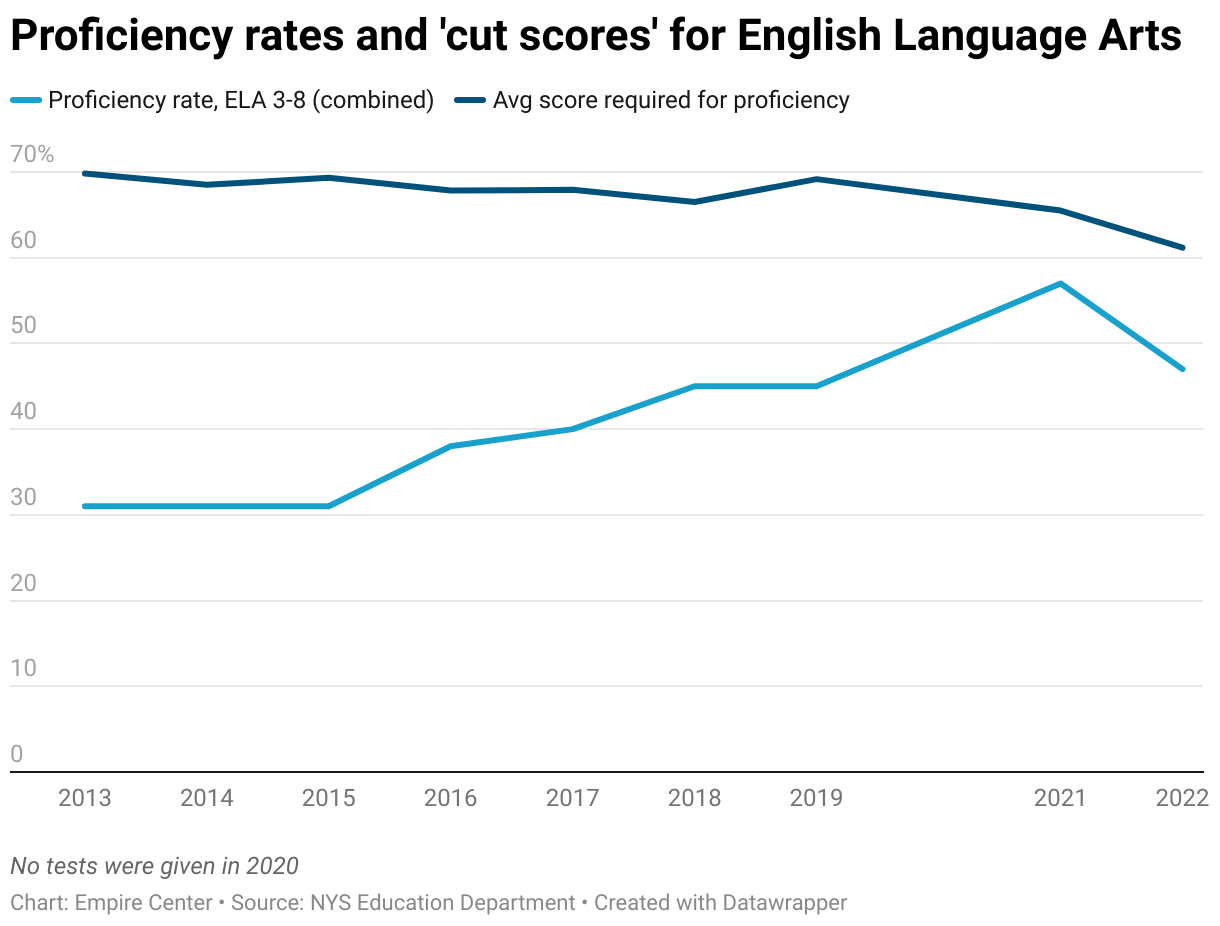
This raises concern that the rising proficiency levels reported by the state Education Department have been an illusion, the result of lowered standards rather than improved student performance.
The improvements reported by the state stand in contrast to New York’s results on the National Assessment of Educational Progress (NAEP), a set of tests administered by the federal government. Known as the Nation’s Report Card, it consists of math and reading tests given to a representative sample of students every other year in grades 4 and 8.
New York’s performance on NAEP tests has been sinking over the past dozen years, down three points in fourth-grade math, six points in fourth-grade reading, six points in eighth-grade math and four points in eighth-grade reading.
In addition to adjusting cut scores, the state has made other course corrections in its testing regime. In 2018, the Education Department said it was setting a new “baseline” after switching to tests that were administered over two days instead of three. In 2023, it said it was adjusting standards to reflect the “new normal” after the coronavirus pandemic. In each case, officials said the new proficiency rates should not be compared to those of the previous year – yet they posted the two years’ figures side by side.
Throughout all of this, the cut scores kept trending down, and the proficiency rates kept trending up.
The state stopped routinely posting its revised cut scores after 2022. When the state announced its 2024-25 test results, the Albany Times Union found that that average percentage of “scale points” needed to achieve proficiency had dropped for some of the tests. (Scale points are part of the scoring methodology that are not directly comparable to cut scores.)
However, when the state announced its 2024-25 test results earlier this month, the Albany Times Union requested and obtained the updated cut scores for 2023, 2024 and 2025 – information that had not previously been made public.
“More students passed this year’s math and English tests, but many of them didn’t have to do as well as last year to be named proficient,” reported the Times Union’s Kathleen Moore.
She quoted a spokeswoman for the department denying that the state had lowered its standards:
Each test is equated to the established scale. If there is a greater or lesser number of difficult questions one year, the number of questions that must be answered correctly is adjusted. This helps ensure that all tests in a subject are equated — no test is harder or easier to pass from year to year.
If that’s the case, then the double-digit declines in cut scores since 2013 over the past 12 years would imply that nearly all all of the state’s tests have gotten steadily more difficult, something officials have not publicly asserted.
The Education Department has presumably conducted a technical analysis of each test before adjusting its cut score. By publishing these analyses – and posting the cut scores for 2023 through 2025 – the department could give the public a better understanding of its scoring process, and a clearer idea of how well the public schools are doing their jobs.
About the Author

You may also like

New York Schools will Spend More and Deliver Less – Again
As voters across New York head to the polls to decide their local school budgets, the big question – why New York schools deliver poor results despite spending the most in the nation – is barely on anyone’s mind.
New York’s fourth-grade and eig Read More

Giving Families an Escape Hatch from NYC Public Schools
Zohran Mamdani's stunning election as mayor of New York City marks a watershed moment for the Empire State. As a self-described democratic socialist and member of the Democratic Socialists of America, Mamdani rode a wave of pr Read More
K-12 SOS. Buffalo City School District
K-12 SOS is a pilot project of the Empire Center to inform parents, politicians, and decision-makers about the state of K-12 education in New York State. Determining why certain schools perform better than others is beyond the scope of this research. Read More

An Eerie Silence About the State of Education in New York
A by National Assessment of Educational Progress (NAEP) lamented the declining state of U.S. education by highlighting how scores in grade 12 math and reading have hit record lows. While Covid-19 was definitely a factor, others correctly pointed out that Read More

New York’s K-12 Problem
New York has an education problem that no one really likes to talk about: it spends more than any other state or country in the world yet achieves mediocre results at best. This might come as a surprise, especially since some politicians and pundits tout Read More

Two Dozen School Districts Are Returning to the Polls for Budget Revotes
Voters in 24 New York school districts return to the polls on Tuesday for school budget revotes. Last month, voters in 96 percent of school districts outside New York City conducting votes approved their school budgets for the upcoming year.
The 683 sc Read More

Empire Center Launches K-12 SOS on Education Achievement and Spending in New York
In 2022-23 New York used to spend more than any other state or country – $30,000 per student. Next school year the spending might increase to $35,000 per student.
Even at $30,000 New York spends twice as much as the US average, and about a third more Read More

Don’t Tell The Grownups: NY Still Hiding State Test Scores
State education officials are refusing to release the results of federally required assessments in grades 3 through 8, deliberately keeping parents and taxpayers in the dark—not only about how New York’s public schools performed, but also about how that performance was measured. Read More