

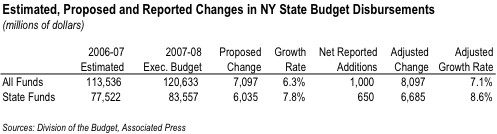
The “state funds” share of New York’s next budget could rise by about 8.6 percent under the preliminary deal announced by Governor Spitzer and legislative leaders. This would rank among the top 10 budget increases in this category over the last 40 years. Including federal funds, the total state budget would grow by more than 7 percent.
These percentage growth estimates are based on the statement released by Governor Spitzer and legislative leaders on Tuesday night, and on news reports containing a few more details of the agreement.
The broad outlines: $850 million will be added to the budget ($350 million in Medicaid, and $500 million in school aid) and about $200 million will be subtracted from state-subsidized property-tax rebates. News reports suggest that the net state-funds spending addition might be as much as $800 million, but there are no official details backing up that figure. Assuming the true total for added spending is the lower figure — $650 million — here is a back-of-the-envelope calculation on how those changes would affect the growth rates originally proposed by the governor:
Adjusting for inflation, the percentage increase in fiscal 2007-08 would come to about 5.9 percent. This would rank ninth among the 10 largest state-funded spending increases in New York since 1968, as shown in the table below.
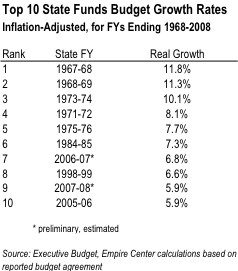
Most of the estimated 2007-08 growth reflects Spitzer’s own Executive Budget proposal. A net legislative spending addition of $650 million, or less than 1 percent of what the governor proposed, would be relatively small by historical standards.
Of course, many details of the budget remain unknown, if not unsettled. The budget negotiation process has, if anything, been murkier than the norm established during George Pataki’s final term.
For the time being, however, here are two observations on the latest turn of events:
- Only $450 million out of the $1.4 billion Medicaid “savings” proposed by the governor involved actual reductions in otherwise scheduled payments to hospitals, nursing homes and other providers. Out of that amount, the most crucial sum was the $73 million to be gained in 2007-08 (growing to $120 million by 2009-10) from “redirecting” subsidies so that more money flows to those institutions that are actually serving the most Medicaid patients. If the final budget includes Spitzer’s changes in this area, he can justifiably cite it as a significant achievement with important implications for future changes in health care finance, even though the amount of money involved is relatively small.
- School aid is the area in which the governor appears to be on the verge of scoring his most significant political victory in the budget. Sources close to the negotiations say the $500 million aid restoration for more affluent suburban districts will largely take the form of “bullet aid” — non-recurring appropriations made on a district-by-district basis, which are not part of the permanent, statutory school-aid formula.
Spitzer’s budget represented the down payment on a four-year, $7 billion expansion of aid and a rewriting of the aid formula in a way that will target the largest future aid increases to districts serving the most “high-needs” pupils. If the final budget contains Spitzer’s “foundation aid” formula, even while allowing $500 million in one-time aid additions for 2007-08, the governor will have succeeded in “breaking shares” in the formula – i.e., departing from the traditional regional distribution of school aid. This is a goal that eluded each of his three predecessors. This also will (a) minimize the impact on future budget gaps, while (b) setting the stage for another big fight next year with the same suburban legislators who fought for more aid for their schools this year. Today’s Gannett News Service report on the budget deal makes this important point on the big picture:
The deal to increase education aid will bring the total hike going to public schools next year to a whopping $1.9 billion, by far the biggest hike in history, that will bring total state spending on public education to just under $20 billion, a hike of 10.6 percent over what’s being spent this year.
About the Author

You may also like

What They Make 2026: North Country
Lewis County employees held nine of the North Country's ten highest-paid local government positions in fiscal year 2025-26, most of them physicians and medical staff, . Jeffery Hellinger, a Lewis County employee, was the highest paid, at $265,978.
Read More
What They Make 2026: Mohawk Valley
Eight local government employees in the Mohawk Valley had gross pensionable earnings of more than $200,000 in fiscal year 2025-26, . Four were county elected officials and three were Oneida County correction officers. The highest paid was Christina Pea Read More
What They Make 2026: Southern Tier
Mary Nobilski, a Steuben County employee, was the Southern Tier's highest-paid local government employee in fiscal year 2025-26, at $309,582, . She was the only local employee in the region paid more than Governor Hochul's $250,000 salary.
Stat Read More
What They Make 2026: Central New York
Syracuse police officers held all ten of the highest-paid local government positions in Central New York during fiscal year 2025-26, . John Tassini was the highest paid, at $282,861.
Statewide, the 179,222 employees of New York's counties, citi Read More
What They Make 2026: Finger Lakes
Rochester police officers held eight of the ten highest-paid local government positions in the Finger Lakes region during fiscal year 2025-26, . Robert Hill was the region's highest-paid employee, at $314,040.
Statewide, the 179,222 employees o Read More
What They Make 2026: Western New York
Erie County deputy sheriff Simon Biegasiewicz was Western New York's highest-paid local government employee in fiscal year 2025-26, at $305,077, followed by Buffalo firefighter Daniel Bossi at $300,488, . They were the only two local employees in the r Read More
What They Make 2026: Capital Region
An Albany police officer, Willie Flack, was the Capital Region's highest-paid local government employee in fiscal year 2025-26, at $279,370, . Police officers in Albany, Schenectady and Troy and the Town of Colonie held six of the region's ten highest- Read More
What They Make 2026: Mid-Hudson
Town of Ramapo police officers held four of the five highest-paid local government positions in the Mid-Hudson region during fiscal year 2025-26, led by Daniel Hyman at $421,338, the second-highest local government pay in the state, .
Statewide Read More