

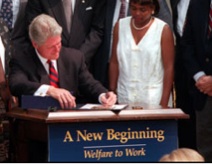
On July 12th, the Obama Administration announced that it would unilaterally allow states to experiment through waivers with different ways of defining the “work” required of welfare recipients under the Temporary Assistance to Needy Families (TANF) program. This could be a first step to permanently watering down the “work participation” requirements that were a centerpiece of the 1996 welfare reform law and to backing away from the primary theme of TANF: personal responsibility.
Making matters worse, waivers would only be granted to states that expand their welfare rolls:
The Secretary will not approve a waiver for an initiative that appears substantially likely to reduce access to assistance or employment for needy families.
In the 16 years since welfare reform was enacted, welfare caseloads in New York State alone have dropped by nearly two thirds (from 1.6 million to 570,000 people). There has been a significant increase in the number of single female heads of households in the work force. And, despite the prolonged recession, the poverty rate 16 years later is still lower than before the law, according to the US Census Bureau Table 21.
Dollars that would have been spent on welfare benefits in New York under the old federal Aid to Families With Dependent Children (AFDC) system have been redirected to programs designed to make work pay for those who leave welfare, including the state Earned Income Tax Credit, subsidized child care payments and aggressive child support enforcement.
States are now required under federal law to engage 50 percent of their able-bodied TANF adult recipients in work or allowable work related activities aimed directly at employment for 30 hours weekly. States get additional credit against this 50 percent rate for the amount by which their caseload has dropped since 2005 and for excess spending beyond a required TANF maintenance of effort. New York achieves the required rate through a combination of all three.
The new regulatory “guidance” from the federal Department of Health and Human Services is ostensibly to give states flexibility to test other ways than work participation rates to get people employed. Unfortunately, in this case HHS seems most intent on diluting work requirements in favor of fuzzy and less measurable alternatives. For example, it would allow longer assignments to education and training to count as work — this was a major reason why previous welfare reforms failed.
The president’s legal authority to waive statutory work requirements has been questioned by key congressional Republicans involved in overseeing TANF. If the guidance survives a potential legal challenge, there may be some aspects of the new approach that New York State could exploit to improve its administration of TANF under the existing, statutory welfare-to-work guidelines.
But the state should steer clear of any options that don’t maintain a work-first approach, which is still the best avenue out of poverty. Returning to the old days of welfare — when virtually any assignment counted as work, as Obama’s new approach would allow — would be an insult to able-bodied welfare recipients who actually want to be employed.
You may also like

Hochul’s Energy Infrastructure Plan Gets the Diagnosis Right but Offers No Prescription
Editor’s note: Roger Caiazza is an adjunct fellow at the Empire Center. He has a long and deep private industry background in environmental regulatory analysis and compliance. His frequently updated personal blog on New York State environmental poli Read More
New Poll Shows New Yorkers Want Cheaper Energy — RGGI’s Price Record Shows They Aren’t Getting It
Editor's note: Roger Caiazza is an adjunct fellow at the Empire Center. He has a long and deep private industry background in environmental regulatory analysis and compliance. His frequently updated personal blog on New York Read More

New York’s Health Premiums Stayed at the Top in 2025
New Yorkers and their employers paid the highest health premiums in the lower 48 states in 2025, and their costs moved further above the U.S. average, according to recently released federal data.
Read More

NY’s Medicaid Fraud Watchdog Shows Declining Performance
Enforcement by the New York's Office of Medicaid Inspector General has dropped in recent years across a range of benchmarks – a sign that the state's anti-fraud efforts have slackened even as its Medicaid spending soared. Read More
The Attorney General’s MFCU SNAFU
Attorney General Letitia James' latest fight with the Trump administration focuses on New York's Medicaid Fraud Control Unit, a federally funded agency housed in James' office.
On T Read More
Healthcare Revelations in the Enacted Budget Financial Plan
The state financial plan published on June 10 disclosed key information about healthcare revenue and spending that lawmakers had not made public when approving the annual budget two weeks before.
Read More
Federal Suit Traces Medicaid Fraud to the Top of NYS Government
The Trump administration's latest salvo against Medicaid fraud takes aim at a different kind of target – two high-ranking New York officials along with a major state contractor.
A Read More

It Is Time to Rethink the Regional Greenhouse Gas Initiative
Before budget negotiations, Gov. Hochul warned that unless New York changes its climate plans, New Yorkers could face a $2.26-per-gallon increase in gasoline prices. The reason is the so-called “cap-and-invest” scheme, under which energy companies wou Read More