

New York adopted the millionaires’ tax in 2009. Shortly afterward, Paychex Inc. founder Thomas Golisano told Albany what he thought of it: He said he would move to Florida.
Nearly a decade later, New York’s “temporary” surtax on high earners is still in place. And though it is scheduled to expire on Dec. 31, Gov. Andrew Cuomo and others are campaigning hard to make sure that does not happen.
Those who favor the higher rates for filers with big incomes often argue that the concern about the wealthy fleeing New York is overblown. IRS data appear to back them up: From 2010 to 2014, the number of tax filers in this state earning $1 million or more jumped more than 32 percent.
If the surtax is chasing wealthy filers from the state, why are their ranks in New York growing?
The answer, in part, is that the period from 2010 to 2014 was marked by a strengthening economy and especially by a surging stock market.
But the full answer is more complicated. As E.J. McMahon of the Empire Center for Public Policy explained last week in testimony in Albany, the number of nonresidents among New York taxpayers with annual incomes exceeding $1 million now accounts for nearly half of all filers subject to the surtax.
Why does that matter? Because, he noted, nonresidents pay tax “only on their New York source income, mainly salaries and profit shares from New York businesses, and not on their capital gains, dividends and interest that make up the bulk of their personal income.”
By his calculation, even if only 10 percent of nonresident filers moved their main residence to New York, it would generate more than $1.5 billion in additional revenue—without the surtax.
There are other strong arguments against the surtax: It is anti-competitive because most other states have lower personal income tax rates and it discourages expansion by owners of small firms who report their business income on their personal returns.
But the notion that New York’s high earners will simply stay and pay does not hold up under scrutiny.
© 2017 Rochester Business Journal
About the Author

You may also like

Switching to Electric Home Heating Could Add Thousands to Energy Bills
FOR IMMEDIATE RELEASE: ALBANY, N.Y. that heating an average home from October to March would cost approximately $790 with natural gas, compared with $1,100 with a heat pump and $3,300 with electr Read More
Hochul’s Energy Infrastructure Plan Gets the Diagnosis Right but Offers No Prescription
Editor’s note: Roger Caiazza is an adjunct fellow at the Empire Center. He has a long and deep private industry background in environmental regulatory analysis and compliance. His frequently updated personal blog on New York State environmental poli Read More

Poll: 64% of New Yorkers Back Eliminating the State Income Tax; 67% Say State Taxes Aren’t Delivering
Dissatisfaction spans party and regional lines as broad majorities rally behind sweeping tax reform
FOR IMMEDIATE RELEASE: ALBANY, N.Y. - New Yorkers are delivering a blunt assessment of the state’s tax system: 67% say they ar Read More
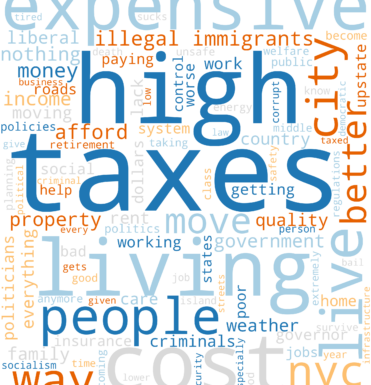
New Yorkers Want to Eliminate the Income Tax
Summary
New Yorkers have reached a clear verdict: The state’s tax system is not delivering. A full 67% say they are not getting good value for their tax dollars, while 64% support eliminating the state income tax. Read More
SUNY Research Foundation Payroll Tops $400 Million
Payroll records for 8,401 employees of the Research Foundation for the State University of New York (RF SUNY) for fiscal year 2026 are , the Empire Center's government transparency website.
The Research Foundation is a private, nonprofit educational co Read More

Newly Retired NYC Firefighters Average Over $177k In Pensions
New York City firefighters and fire officers retiring last year after full careers were entitled to average annual pension benefits of $177,016, according to , the Empire Center's government transparency website.
Among the 499 new retirees with at leas Read More
New York Annual Household Electricity Costs Rise $270
FOR IMMEDIATE RELEASE ALBANY, N.Y. — New York’s average residential electricity price reached 29.90 cents per kilowatt-hour (kWh) in July 2026, the fifth highest in the nation and 63.3 percent Read More
Energy Data Bulletin September 2026
September 2026
Summary and Insights
Electricity. In June 2026, New York had the nation's fifth-highest residential electricity price at 29.49 cents per kilowatt-hour (kWh), 60.8 percent above the U.S. average. Prices d Read More