

As Washington skirmishes over the future of enhanced tax credits under the Affordable Care Act, New York has relatively little to gain or lose.
The number of New Yorkers using any ACA credits – enhanced or not – stands at about 119,000 or 0.6 percent of the population, the lowest proportion of any state other than the District of Columbia, according to the latest federal enrollment report.
That compares to utilization rates as high as 19 percent in Florida and 13 percent in Georgia and an average of 6 percent nationwide.
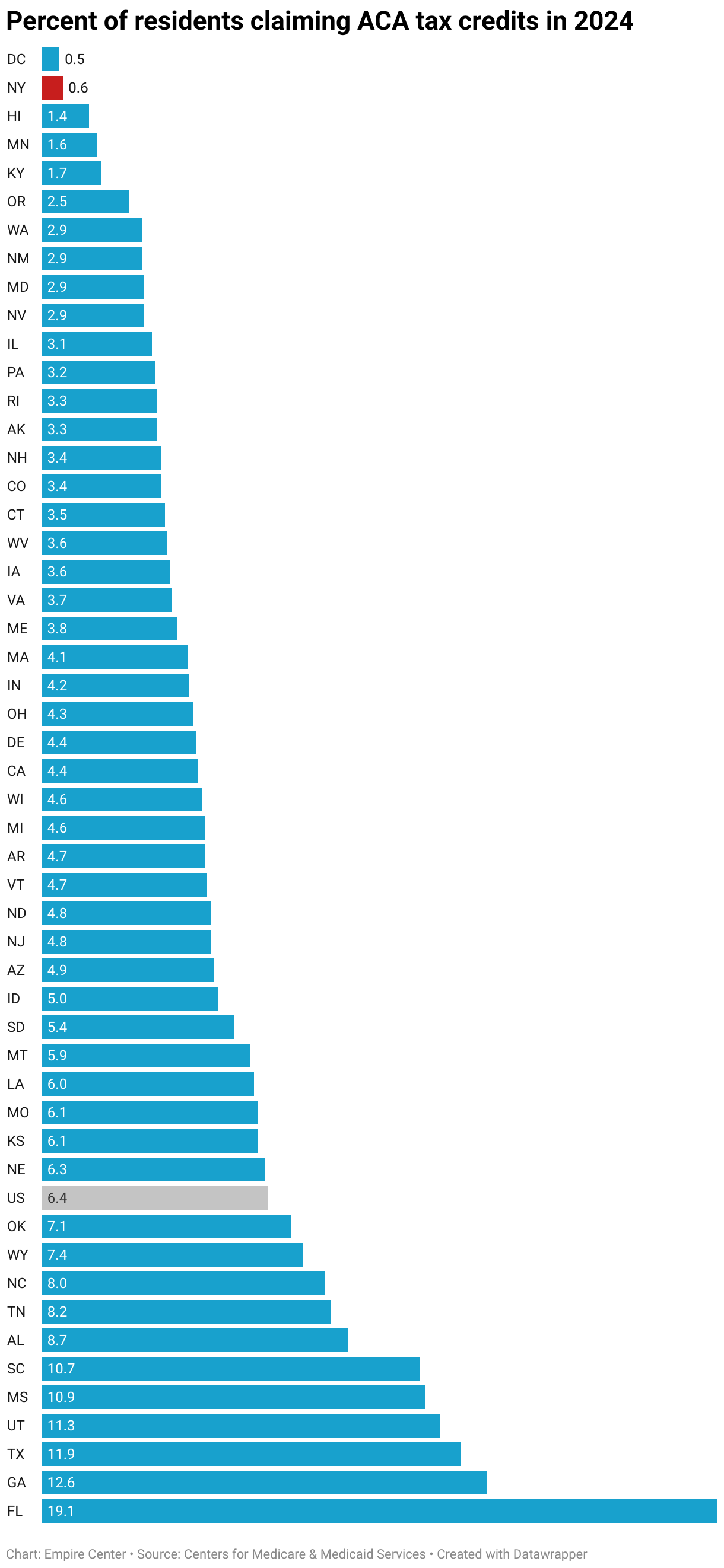
The driver of this disparity is New York’s Essential Plan, which offers zero-premium, government-funded coverage to residents up to 250 percent of the poverty level. That program has absorbed the bulk of the population that would otherwise be using ACA tax credits to offset their costs.
The Essential Plan also reaps the federal money that would otherwise have been spent on credits for its enrollees, covering all of its $14 billion budget.
Although the enhanced credits enacted in 2021 have nominally boosted that revenue by about $1 billion per year, it’s not clear the state is actually collecting that amount – because the program was unable to spend all of its available funding even before the enhancements took effect.
Still, the Hochul administration has joined a Democrat-led campaign to prevent the enhanced credits from expiring in December – and the state’s publicity materials portray the Essential Plan’s 1.7 million enrollees as having something to lose if that happens.
The original ACA tax credits were targeted to the working poor – people who made too much money to qualify for Medicaid but didn’t have access to employer-sponsored health benefits and could not afford insurance on their own.
The law established a percentage of income that consumers were expected to pay toward their own coverage – on a sliding scale from 100 percent to 400 percent of the poverty level – and offered tax credits that were enough to cover the balance of a benchmark premium from coverage purchased through an ACA insurance exchange (see table).
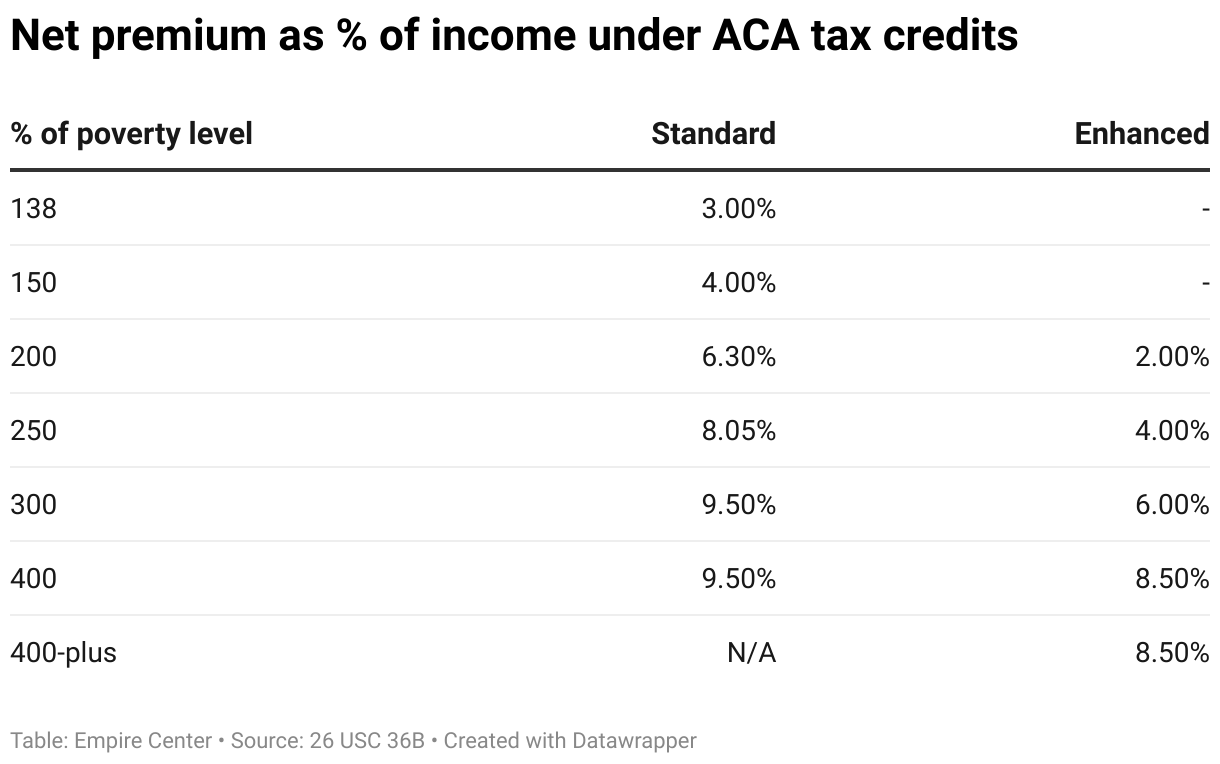
As part of a pandemic relief package in 2021, Washington lawmakers enhanced the credits by lowering the share of income consumers were expected to contribute – to zero for incomes up to 150 percent of the poverty level and to no more than 8.5 percent at the high end. They also extended the credits to people of any income, ending what had been a benefit “cliff” at 400 percent of the poverty level.
As seen in the chart below, the biggest benefit of the enhancement went to people just above 400 percent of the poverty level, who saw their net costs cut in half. Based on a typical premium of $27,000, a family of four with income at 900 percent of the poverty level, or $289,000, could claim a credit of more than $2,000.
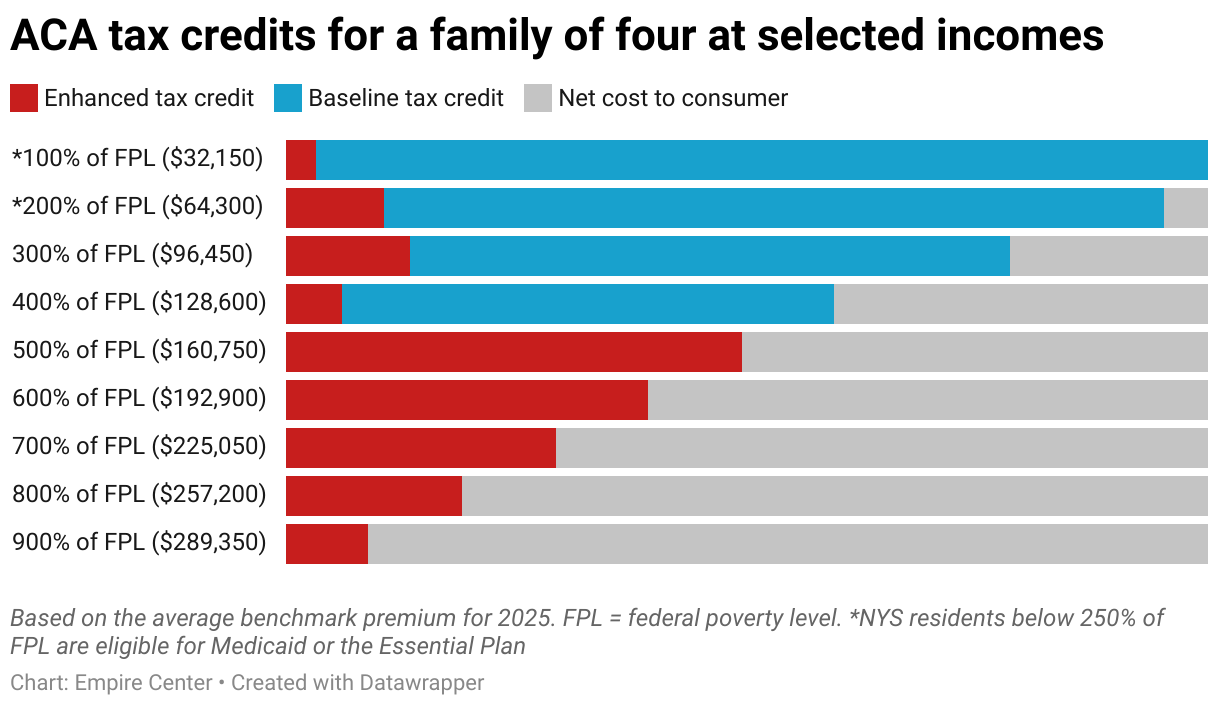
However, that would be an unusual scenario. Most Americans at that income level get health coverage through their employers – and have no reason to buy insurance directly. The bulk of people claiming ACA credits still fall below 400 percent of the poverty level.
New York’s ACA insurance change – known as the New York State of Health – said that 146,000 New Yorkers were benefiting from enhanced tax credits as of September 2024. This includes 43,000 or 29 percent with incomes above 400 percent of the poverty level.
The report also said that federal funding for the Essential Plan “is estimated to be $1 billion higher as a result of these enhanced federal subsidies.”
That $1 billion figure is consistent with what the Health Department estimated when it applied for – and later received – federal authorization to extend the Essential Plan’s eligibility ceiling from 200 percent to 250 percent of the poverty level.
However, those same estimates indicated that the program’s revenue would exceed its costs by $1.4 billion even if the credits were allowed to expire – implying that the extra $1 billion was unnecessary in the near term.
Over its first nine years, excess revenue accumulated in the Essential Plan’s trust fund, which held a balance of $8.9 billion as of May, according to the state comptroller’s office. Since the program’s expansion took effect in April 2024, the comptroller’s records indicate that the trust fund balance is no longer growing because the state is now collecting only the federal revenue it needs to cover expenses. This raises the possibility that some available revenues, including proceeds from enhanced tax credits, could be going unused.
With enactment of President Trump’s tax- and budget-cutting package this summer, the Essential Plan’s well-cushioned finances are in jeopardy. The legislation cut off most legally present immigrants from eligibility for federal health programs, including ACA tax credits, starting in 2026. Some 730,000 of the affected immigrants are enrolled in the Essential Plan. Their departure will chop the plan’s revenue by more than half, or $7.6 billion.
In response, Governor Hochul has moved to unwind the program’s 2024 expansion. Officials say this would temporarily save the state money on covering about 500,000 of the affected immigrants but displace some 450,000 enrollees above 200 percent of the poverty level.
Given these looming changes, the lost revenue associated with enhanced tax credits is one of many moving parts in a complicated financial structure. As members of Congress consider whether that credits should be continued, the Hochul administration should do more to clarify how the money is being used now – and how it might be used going forward.
About the Author

You may also like

New York’s Health Premiums Stayed at the Top in 2025
New Yorkers and their employers paid the highest health premiums in the lower 48 states in 2025, and their costs moved further above the U.S. average, according to recently released federal data.
Read More

NY’s Medicaid Fraud Watchdog Shows Declining Performance
Enforcement by the New York's Office of Medicaid Inspector General has dropped in recent years across a range of benchmarks – a sign that the state's anti-fraud efforts have slackened even as its Medicaid spending soared. Read More

The Attorney General’s MFCU SNAFU
Attorney General Letitia James' latest fight with the Trump administration focuses on New York's Medicaid Fraud Control Unit, a federally funded agency housed in James' office.
On T Read More

Healthcare Revelations in the Enacted Budget Financial Plan
The state financial plan published on June 10 disclosed key information about healthcare revenue and spending that lawmakers had not made public when approving the annual budget two weeks before.
Read More
Federal Suit Traces Medicaid Fraud to the Top of NYS Government
The Trump administration's latest salvo against Medicaid fraud takes aim at a different kind of target – two high-ranking New York officials along with a major state contractor.
A Read More

Healthcare Highlights in the New State Budget
Governor Hochul's focus on affordability seems to have skipped over the healthcare portions of the new state budget.
The deal finalized May 27 Read More

Lawmakers Consider Hiking Fees for Filling Prescriptions
UPDATE: The proposal discussed below passed the Assembly Friday evening by an unofficial vote of 133-0. Having previously been approved by the Senate, the bill will head to Governor Hochul's desk for her signature or ve Read More

Budget Deal Reportedly Earmarks $100M for 1199 and Extends MCO Tax
As Governor Hochul and legislative leaders rush to finalize the overdue state budget, outlines of some healthcare-related deals have begun to emerge from the closed-door negotiations.
Read More