

Pension costs for every level of government in New York have been exploding over the past four years — yet state legislators seem determined to make things worse.
In the recently concluded session, the Legislature passed at least 46 bills expanding pension benefits for groups of government emplolyees, as detailed in a new FiscalWatch Memo by E.J. McMahon, the Empire Center’s director. The most costly in the group created a presumptive disability benefit for any New York City employee who ever claims a lung ailment allegedly resulting from clean-up work at the World Trade Center site. This measure has been signed into law by Governor Pataki, despite the city’s claim that it will pump up pension expenses by $50 million.
Other bills still awaiting gubernatorial action include a more expansive “heart bill” for non-New York City cops and firefighters, as well as state corrections and court officers. Any worker in these groups who comes down with heart disease would have a better shot at claiming it is job-related — and thus qualify for a more generous disability pension.
And that’s just the tip of the iceberg. Legislators have introduced hundreds of other pension-related bills, all of which will remain live in the bill hopper for next year’s election-year session.
Public employees already receive far more generous benefits than are available to the vast majority of the private sector workers who pay their salaries. Yet neither the Governor nor any member of the Legislature has introduced a single bill permanently restructuring pension benefits for newly hired workers, which would curb the growth of pension costs in the future.
The conclusion of McMahon’s in-depth analysis:
Pension costs are among the most serious and intractable financial issues facing government managers. New York is not alone in having to grapple with this problem; indeed, pension funding crunches have been reported across the country. In some cases severe shortfalls in pension funding have threatened to bankrupt several major cities (such as San Diego).In the long run, New York’s public employee retirement plans could be made much more predictable, affordable, and controllable through a move to the sort of “defined contribution” plan common in the private sector. Such plans consist of individual accounts supported by employer contributions, usually matched at least in part by the employees’ own pre-tax savings. But the concept is hardly new to government. After all, for decades now, a defined-contribution plan has been the retirement vehicle of choice for employees of public higher education systems such as the State University of New York.
To initiate such reform statewide, existing government employees would stay in the old system, but the overall expenses would drop quickly over the next 10 years due to natural turnover as replacement employees join the new retirement system.
A more modest reform of the existing system, supported by New York City Mayor Michael Bloomberg, would be to create a “Tier V” for newly hired employees, under which benefits would remain guaranteed but would be scaled back to the pre-2000 level.
In the short run, there is nothing government officials can do to reverse the recent run-up in pension costs. But they should at least observe the Hippocratic oath: “first, do no harm.” Rather than routinely reintroducing the public employee unions’ full wish list of pension benefit enhancements, it would be more appropriate for the Legislature to declare a moratorium on consideration of any new retirement benefit increases.
To understand more about how New York’s public pension bomb was built — and how it can be defused — see this report.
About the Author

You may also like

Switching to Electric Home Heating Could Add Thousands to Energy Bills
FOR IMMEDIATE RELEASE: ALBANY, N.Y. that heating an average home from October to March would cost approximately $790 with natural gas, compared with $1,100 with a heat pump and $3,300 with electr Read More
Hochul’s Energy Infrastructure Plan Gets the Diagnosis Right but Offers No Prescription
Editor’s note: Roger Caiazza is an adjunct fellow at the Empire Center. He has a long and deep private industry background in environmental regulatory analysis and compliance. His frequently updated personal blog on New York State environmental poli Read More

Poll: 64% of New Yorkers Back Eliminating the State Income Tax; 67% Say State Taxes Aren’t Delivering
Dissatisfaction spans party and regional lines as broad majorities rally behind sweeping tax reform
FOR IMMEDIATE RELEASE: ALBANY, N.Y. - New Yorkers are delivering a blunt assessment of the state’s tax system: 67% say they ar Read More
New Yorkers Want to Eliminate the Income Tax
Summary
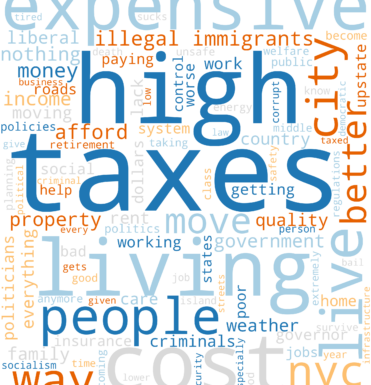
New Yorkers have reached a clear verdict: The state’s tax system is not delivering. A full 67% say they are not getting good value for their tax dollars, while 64% support eliminating the state income tax. Read More
SUNY Research Foundation Payroll Tops $400 Million
Payroll records for 8,401 employees of the Research Foundation for the State University of New York (RF SUNY) for fiscal year 2026 are , the Empire Center's government transparency website.
The Research Foundation is a private, nonprofit educational co Read More

Newly Retired NYC Firefighters Average Over $177k In Pensions
New York City firefighters and fire officers retiring last year after full careers were entitled to average annual pension benefits of $177,016, according to , the Empire Center's government transparency website.
Among the 499 new retirees with at leas Read More
New York Annual Household Electricity Costs Rise $270
FOR IMMEDIATE RELEASE ALBANY, N.Y. — New York’s average residential electricity price reached 29.90 cents per kilowatt-hour (kWh) in July 2026, the fifth highest in the nation and 63.3 percent Read More
Energy Data Bulletin September 2026
September 2026
Summary and Insights
Electricity. In June 2026, New York had the nation's fifth-highest residential electricity price at 29.49 cents per kilowatt-hour (kWh), 60.8 percent above the U.S. average. Prices d Read More