

Contact: 518.434.3100
New York’s counties, municipalities and school districts can eventually eliminate their long-term liabilities for retiree health benefits by encouraging the creation of employee-run Retirement Medical Trusts (RMTs), according to the Empire Center for Public Policy.
The potential for such trust funds was explained in a report released today to kick off the Empire Center’s new “Empire Ideas” project, which will include a series of research papers and public forums designed to help elected officials, local taxpayer groups, community associations and concerned taxpayers explore ways of improving the quality and cost-effectiveness of local governments and school districts across New York.
Retiree healthcare for state and local employees — known in accounting terms as other post-employment benefits, or OPEB – is “a huge, unfunded and rapidly growing liability” whose rising annual cost “is adding to the stress on local budgets already squeezed by the economic downturn and skyrocketing public pension bills,” the report says. As previously revealed in another Empire Center study, the state and its counties, municipalities, school districts and major public authorities have promised nearly $250 million in retiree healthcare – without setting aside any money to pay for it.
Local elected officials “should use the information disclosed under new government accounting rules to help taxpayers and employees understand that their retiree healthcare promises are simply unsustainable in the long run,” the report says.
In the short term, the report says local officials can seek to reduce annual outlays for OPEB by ending the reimbursement of Medicare Part B premiums, increasing premiums paid by younger retirees and reserving the greatest coverage for those who have worked the longest. In the long run, it recommends, governments should establish a strong preference for funding retiree healthcare solely through Retiree Medical Trusts, managed by unions. Such trusts could serve multiple government employers on a county or regional basis, the report says.
The report includes an explanation of how retiree healthcare could be pre-funded through fixed-dollar contributions shared by employees and employers. As an example, it estimates that for an initial contribution of $100, rising to $200 after seven years, a 25-year union employee could retire at age 55 with a tax-free benefit of over $691 a month.
RMTs are a “win-win” solution that could ensure retiree healthcare is pre-funded on a mutually affordable basis while relieving taxpayers of the long-term OPEB burden, the report says. Although elected officials cannot create employee-run RMTs for their bargaining units – only employees themselves can do that —they can encourage the approach, the report says.
In localities were retiree healthcare is authorized under law, “elected officials could approach their unions with stark choice: create an RMT or risk losing access entirely to health coverage for future retirees,” the report says. “Among school districts and other government employers required to collectively bargain any proposed change in retiree health benefits, the governing body could pass a resolution formally establishing a preference for RMTs as a negotiating objective.”
You may also like

Poll: 64% of New Yorkers Back Eliminating the State Income Tax; 67% Say State Taxes Aren’t Delivering
Dissatisfaction spans party and regional lines as broad majorities rally behind sweeping tax reform
FOR IMMEDIATE RELEASE: ALBANY, N.Y. - New Yorkers are delivering a blunt assessment of the state’s tax system: 67% say they ar Read More
SUNY Research Foundation Payroll Tops $400 Million
Payroll records for 8,401 employees of the Research Foundation for the State University of New York (RF SUNY) for fiscal year 2026 are , the Empire Center's government transparency website.
The Research Foundation is a private, nonprofit educational co Read More

Newly Retired NYC Firefighters Average Over $177k In Pensions
New York City firefighters and fire officers retiring last year after full careers were entitled to average annual pension benefits of $177,016, according to , the Empire Center's government transparency website.
Among the 499 new retirees with at leas Read More
New York Annual Household Electricity Costs Rise $270
FOR IMMEDIATE RELEASE ALBANY, N.Y. — New York’s average residential electricity price reached 29.90 cents per kilowatt-hour (kWh) in July 2026, the fifth highest in the nation and 63.3 percent Read More
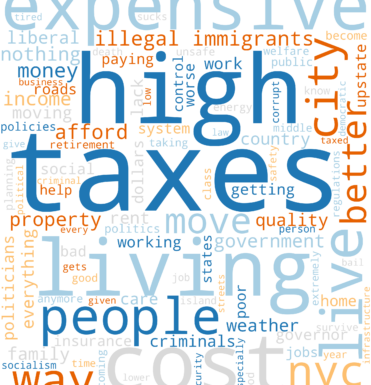
Taxes, the Cost of Living, and Feeling Ignored: Why New Yorkers Are Thinking of Leaving
FOR IMMEDIATE RELEASE ALBANY, N.Y. - New Yorkers across the political spectrum are considering leaving the state. A new finds that Republicans and independent voters most often cite taxes as the reason, while Dem Read More
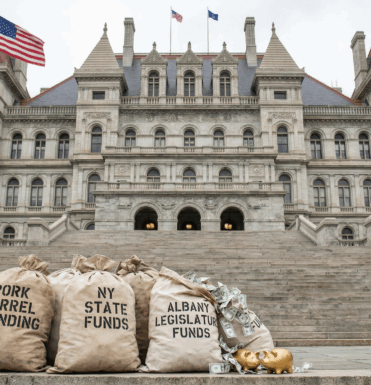
Albany Steers Nearly $100 Million in 2026 Pork Barrel Spending
Albany steered $97.2 million to 206 local projects during the first half of 2026 in the newest batch of state discretionary grants, according to. The new tranche is the latest addition to the pork-barrel grant database the Empire Center h Read More

New York’s Electricity Prices Fifth Highest in the Country
FOR IMMEDIATE RELEASE
ALBANY, N.Y. — Empire Center’s shows New York households paid the fifth‑highest residential electricity prices in the country in June 2026, trailing only Hawaii, California Read More

Nine Millionaires among NY’s Public Authorities in 2025
Nine millionaires, all healthcare executives, emerged among the 88,228 New York public authority employees, according to, the Empire Center’s transparency website.
The data includes payroll information from 385 different agen Read More