

 Governor Cuomo’s proposal to expropriate “excess” reserves from Medicaid managed care plans would apparently target just two insurers—Fidelis Care and MetroPlus—even though their reserve levels are not unusually high.
The plan adds to the pressure on the state’s Catholic bishops, who control Fidelis, to transfer part of the proceeds of the plan’s pending $3.75 billion sale to the state treasury, as Cuomo is also demanding in last-minute budget talks with the Legislature.
If the Legislature approves Cuomo’s proposals, the bishops would effectively face a choice: go ahead with the sale and give up part of their proceeds, or continue as a non-profit and give up part of their reserves.
Politico New York reported Thursday that a negotiated settlement between the bishops and Cuomo is “nearing the finish line.”
The governor’s proposal on excess reserves, recently floated in budget negotiations, would apply only to non-profit prepaid health services plans, of which there are five. In that group, Catholic Church-affiliated Fidelis and New York City-operated MetroPlus have the largest reserves.
Among the 16 insurers that enroll Medicaid recipients, however, there are at least four other plans with higher reserves as a percentage of premium revenue, as shown in the chart below.
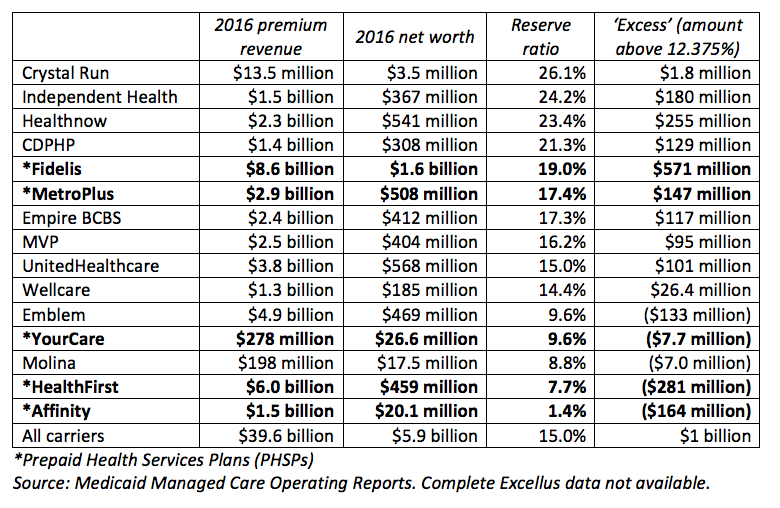
Health insurers are required under state laws and regulations to keep a portion of their money in reserve, to make sure they can pay their bills even in the face of a surge in claims or a loss of revenue. The minimums vary according to type of plan: Medicaid plans are expected to have reserves equal to 8.25 percent of revenue, or about one month’s worth of cash. The ratio for commercial plans is 12.5 percent, or six-and-a-half weeks of cash.
Under the governor’s proposal, the state would be entitled to expropriate “excess” funds from Medicaid PHSPs with reserves that exceed 150 percent of the minimum. Draft language provided to legislative negotiators does not say exactly how the excess would be calculated, leaving details to be determined by the health commissioner.
The chart above is based on a hypothetical threshold of 12.375 percent, which is 150 percent of the Medicaid minimum. By that standard, 10 Medicaid managed care plans of all types would potentially have accumulated excess reserves as of 2016, according to data reported by plans to the Health Department. Of that group, only Fidelis and MetroPlus are PHSPs that would be subject to expropriation.
Cuomo also recently proposed for the state to claim 80 percent of the proceeds when a non-profit health plan becomes a for-profit company. The only known example of that is the Fidelis. As Politico reports, the plan’s deal with Centene includes a clause allowing Fidelis to cancel if the state claims more than 10 percent of the sale price, or $375 million.
About the Author

You may also like

New York’s Health Premiums Stayed at the Top in 2025
New Yorkers and their employers paid the highest health premiums in the lower 48 states in 2025, and their costs moved further above the U.S. average, according to recently released federal data.
Read More

NY’s Medicaid Fraud Watchdog Shows Declining Performance
Enforcement by the New York's Office of Medicaid Inspector General has dropped in recent years across a range of benchmarks – a sign that the state's anti-fraud efforts have slackened even as its Medicaid spending soared. Read More
The Attorney General’s MFCU SNAFU
Attorney General Letitia James' latest fight with the Trump administration focuses on New York's Medicaid Fraud Control Unit, a federally funded agency housed in James' office.
On T Read More
Healthcare Revelations in the Enacted Budget Financial Plan
The state financial plan published on June 10 disclosed key information about healthcare revenue and spending that lawmakers had not made public when approving the annual budget two weeks before.
Read More
Federal Suit Traces Medicaid Fraud to the Top of NYS Government
The Trump administration's latest salvo against Medicaid fraud takes aim at a different kind of target – two high-ranking New York officials along with a major state contractor.
A Read More

Healthcare Highlights in the New State Budget
Governor Hochul's focus on affordability seems to have skipped over the healthcare portions of the new state budget.
The deal finalized May 27 Read More

Lawmakers Consider Hiking Fees for Filling Prescriptions
UPDATE: The proposal discussed below passed the Assembly Friday evening by an unofficial vote of 133-0. Having previously been approved by the Senate, the bill will head to Governor Hochul's desk for her signature or ve Read More
Budget Deal Reportedly Earmarks $100M for 1199 and Extends MCO Tax
As Governor Hochul and legislative leaders rush to finalize the overdue state budget, outlines of some healthcare-related deals have begun to emerge from the closed-door negotiations.
Read More