

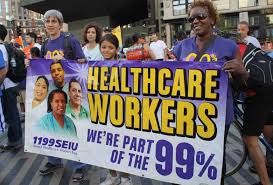
 Two pension funds affiliated with 1199 SEIU, the state’s largest and most influential union for health-care workers, recently disclosed that they are in “critical” status due to funding or liquidity problems for an 11th straight year.
The affected funds are the 41,201-member 1199 SEIU Greater New York Pension Fund, aimed at nursing home workers in the New York City region, and the 8,987-member Service Employees Pension Fund of Upstate New York for hospital and nursing home workers, which is jointly sponsored by 1199, SEIU Local 200 United and UNITE HERE Local 150.
The two plans’ fiscal woes date back to the aftermath of the Great Recession in 2009, when stock market losses took a toll on the assets of many pension systems. Since then, stocks prices have climbed at a historic pace and the number of fiscally troubled pension plans has dropped by more than half.
As of 2019, 98 multi-employer pension funds, or about 7 percent of all such plans, were listed in “critical and declining,” “critical” or “endangered” status, down from 232 in 2019.
The Greater New York fund said in a notice to members that it was in critical status because of “an accumulated funding deficiency for the current plan year.” The Upstate fund said it is “projected to have an accumulated funding deficiency at some point during the current plan year or the nine succeeding plan years.”
Funds in critical status may reduce adjustable benefits and are barred from issuing lump-sum distributions in excess of $5,000.
There are a total of five 1199-affiliated pension funds operating in New York, with $11 billion in assets and 421,000 participants, both active and inactive or retired. The 1199SEIU Health Care Employees Pension Fund, serving 264,517 current and former hospital workers, was the sixth largest in the nation as of 2015.
Based on their 2017 filings, all show signs of common ailments affecting defined-benefit pension systems, including low ratios of active to inactive members and substantial unfunded liabilities (see chart). The issues are similar to those affecting New York’s largest construction union pension plans, as E.J. McMahon blogged in this space last week.

For the five 1199 plans taken together, 44 percent of members are actively working – and thereby generating employer contributions to their respective pension systems.
By the funds’ own actuarial standards – which assume generous rates of return on investment, ranging from 7 percent to 7.75 percent – the systems’ assets are only 81 percent of the amount needed to guarantee future benefits.
Using the more conservative standard spelled out out in the Retirement Protection Act of 1994, the five systems are only 41 percent funded – leaving an unfunded liability of $16.2 billion.
If they are to make good on their commitments to retirees, the plans must ultimately close that gap through a combination of investment returns and contributions from their 588 participating employers, which are hospitals, nursing homes and other health-care providers across the state.
About the Author

You may also like

New York’s Health Premiums Stayed at the Top in 2025
New Yorkers and their employers paid the highest health premiums in the lower 48 states in 2025, and their costs moved further above the U.S. average, according to recently released federal data.
Read More

NY’s Medicaid Fraud Watchdog Shows Declining Performance
Enforcement by the New York's Office of Medicaid Inspector General has dropped in recent years across a range of benchmarks – a sign that the state's anti-fraud efforts have slackened even as its Medicaid spending soared. Read More
The Attorney General’s MFCU SNAFU
Attorney General Letitia James' latest fight with the Trump administration focuses on New York's Medicaid Fraud Control Unit, a federally funded agency housed in James' office.
On T Read More
Healthcare Revelations in the Enacted Budget Financial Plan
The state financial plan published on June 10 disclosed key information about healthcare revenue and spending that lawmakers had not made public when approving the annual budget two weeks before.
Read More
Federal Suit Traces Medicaid Fraud to the Top of NYS Government
The Trump administration's latest salvo against Medicaid fraud takes aim at a different kind of target – two high-ranking New York officials along with a major state contractor.
A Read More

Healthcare Highlights in the New State Budget
Governor Hochul's focus on affordability seems to have skipped over the healthcare portions of the new state budget.
The deal finalized May 27 Read More

Lawmakers Consider Hiking Fees for Filling Prescriptions
UPDATE: The proposal discussed below passed the Assembly Friday evening by an unofficial vote of 133-0. Having previously been approved by the Senate, the bill will head to Governor Hochul's desk for her signature or ve Read More
Budget Deal Reportedly Earmarks $100M for 1199 and Extends MCO Tax
As Governor Hochul and legislative leaders rush to finalize the overdue state budget, outlines of some healthcare-related deals have begun to emerge from the closed-door negotiations.
Read More