

The pattern of New York’s Covid-era demographic shifts became a little clearer with the release this week of the Census Bureau’s 2020-21 population estimates for towns and cities.
The “place” estimates are a follow-up to the Census Bureau’s annual state- and county-level estimates, issued in March, which indicated that New York’s population had decreased by a single-year record of 319,020, or 1.6 percent, during the 12 months ended July 1, 2021. This decrease wiped out nearly 40 percent of the surprisingly large state population growth found by the 2020 national decennial census.
With New York City accounting for nearly 96 percent of the total estimated population decline in 2020-21, the changes in other cities, towns and villages were mostly minor—averaging less than one percent up or down. During the 12-month period, populations declined in roughly two-thirds of the 3,395 New York cities, towns and villages for which estimates were produced.
According to the Census Bureau, New York’s biggest population increase occurred in Palm Tree, a newly formed town coterminous with the Orange County village of Kiryas Joel, which serves a mainly ultra-orthodox Jewish population. Palm Tree added 2,666 residents, a growth rate of 7.9 percent. Growth was otherwise seen in scattered pockets of the New York City suburbs, the Hudson Valley and Catskills and isolated towns and small cities in upstate, as indicated by the green-shaded areas on the map below.
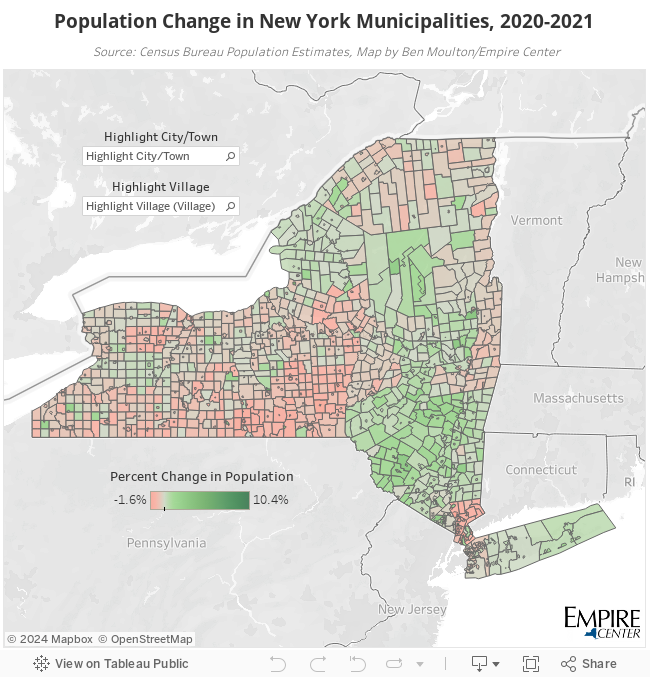
The Census Bureau’s annual population estimates, based on statistical sampling augmented by government tax records and vital statistics, are benchmarked every 10 years to the more complete decennial headcount of the American population, which is the basis for congressional and legislative apportionment. Released just over a year ago, the decennial census put New York’s 2020 total resident population at 20,201,249, an increase of 823,147 residents, or 4.25 percent, following several consecutive years of estimates pointing in the opposite direction. The census numbers represented the Empire State’s second fastest growth rate since the 1960s (it was 5.5 percent during the 1990s), and more than twice the 2000-2010 increase of 2.1 percent.
Then again, maybe the increase wasn’t so big after all. Last week, the Census Bureau issued a Post-Enumeration Survey Estimate Report—essentially a statistical second-guess of the census. The report found that New York’s population had been overcounted by 3.4 percent, or nearly 700,000 people. In absolute terms that was the biggest change among eight states in which the report found overcounts.
The official 2020 census numbers remain locked in place for the next decade as the basis for political apportionment purposes and also in some per-capita federal aid formulas. But the Post-Enumeration Survey, a version of which is conducted every 10 years, raised more questions than usual about the reliability of the Census Bureau’s people-counting and sampling techniques, especially as affected by pandemic disruptions that coincided with the 2020 headcount.
How could the census have been so far off? John Bacheller, former chief economist for the state Empire State Development Corp., has explored the question in an informative deep dive at his “Policy by the Numbers” blog. His penultimate graph sums it up:
The 2020 Census Post Enumeration Survey demonstrated that the likelihood that New York’s population increased as much from 2010 as the Decennial Census reported was less than 10% [i.e., its a 90 percent likelihood that the official Census count was not accurate]. But, because the [Post-Enumeration] Survey included a relatively small sample of New Yorkers, it is impossible to know the state’s precise population change. The range around New York’s 2020 population estimate for 95% certainty was 3.6% of the published value – a confidence interval of 697,000. The difference between the high end of the confidence interval and the low end resulted in 2010-2020 population change estimates ranging from a loss of 220,000 residents to a gain of 477,000. Smaller states had larger potential 2020 population estimate ranges and 2010-2020 population change confidence intervals.
On another element of population change, the 2019-20 taxpayer migration data from the Internal Revenue Service point to a sharp increase in net out-migration of New Yorkers to other states in (mainly) the year leading up to the pandemic. Census estimates for the state had pointed to a similar net outflow caused in part by continuing high rates of net out-migration between mid-2020 and July 1, 2021. Whatever the true population count, every available measure shows lots of New Yorkers are continuing to look for the exits.
You may also like

Hochul’s Energy Infrastructure Plan Gets the Diagnosis Right but Offers No Prescription
Editor’s note: Roger Caiazza is an adjunct fellow at the Empire Center. He has a long and deep private industry background in environmental regulatory analysis and compliance. His frequently updated personal blog on New York State environmental poli Read More
New Poll Shows New Yorkers Want Cheaper Energy — RGGI’s Price Record Shows They Aren’t Getting It
Editor's note: Roger Caiazza is an adjunct fellow at the Empire Center. He has a long and deep private industry background in environmental regulatory analysis and compliance. His frequently updated personal blog on New York Read More

New York’s Health Premiums Stayed at the Top in 2025
New Yorkers and their employers paid the highest health premiums in the lower 48 states in 2025, and their costs moved further above the U.S. average, according to recently released federal data.
Read More

NY’s Medicaid Fraud Watchdog Shows Declining Performance
Enforcement by the New York's Office of Medicaid Inspector General has dropped in recent years across a range of benchmarks – a sign that the state's anti-fraud efforts have slackened even as its Medicaid spending soared. Read More

The Attorney General’s MFCU SNAFU
Attorney General Letitia James' latest fight with the Trump administration focuses on New York's Medicaid Fraud Control Unit, a federally funded agency housed in James' office.
On T Read More
Healthcare Revelations in the Enacted Budget Financial Plan
The state financial plan published on June 10 disclosed key information about healthcare revenue and spending that lawmakers had not made public when approving the annual budget two weeks before.
Read More
Federal Suit Traces Medicaid Fraud to the Top of NYS Government
The Trump administration's latest salvo against Medicaid fraud takes aim at a different kind of target – two high-ranking New York officials along with a major state contractor.
A Read More

It Is Time to Rethink the Regional Greenhouse Gas Initiative
Before budget negotiations, Gov. Hochul warned that unless New York changes its climate plans, New Yorkers could face a $2.26-per-gallon increase in gasoline prices. The reason is the so-called “cap-and-invest” scheme, under which energy companies wou Read More