

New York’s state legislators would like a raise, but a review of state payroll data shows that more than three-quarters of them already earn more than their frequently cited $79,500 statutory base salary.
The extra pay consists of annual stipends issued to legislators who hold committee posts or other leadership titles. The payments, enumerated in Article 2, Section 5A of the Legislative law, range in value from $9,000 to $41,500.
At the start of 2015, the most recent full year for which legislative pay data are available, all 63 members of the state Senate were eligible to collect a stipend on top of base pay. (Some senators have declined to accept the stipend associated with their leadership position.) Nearly five out of six senators were paid more than $90,000 in 2015, including 15 who were paid more than $100,000.
More than two-thirds of the members of the Assembly received a stipend, with 104 assembly members collecting them in 2015. More than half of Assembly members (81) were paid more than $90,000, including 12 who were paid more than $100,000.
The New York Legislature’s base pay of $79,500 is the third highest in the country, trailing only California and Pennsylvania, and its operational budget of $906,418 per member (as of 2012) is the fourth largest, behind state legislatures in California, Pennsylvania and Florida. As of 2011, New York spent the most of any state on added legislative pay stipends, according to this analysis by an Illinois newspaper, based on National Conference of State Legislatures data.
Click here for a 50-state rundown of legislative pay and legislative budgets.
Albany lawmakers have given themselves five raises since 1970. Adjusting for inflation, their base pay over the past 46 years has averaged $89,630. The last raise was adopted in 1998 and took effect in 1999. At that point, it was the equivalent in 2016 dollars of $115,171.
About the Author

You may also like

Switching to Electric Home Heating Could Add Thousands to Energy Bills
FOR IMMEDIATE RELEASE: ALBANY, N.Y. that heating an average home from October to March would cost approximately $790 with natural gas, compared with $1,100 with a heat pump and $3,300 with electr Read More
Hochul’s Energy Infrastructure Plan Gets the Diagnosis Right but Offers No Prescription
Editor’s note: Roger Caiazza is an adjunct fellow at the Empire Center. He has a long and deep private industry background in environmental regulatory analysis and compliance. His frequently updated personal blog on New York State environmental poli Read More

Poll: 64% of New Yorkers Back Eliminating the State Income Tax; 67% Say State Taxes Aren’t Delivering
Dissatisfaction spans party and regional lines as broad majorities rally behind sweeping tax reform
FOR IMMEDIATE RELEASE: ALBANY, N.Y. - New Yorkers are delivering a blunt assessment of the state’s tax system: 67% say they ar Read More
New Yorkers Want to Eliminate the Income Tax
Summary
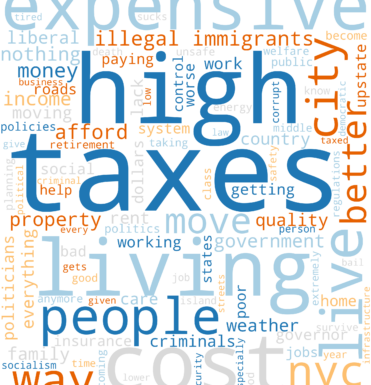
New Yorkers have reached a clear verdict: The state’s tax system is not delivering. A full 67% say they are not getting good value for their tax dollars, while 64% support eliminating the state income tax. Read More
SUNY Research Foundation Payroll Tops $400 Million
Payroll records for 8,401 employees of the Research Foundation for the State University of New York (RF SUNY) for fiscal year 2026 are , the Empire Center's government transparency website.
The Research Foundation is a private, nonprofit educational co Read More

Newly Retired NYC Firefighters Average Over $177k In Pensions
New York City firefighters and fire officers retiring last year after full careers were entitled to average annual pension benefits of $177,016, according to , the Empire Center's government transparency website.
Among the 499 new retirees with at leas Read More
New York Annual Household Electricity Costs Rise $270
FOR IMMEDIATE RELEASE ALBANY, N.Y. — New York’s average residential electricity price reached 29.90 cents per kilowatt-hour (kWh) in July 2026, the fifth highest in the nation and 63.3 percent Read More
Energy Data Bulletin September 2026
September 2026
Summary and Insights
Electricity. In June 2026, New York had the nation's fifth-highest residential electricity price at 29.49 cents per kilowatt-hour (kWh), 60.8 percent above the U.S. average. Prices d Read More