

 The growth of Obamacare-related health coverage in New York slowed to 3 percent over the past year, as surging enrollment in the Essential Plan and Child Health Plus was offset by declining signups for commercial plans and Medicaid.
It was the state’s smallest annual increase in the combined enrollment of the programs since President Obama’s Affordable Care Act took full effect in 2014.
The numbers suggest that the shrinking of New York’s uninsured rate, which went from 10 percent in 2013 to 5 percent last year, may be coming to an end. If not for strong growth in the Essential Plan – the funding for which is in jeopardy – total ACA-related enrollment would have declined over the past year.
Earlier this year, the state’s ACA exchange, known as the New York State of Health, reported that it had enrolled 3.6 million people for coverage as of January 31, up 28 percent, or about 800,000, from the year before.
However, those figures left out the large but declining group who signed up for two programs, Medicaid and Child Health Plus, without using the exchange. The 28 percent increase mainly reflected a shift in bureaucratic procedure rather than an expansion of coverage.
Now, thanks to updated enrollment counts from the state Health Department and the federal Centers for Medicare & Medicaid Services, the underlying trends can be better tracked.
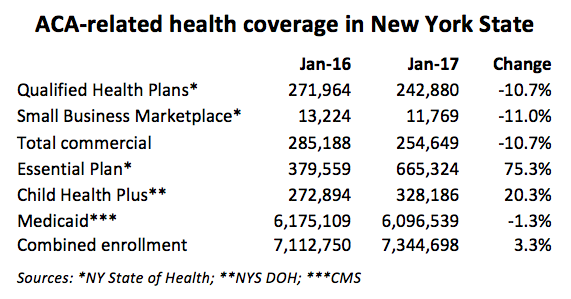
As seen in the chart, the fastest-growing program was the Essential Plan, where enrollment increased by 75 percent. This government-funded option, launched in 2016, is aimed at people with incomes up to 200 percent of the federal poverty level ($24,120 for an individual). The premiums are either free or $20 a month, or depending on income, and there are no copayments or deductibles. The program relies heavily on federal aid that is on the chopping block in Washington.
Commercial coverage, meanwhile, dropped by 11 percent – possibly due in part to “crowding out” by the Essential Plan. Even with heavy tax subsidies available through Obamacare, commercial plans come with higher premiums and out-of-pocket expenses than the Essential Plan.
Child Health Plus, which covers low-income children, saw 20 percent growth in January after several years of declining or flat enrollment. What drove the sudden turnaround in a long-standing program is not immediately clear.
The state’s Medicaid program, meanwhile, declined by just over 1 percent, a sign that a burst of enrollment under Obamacare has effectively reached all of the eligible population. The program peaked at 6.5 million in October 2015 and now stands at 6.1 million, or just under one-third of the state’s population.
This analysis does not include people who enrolled in commercial coverage outside of the exchange, statistics for which are not readily available.
ACA-related programs enrolled a total of 6.2 million New Yorkers in 2014, the first year that the health reform law became fully effective. That total grew by 10 percent in 2015, 4 percent in 2016, and 3 percent in 2017 — for a total increase of 1.1 million since 2014.
Comparisons to pre-Obamacare enrollment are difficult to make, because some enrollees switched from private coverage or other state programs that no longer exist. Overall, the state’s uninsured rate dropped from 10 percent in 2013 to 5 percent last year — which corresponds to a coverage expansion of about 1 million New Yorkers.
About the Author

You may also like

Hochul’s Energy Infrastructure Plan Gets the Diagnosis Right but Offers No Prescription
Editor’s note: Roger Caiazza is an adjunct fellow at the Empire Center. He has a long and deep private industry background in environmental regulatory analysis and compliance. His frequently updated personal blog on New York State environmental poli Read More
New Poll Shows New Yorkers Want Cheaper Energy — RGGI’s Price Record Shows They Aren’t Getting It
Editor's note: Roger Caiazza is an adjunct fellow at the Empire Center. He has a long and deep private industry background in environmental regulatory analysis and compliance. His frequently updated personal blog on New York Read More

New York’s Health Premiums Stayed at the Top in 2025
New Yorkers and their employers paid the highest health premiums in the lower 48 states in 2025, and their costs moved further above the U.S. average, according to recently released federal data.
Read More

NY’s Medicaid Fraud Watchdog Shows Declining Performance
Enforcement by the New York's Office of Medicaid Inspector General has dropped in recent years across a range of benchmarks – a sign that the state's anti-fraud efforts have slackened even as its Medicaid spending soared. Read More
The Attorney General’s MFCU SNAFU
Attorney General Letitia James' latest fight with the Trump administration focuses on New York's Medicaid Fraud Control Unit, a federally funded agency housed in James' office.
On T Read More
Healthcare Revelations in the Enacted Budget Financial Plan
The state financial plan published on June 10 disclosed key information about healthcare revenue and spending that lawmakers had not made public when approving the annual budget two weeks before.
Read More
Federal Suit Traces Medicaid Fraud to the Top of NYS Government
The Trump administration's latest salvo against Medicaid fraud takes aim at a different kind of target – two high-ranking New York officials along with a major state contractor.
A Read More

It Is Time to Rethink the Regional Greenhouse Gas Initiative
Before budget negotiations, Gov. Hochul warned that unless New York changes its climate plans, New Yorkers could face a $2.26-per-gallon increase in gasoline prices. The reason is the so-called “cap-and-invest” scheme, under which energy companies wou Read More