

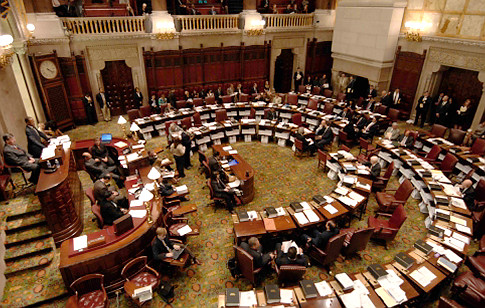
 Nearly six months after being passed by the state Legislature, two bills with significant implications for public pension benefit levels and costs in New York finally have been sent to Governor Andrew Cuomo for his veto or signature.
The broadest of the two measures, A9643A, would expand the share of public pension funds that can be invested in complex, high-risk alternative assets such as private equity and hedge funds. It would raise, from to 30 percent from 25 percent, New York’s statutory “basket clause” cap on such investments.
If Cuomo signs the bill, the New York State and New York City pension funds will move further in the opposite direction from the $300 billion California Public Employees’ Retirement System (Calpers), which recently announced it would eliminate its investment in hedge funds due to their “complexity, cost, and the lack of ability to scale.”
Another bill, S7757, would benefit uniformed state court officers hired since April 1, 2012, by lowering their “normal” retirement age to 62 from 63 and restoring the option of retiring at age 55 after 30 years of service. As explained here, the bill would have a minimal immediate cost but would represent the first attempted rollback of any provision of Gov. Andrew Cuomo’s “bold and transformational” Tier 6 pension package of 2012.
The bills, both of which passed near the end of session in June by lopsided margins with no debate, were sent to the governor on Friday, Dec. 5. His 10-day period (excluding Sundays) for signing or vetoing each measure expires Dec. 17.
Another pension-related bill sent to the governor last week was A9162, which would, as described by the Citizens Budget Commission, “circumvent a recent court ruling by allowing Tier III and V police and firefighters hired between July 1, 2009 and March 31, 2012, who may have been working under an expired collective bargaining agreement, to join an optional 20-year retirement plan without any employee contributions.”
You may also like

Hochul’s Energy Infrastructure Plan Gets the Diagnosis Right but Offers No Prescription
Editor’s note: Roger Caiazza is an adjunct fellow at the Empire Center. He has a long and deep private industry background in environmental regulatory analysis and compliance. His frequently updated personal blog on New York State environmental poli Read More
New Poll Shows New Yorkers Want Cheaper Energy — RGGI’s Price Record Shows They Aren’t Getting It
Editor's note: Roger Caiazza is an adjunct fellow at the Empire Center. He has a long and deep private industry background in environmental regulatory analysis and compliance. His frequently updated personal blog on New York Read More

New York’s Health Premiums Stayed at the Top in 2025
New Yorkers and their employers paid the highest health premiums in the lower 48 states in 2025, and their costs moved further above the U.S. average, according to recently released federal data.
Read More

NY’s Medicaid Fraud Watchdog Shows Declining Performance
Enforcement by the New York's Office of Medicaid Inspector General has dropped in recent years across a range of benchmarks – a sign that the state's anti-fraud efforts have slackened even as its Medicaid spending soared. Read More

The Attorney General’s MFCU SNAFU
Attorney General Letitia James' latest fight with the Trump administration focuses on New York's Medicaid Fraud Control Unit, a federally funded agency housed in James' office.
On T Read More
Healthcare Revelations in the Enacted Budget Financial Plan
The state financial plan published on June 10 disclosed key information about healthcare revenue and spending that lawmakers had not made public when approving the annual budget two weeks before.
Read More
Federal Suit Traces Medicaid Fraud to the Top of NYS Government
The Trump administration's latest salvo against Medicaid fraud takes aim at a different kind of target – two high-ranking New York officials along with a major state contractor.
A Read More

It Is Time to Rethink the Regional Greenhouse Gas Initiative
Before budget negotiations, Gov. Hochul warned that unless New York changes its climate plans, New Yorkers could face a $2.26-per-gallon increase in gasoline prices. The reason is the so-called “cap-and-invest” scheme, under which energy companies wou Read More