

An anonymous Paterson Administration official is quoted in today’s Albany Times Union as predicting that the governor’s budget proposal would include an “aggressive set of cuts” that will leave “blood in the streets.” Maybe he meant ketchup – for despite what the governor calls a “staggering deficit,” Paterson’s 2009-10 Executive Budget would not reduce overall spending. In fact, if enacted as proposed, the budget would grow slightly.

The bellwether State Funds portion of the budget – including all operations and capital spending, but excluding federal grants – would rise by 1.7 percent next year under the plan the governor presented to the Legislature today. The State Operating Funds category, which excludes capital, would rise 0.5 percent. The core General Fund would be held flat. On an All Funds basis (including federal grants and off-budget capital spending), the budget would grow 0.6 percent. Meanwhile, the Division of the Budget (DOB) forecasts inflation of just 1.1 1.2 percent for the fiscal year that begins April 1.
Paterson’s proposed spending increases are significantly lower than those proposed by former Governor Eliot Spitzer, whose first two Executive Budgets called for State Funds spending increases of 8 percent and 6.2 percent, respectively. Both were more than double the inflation rate at the time.
But the 2009-10 Executive Budget would not cut as deeply as several of former Governor George Pataki’s proposals, as shown below. (Pataki, like Paterson this year, presented his 1996-97 plan a full month early.)
Note: chart below corrects originally posted version, in which General Fund and State Funds growth rates for 2009-10 were inadvertently transposed.
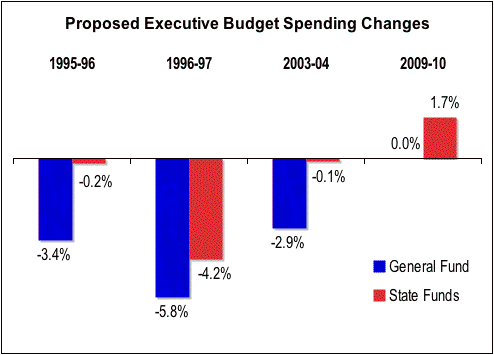
Inflation was averaging closer to 3 percent when Pataki was governor, so his proposed cuts were somewhat larger in real terms than they appear in nominal terms.
The annual Executive Budget essentially sets a floor for negotiation with the Legislature, which inevitably seeks to “restore” and add funds to the governor’s proposal before enacting a budget. The following chart illustrates proposed and enacted growth in State Funds spending going back to Pataki’s first fiscal year as governor.

Paterson now projects a $1.7 billion budget gap for fiscal year 2008-09, which ends March 31, and a $13.7 billion shortfall for 2009-10. He would close these gaps through:
- $9.15 billion in “spending restraint” derived mainly from preventing scheduled growth in next year’s soaring “baseline” budget (the amounts that would be spent under current law if the budget was left on autopilot). The Largest single real reduction would be achieved through elimination of “Middle Class STAR” property tax rebates and other changes in the STAR homestead exemption, which saves $1.7 billion. Net of savings achieved through cuts in reimbursement rates for hospitals and nursing homes, state-funded Medicaid spending would still rise $404 million (3.2 percent) next year. School aid would increase by $41 million (0.2 percent) on a state fiscal year basis, but would decrease $698 million (3.3 percent) on a school year basis. However, if the budget is adopted as proposed, school aid next year will still be 5 percent higher than it was in the 2007-08 school year.
- $3 billion in tax and fee hikes, the largest of which is a doubling of the gross receipts assessment on utilities, slated to raise $652 million (effectivelty raising energy costs).
- $1.1 billion in non-recurring one-shot revenues, including a slight delay in one Medicaid billing cycle.
You may also like

Four Problems with a Statewide Pied-à-Terre Tax
Soon after Governor Hochul floated the idea of a "pied-à-terre" tax in New York City, Albany Sen. Patricia Fahy proposed to expand the concept to the rest of the state.
As with H Read More
Albany Should Listen to Jamie Dimon
In his annual message to shareholders, JP Morgan Chase's chief executive, Jamie Dimon, offered a timely and pointed warning for New York policymakers.
It's worth , with emphasis add Read More

Budget Update Paints Less Alarming Picture of Federal Health Cuts
A new fiscal report from the state Budget Division suggests federal funding cuts will hit New York's health-care budget less severely than officials have previously warned.
A relea Read More

How Immigrants Became a Cash Cow for New York’s Essential Plan
The Hochul administration's move to shrink the Essential Plan in response to federal budget cuts has exposed a surprising reality:
For the past decade, immigrants have been a cash c Read More

How Washington’s Budget Bill Will Affect Health Care in New York
UPDATE: The final version of the federal budget bill omitted a handful of provisions that had been included in earlier drafts. One would have penalized states that use their own money to provide coverage for undocumente Read More

Two Dozen School Districts Are Returning to the Polls for Budget Revotes
Voters in 24 New York school districts return to the polls on Tuesday for school budget revotes. Last month, voters in 96 percent of school districts outside New York City conducting votes approved their school budgets for the upcoming year.
The 683 sc Read More

New York’s Proposed ‘MCO Tax’ Would Generate a Fraction of What Lawmakers Expected
The Hochul administration's proposed "MCO tax" would generate far less than the $4 billion in extra federal aid anticipated by state lawmakers when they approved the concept this spring, according to documents obtained by t Read More

How 1199 Earns its Reputation as Albany’s No. 1 Labor Power Broker
For the fourth time in six years, the president of New York's largest health-care union, George Gresham of 1199SEIU, has won the top spot on the "Labor Power 100" list from City &am Read More