

 State-regulated health premiums for 2020 are rising faster than the medical inflation rate for the sixth year in a row, yet the officials who signed off on the hikes insist they have saved consumers money – because average premiums are lower than what insurers originally requested.
Positive spin notwithstanding, it’s increasingly evident that the state’s nine-year-old price-control regime, known as “prior approval,” is failing as a strategy to keep health costs in check.
The bottom line of Friday’s announcement by the Department of Financial Services is that individual premiums for 2020 will rise by an average of 6.8 percent, and small-group premiums will be up 7.9 percent. Both numbers are well above the Consumer Price Index for medical care, which is currently less than 3 percent.
This round of hikes was hardly unusual. The average annual increase over the past six years was 9.8 percent for individual plans and 7.6 percent for small groups.
It’s true that the final rates are lower than what insurers applied for – by 2.4 points for individual plans, and 4.3 points for small groups. The more important question is: Are premiums lower than they would have been if the price controls did not exist at all? A close look at the data suggests the answer is no.
The prior approval law – which was repealed after 2000, then reinstated in 2010 – regulates policies sold to individuals and small groups but exempts large groups of 100 or more.
This sets up a kind of natural experiment: If the law were effectively controlling costs, regulated small groups would show signs of becoming more affordable relative to unregulated large groups. In fact, just the opposite is the case.
According to annual federal surveys, the difference between New York’s premiums and national averages is consistently higher for small groups than large groups – and the disparity seems to have gotten worse since prior approval took effect. (Because of how the federal data is categorized, this analysis compares small groups of fewer than 50 members to large groups of 1,000 or more. The survey focuses on employer-sponsored insurance and does not gather data on individual policies.)
For large groups, the affordability gap between New York’s premiums and the national norm has ranged since 2010 from 4 percent to 12 percent. For groups of fewer than 50, the gap ranged from 6 percent to a remarkable 31 percent in 2018, which was a 23-year high (see chart).
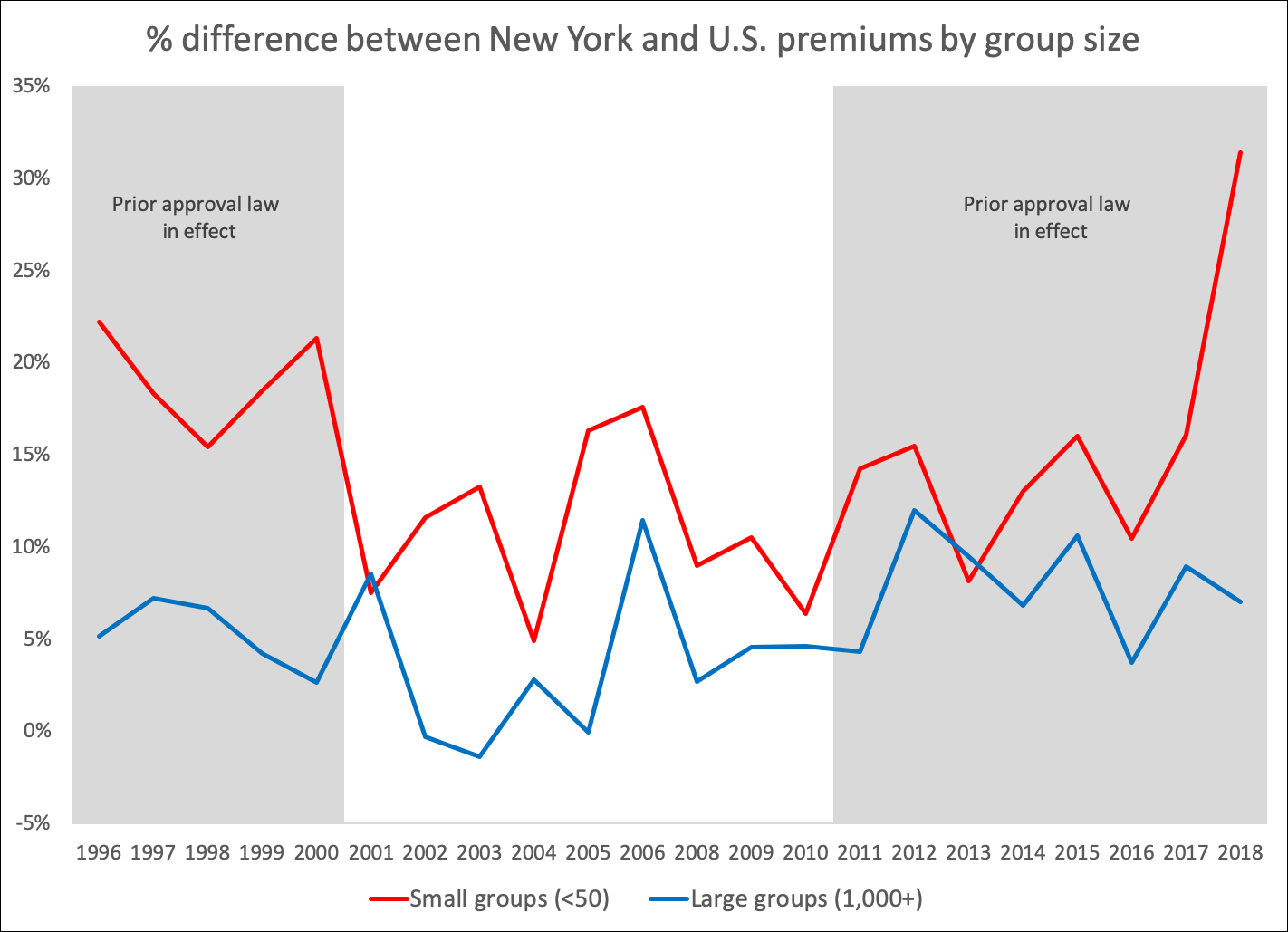
There’s no sign in these figures that prior approval is working at all. In fact, a case could be made that it’s making things worse.
For one thing, the give-and-take of the regulatory process encourages insurance companies to err on the high side when submitting their initial requests, knowing that they’re likely to get less in the end.
For another, prior approval does nothing to address the root causes that push premiums higher, primarily rising prices charged by drug companies, hospitals, doctors and other providers. Another factor is state policy – including heavy taxes on health insurance and a lengthening list of coverage mandates imposed on insurers.
Many large employers choose to “self-insure,” which exempts them from mandates and other state laws. Small groups, by contrast, are fully exposed to Albany’s regulatory regime.
The results of the current approach are seen in the table below: Single coverage for New York’s price-regulated small groups cost $2,094 more than the national average, while the gap for unregulated large groups is $478.

About the Author

You may also like

New Poll Shows New Yorkers Want Cheaper Energy — RGGI’s Price Record Shows They Aren’t Getting It
Editor's note: Roger Caiazza is an adjunct fellow at the Empire Center. He has a long and deep private industry background in environmental regulatory analysis and compliance. His frequently updated personal blog on New York Read More

New York’s Health Premiums Stayed at the Top in 2025
New Yorkers and their employers paid the highest health premiums in the lower 48 states in 2025, and their costs moved further above the U.S. average, according to recently released federal data.
Read More

NY’s Medicaid Fraud Watchdog Shows Declining Performance
Enforcement by the New York's Office of Medicaid Inspector General has dropped in recent years across a range of benchmarks – a sign that the state's anti-fraud efforts have slackened even as its Medicaid spending soared. Read More
The Attorney General’s MFCU SNAFU
Attorney General Letitia James' latest fight with the Trump administration focuses on New York's Medicaid Fraud Control Unit, a federally funded agency housed in James' office.
On T Read More
Healthcare Revelations in the Enacted Budget Financial Plan
The state financial plan published on June 10 disclosed key information about healthcare revenue and spending that lawmakers had not made public when approving the annual budget two weeks before.
Read More
Federal Suit Traces Medicaid Fraud to the Top of NYS Government
The Trump administration's latest salvo against Medicaid fraud takes aim at a different kind of target – two high-ranking New York officials along with a major state contractor.
A Read More

It Is Time to Rethink the Regional Greenhouse Gas Initiative
Before budget negotiations, Gov. Hochul warned that unless New York changes its climate plans, New Yorkers could face a $2.26-per-gallon increase in gasoline prices. The reason is the so-called “cap-and-invest” scheme, under which energy companies wou Read More

Healthcare Highlights in the New State Budget
Governor Hochul's focus on affordability seems to have skipped over the healthcare portions of the new state budget.
The deal finalized May 27 Read More