

In the midst of the constitutional showdown over his pandemic policies, Governor Cuomo made changes to a disputed Brooklyn ‘cluster zone’ that seemed to contradict his own declared guidelines.
The changes rolled back limits on religious gatherings, schools and businesses even though coronavirus metrics remained above the official limits. This seeming attempt to finesse a lawsuit over religious freedom gives credence to the perception that Cuomo enforces his cluster-zone policy arbitrarily.
If the governor was trying to head off an adverse ruling by the Supreme Court, his strategy did not work: In a 5-4 ruling on Thanksgiving eve, the justices struck down the cluster-zone limits on religious gatherings as a violation of the First Amendment’s protection of freedom of worship.
The episode adds to the confusion surrounding the Cuomo administration’s pandemic management as the state heads into the holiday season with a sharply rising infection rate.
The cluster-zone strategy, first announced on Oct. 6, imposes special restrictions on limited areas with especially severe coronavirus outbreaks. The tightest rules apply to “red” zones – including a limit of 10 people at religious gatherings, which was challenged in federal court by the Roman Catholic Diocese of Brooklyn and Agudath Israel, an Orthodox Jewish organization.
According to the guidelines, zones move in and out of the various color levels based on a variety of data points, including most prominently the “positivity rate” – the percentage of tests that come back positive in a seven-day period.
The Brooklyn zone was supposed to stay red until its positivity rate dropped below 3 percent for three consecutive days, and could move from orange to yellow only after its rate dropped below 2 percent for three days.
However, Cuomo switched the zone to orange on Nov. 9, and to yellow on Nov. 18, even though its positivity rate – as reported at the governor’s daily briefings – never dropped below 3 percent (see chart). The governor said the zone “has continued to demonstrate progress” but did not explain why he was disregarding the positivity thresholds.
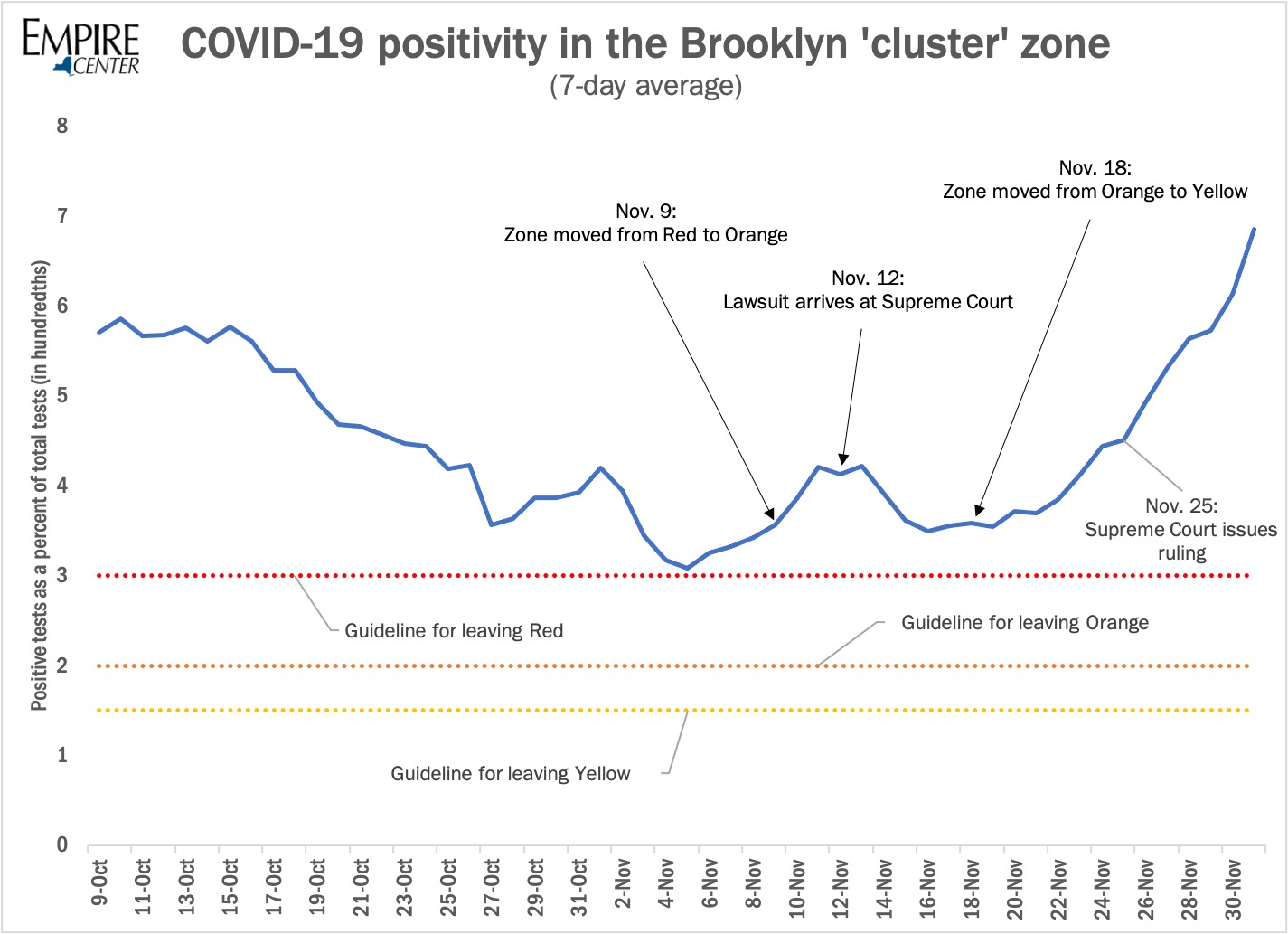
In the midst of those transitions, on Nov. 12, the religious groups’ appeal arrived at the Supreme Court. On Nov. 19, the state’s solicitor general, Barbara Underwood, notified the court in a letter that the disputed limits on worship had been eased – effectively granting the plaintiffs the relief they had sought.
Given that development, the dissenting justices – including Chief Justice John Roberts – argued that there was no longer a need for the court to intervene. The majority ruled otherwise, noting that the limits they considered unconstitutional might be reinstated at any time so long as the cluster policy remained in place.
With or without the restrictions on worship, it was unclear that the cluster zone policy was working. In the two months it has been in force, the state’s autumn wave has gotten markedly worse. New York’s infection rate remains low compared to the national average, but it has risen more sharply than any other state’s over the past two weeks.
Nor can it be said that the autumn wave is any longer contained to isolated clusters. The statewide positivity rate has risen past 4 percent, and at least 16 entire counties were above the cluster-zone thresholds as of late last month.
Although Cuomo is standing by his strategy, he has acknowledged the worsening trend – and promised additional, yet to be specified measures to monitor and mitigate pressure on hospitals. It remains to be seen if this new approach will be more effective, and more consistently enforced, than what has gone before.
About the Author

You may also like

New York’s Health Premiums Stayed at the Top in 2025
New Yorkers and their employers paid the highest health premiums in the lower 48 states in 2025, and their costs moved further above the U.S. average, according to recently released federal data.
Read More

NY’s Medicaid Fraud Watchdog Shows Declining Performance
Enforcement by the New York's Office of Medicaid Inspector General has dropped in recent years across a range of benchmarks – a sign that the state's anti-fraud efforts have slackened even as its Medicaid spending soared. Read More
The Attorney General’s MFCU SNAFU
Attorney General Letitia James' latest fight with the Trump administration focuses on New York's Medicaid Fraud Control Unit, a federally funded agency housed in James' office.
On T Read More
Healthcare Revelations in the Enacted Budget Financial Plan
The state financial plan published on June 10 disclosed key information about healthcare revenue and spending that lawmakers had not made public when approving the annual budget two weeks before.
Read More
Federal Suit Traces Medicaid Fraud to the Top of NYS Government
The Trump administration's latest salvo against Medicaid fraud takes aim at a different kind of target – two high-ranking New York officials along with a major state contractor.
A Read More

Healthcare Highlights in the New State Budget
Governor Hochul's focus on affordability seems to have skipped over the healthcare portions of the new state budget.
The deal finalized May 27 Read More

Lawmakers Consider Hiking Fees for Filling Prescriptions
UPDATE: The proposal discussed below passed the Assembly Friday evening by an unofficial vote of 133-0. Having previously been approved by the Senate, the bill will head to Governor Hochul's desk for her signature or ve Read More
Budget Deal Reportedly Earmarks $100M for 1199 and Extends MCO Tax
As Governor Hochul and legislative leaders rush to finalize the overdue state budget, outlines of some healthcare-related deals have begun to emerge from the closed-door negotiations.
Read More