

From Comptroller Thomas DiNapoli’s new report on the financial meltdown’s economic impact on New York, there’s this chart comparing the drop in Wall Street jobs during the “current downturn” (dated back to the summer of 2007) to losses following the crash of 1987 and the “Dot-Com and 9/11” decline beginning in 2001:
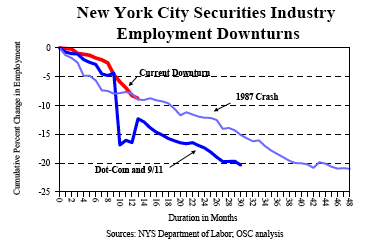
So far, the trend is closely following the 1987 track, during which securities industry employment took four years to hit bottom. But this chart, and others like it, may actually understate the problem. This is not just another “downturn” but a massive upheaval in a sector whose business model is, basically, broken. The financial sector that emerges from the ashes will be far leaner and more heavily regulated than Wall Street used to be. Beyond the budget cuts needed to close next year’s gap, both the state and city budgets must be fundamentally restructured to reflect this new economic reality.
Another key finding of the comptroller’s report: Hedge funds and private equity firms are the strongest remaining players in New York’s securities industry. It’s vitally important for New York to hold onto these businesses in the years ahead, obviously. But state officials need to recognize that the largest and most profitable of these firms tend to be small, employing just 100 people on average. The typical investment boutique is far more nimble and mobile than a big old-fashioned investment bank. Small hedge funds and private equity firms will find it easier to pick up stakes in search of friendlier business climates if the state and city respond to the budget crisis by hammering investment managers with income tax increases.
You may also like
Albany Should Listen to Jamie Dimon
In his annual message to shareholders, JP Morgan Chase's chief executive, Jamie Dimon, offered a timely and pointed warning for New York policymakers.
It's worth , with emphasis add Read More
Parsing the Impact of Mamdani’s Tax Hike Plans
The front-running candidate for New York City mayor, Zohran Mamdani, has said he can finance his costly campaign promises – including free buses and universal child care – by taxing only a sliver of the city's residents Read More

At mid-year, NY still far below most states in pandemic jobs recovery
New York has added private-sector jobs in all but three of the 38 months since the COVID-19 outbreak of March 2020—but the Empire State remains below its pre-pandemic employment level and continues to trail the national recovery.
On a seasonally adju Read More

New York’s pricey hospitals draw pushback from labor
A City Council hearing in Manhattan on Thursday promises a rare scene in New York politics: hospitals playing defense. The council is debating whether to establish a watchdog agency focused on the high price of hospital care in New York, with a goal of helping the city and other employers contain the rapidly rising cost of health benefits for workers. Read More

At end of ’22, NY still near bottom in pandemic recovery
The more time passes since the spring 2020 Covid-19 outbreak, the more New York stands out among all states for the weakness of its post-pandemic employment recovery.
As of December, seasonally adjusted private employment in New York was still nearly 2 Read More

On College Readiness, Comptroller Asks Wrong Question, Delivers Flawed Answer
Graduation rates are rising while standards for graduation are falling. It begs the question: What number of graduating students are college ready? Read More

A Look at Covid Learning Loss in NYC
New York City set an example worthy of approbation and emulation by publishing their grade 3-8 test results in math and English language arts. Read More

Judge, Jury and … CFO?
A state court judge at a hearing this morning will consider whether to interfere with New York City authority over its own budget by ordering a preliminary injunction that ices a portion of Gotham’s recently enacted FY 23 city budget. Read More