

 Congressional Republicans today unveiled a summary of their plans for permanently extending last year’s federal income tax cuts—which were financed in large part by the revenue raised from a $10,000 cap on state and local tax (SALT) deductions.
The House Ways and Means Committee released a two-page “listening session framework” for what it bills as “Tax Reform 2.0.” It’s actually little more than self-congratulatory press release outline promising to “build on the growing successes” of the Tax Cut and Jobs Act (TCJA), which Congress passed and President Trump signed into law last December.
There is still no bill language for the promised second-generation tax bill—and apparently won’t be until a planned vote as early as September. But the rhetoric surrounding the release certainly implies that the Republican leadership wants to vote on extending all of the individual income tax changes in the TCJA—which (unless they’re willing to add to projected deficits) would necessarily include the SALT cap as well as tax rate cuts and bracket adjustments, expansion of the standard deduction and child credits, and rollback of the Alternative Minimum Tax (AMT).
Unlike the corporate tax cuts approved as part of the TCJA, the individual income tax changes were nearly all scheduled to expire in 2025, because permanent changes affecting projected deficits beyond 10 years would have required an unattainable 60 votes in the Senate.
The new wrinkle in the House Ways and Means framework is a promise of new “family-friendly savings plans,” including:
• USA accounts. Creating a new Universal Savings Account to offer a fully flexible savings tool for families.
• Expanded 529 Education accounts. Building upon the improvements in the Tax Cuts and Jobs Act so families can also use their education savings to pay for apprenticeship fees to learn a trade, cover the cost of home schooling, and help pay off student debt.
• New Baby savings. Allowing families to access their own retirement accounts penalty-free for expenses when welcoming a new child into the family, whether by birth or adoption. And allowing families to replenish those accounts in the future.
Also promised: an unspecified “range of proposals”—presumably including those “USA Accounts”—to “help local businesses provide retirement plans to their workers—and to help workers participate in those plans so their retirement years are more secure.” And provisions to “help brand-new businesses write off more of their initial start-up costs, and remove barriers to growth.”
These new breaks obviously would add to the fiscal impact of the other tax cuts, and thus make it inevitable that the plan will permanently extend the SALT cap to help continue paying for the whole thing.
SALT aside, a crucial second-stage tax reform issue for New York State congressional representatives will be the income thresholds attached to the proposed savings plans. The original TCJA focused on “middle class” as defined by midwest (and upstate) living standards. If this remains the approach, a broad swath of New York’s downstate middle class, whose family incomes typically are in low six-figures, will derive less benefit from these sorts of changes.
Senate Republicans reportedly are cool to the idea of voting on a permanent tax cut extension before the election. House Ways and Means Chairman Kevin Brady of Texas indicated the second-generation reform would ultimately “move as three separate bills—permanency, savings and innovation, to allow the House and Senate to set the right timing and gauge the interest on each of area,” Bloomberg News reported.
Whatever form it takes, Governor Cuomo can be expected to harshly denounce Tax Reform 2.0. Meanwhile:
- last week, New York and three other states filed a federal lawsuit seeking to block implementation of the SALT cap (on highly questionable grounds); and
- the July 18 deadline passed for comments on the “discussion draft” of a Cuomo administration proposal to resurrect the state Unincorporated Business Tax to preserve deductibility of employer-partner-owner compensation for “pass-through entities,” the predominant form of small business organization.
House Republicans have acknowledged that the curtailment of SALT was designed to help finance tax cuts by denying most of the deductions previously claimed by high-earning households in a handful of high-tax (and overwhelmingly Democratic) states, especially New York and California.
In attacking the SALT provision, Cuomo has repeatedly implied that New Yorkers in general will be paying higher taxes under the new federal law. In fact, as acknowledged even in the multi-state lawsuit, the vast majority of New Yorkers will not be paying higher taxes.
You may also like

New Poll Shows New Yorkers Want Cheaper Energy — RGGI’s Price Record Shows They Aren’t Getting It
Editor's note: Roger Caiazza is an adjunct fellow at the Empire Center. He has a long and deep private industry background in environmental regulatory analysis and compliance. His frequently updated personal blog on New York Read More

New York’s Health Premiums Stayed at the Top in 2025
New Yorkers and their employers paid the highest health premiums in the lower 48 states in 2025, and their costs moved further above the U.S. average, according to recently released federal data.
Read More

NY’s Medicaid Fraud Watchdog Shows Declining Performance
Enforcement by the New York's Office of Medicaid Inspector General has dropped in recent years across a range of benchmarks – a sign that the state's anti-fraud efforts have slackened even as its Medicaid spending soared. Read More
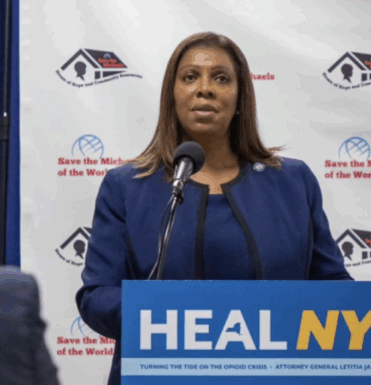
The Attorney General’s MFCU SNAFU
Attorney General Letitia James' latest fight with the Trump administration focuses on New York's Medicaid Fraud Control Unit, a federally funded agency housed in James' office.
On T Read More
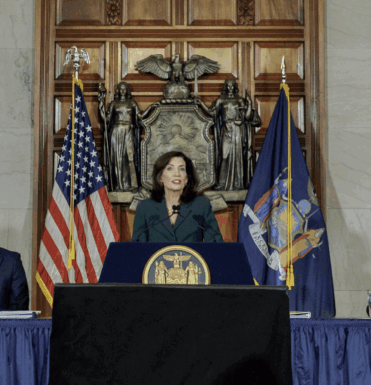
Healthcare Revelations in the Enacted Budget Financial Plan
The state financial plan published on June 10 disclosed key information about healthcare revenue and spending that lawmakers had not made public when approving the annual budget two weeks before.
Read More
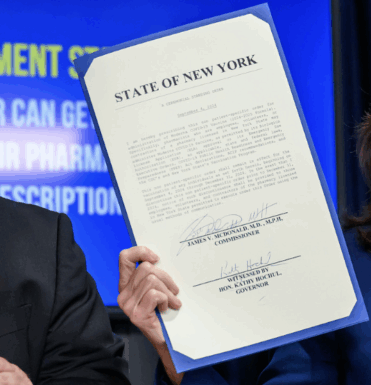
Federal Suit Traces Medicaid Fraud to the Top of NYS Government
The Trump administration's latest salvo against Medicaid fraud takes aim at a different kind of target – two high-ranking New York officials along with a major state contractor.
A Read More

It Is Time to Rethink the Regional Greenhouse Gas Initiative
Before budget negotiations, Gov. Hochul warned that unless New York changes its climate plans, New Yorkers could face a $2.26-per-gallon increase in gasoline prices. The reason is the so-called “cap-and-invest” scheme, under which energy companies wou Read More

Healthcare Highlights in the New State Budget
Governor Hochul's focus on affordability seems to have skipped over the healthcare portions of the new state budget.
The deal finalized May 27 Read More