

In her first State of the State message today, Governor Kathy Hochul pledged to accelerate scheduled personal income tax cuts for “middle class” New Yorkers, with a fiscal impact she pegged at $1.2 billion.
That figure sounds large but doesn’t amount to all that much in a multi-year state fiscal context; even combined with a $1 billion “property tax rebate” also promised by the governor, the PIT reduction stacks up an election-year voter gratuity rather than a significant, growth-boosting reduction in the tax burden.
Conveniently enough, Hochul’s proposed tax cuts effectively would be subsidized by historically large (and, in part, supposedly temporary) tax increases for New York’s highest-earning residents, approved last spring as part of her predecessor’s last budget.
Background
The tax cuts in question were marginal rate reductions first enacted in 2016 as part of a budget deal between former Governor Andrew Cuomo and (mainly) the then-Republican working majority in the state Senate. They were scheduled for implementation across eight years, starting in 2018 and becoming fully effective in 2025.
Hochul proposes accelerating the tax year 2025 rates into 2023. For perspective, here’s a table summarizing the original rate cut schedule as of 2016 (by 2018, the taxable income thresholds had settled at levels $150 to $200 higher than shown here). While the rate changes shown are for married-joint filers, equivalent cuts also were scheduled for single and head of household taxpayers.
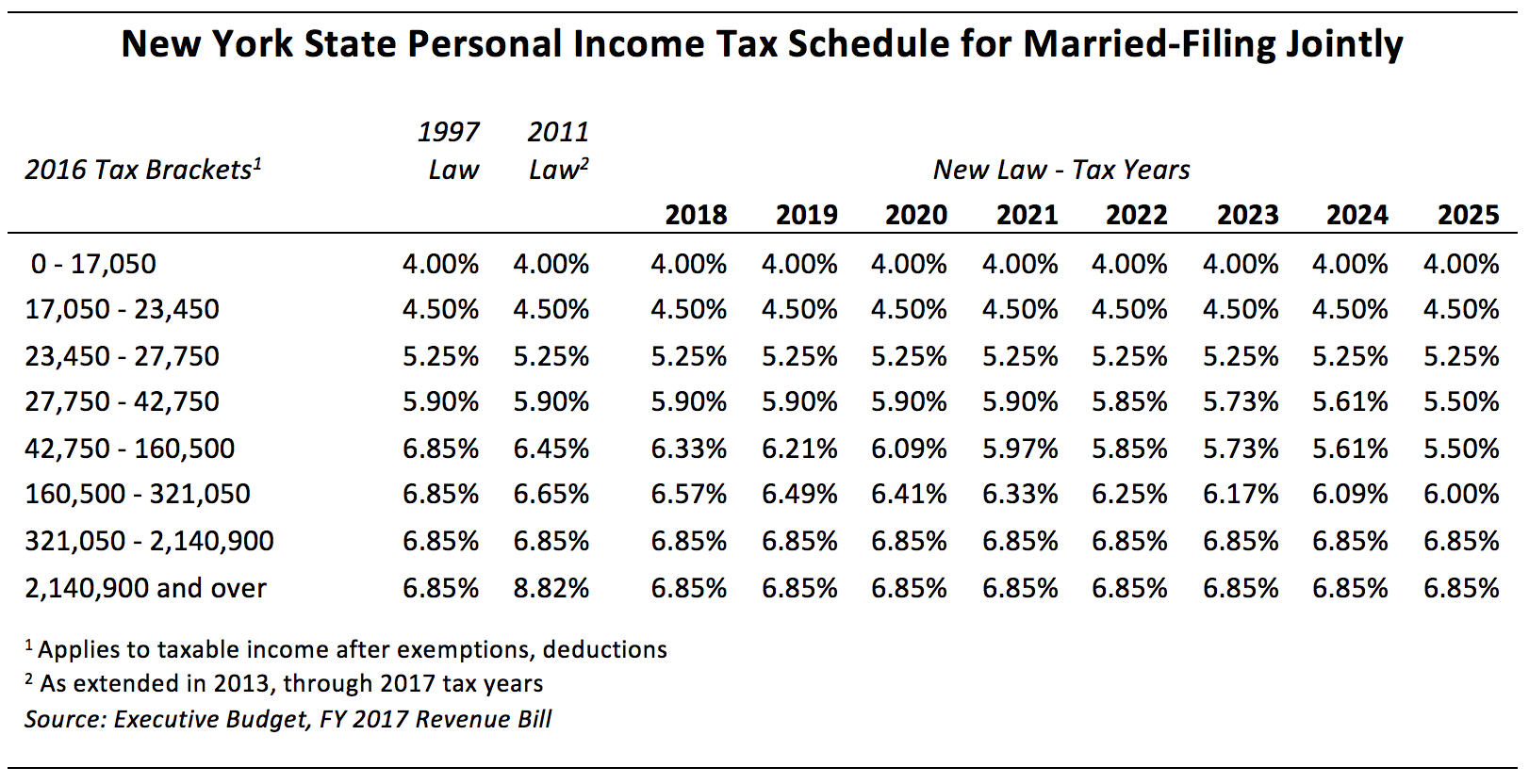 We’re now halfway through that schedule, and also roughly halfway through the full value of tax savings delivered by the 2016 law (which, it should be noted, did not reduce taxes at all in lower brackets).
The following table, also dating back to 2016, is a projection of fully implemented income tax savings for families at the median-income level in different regions of the state.
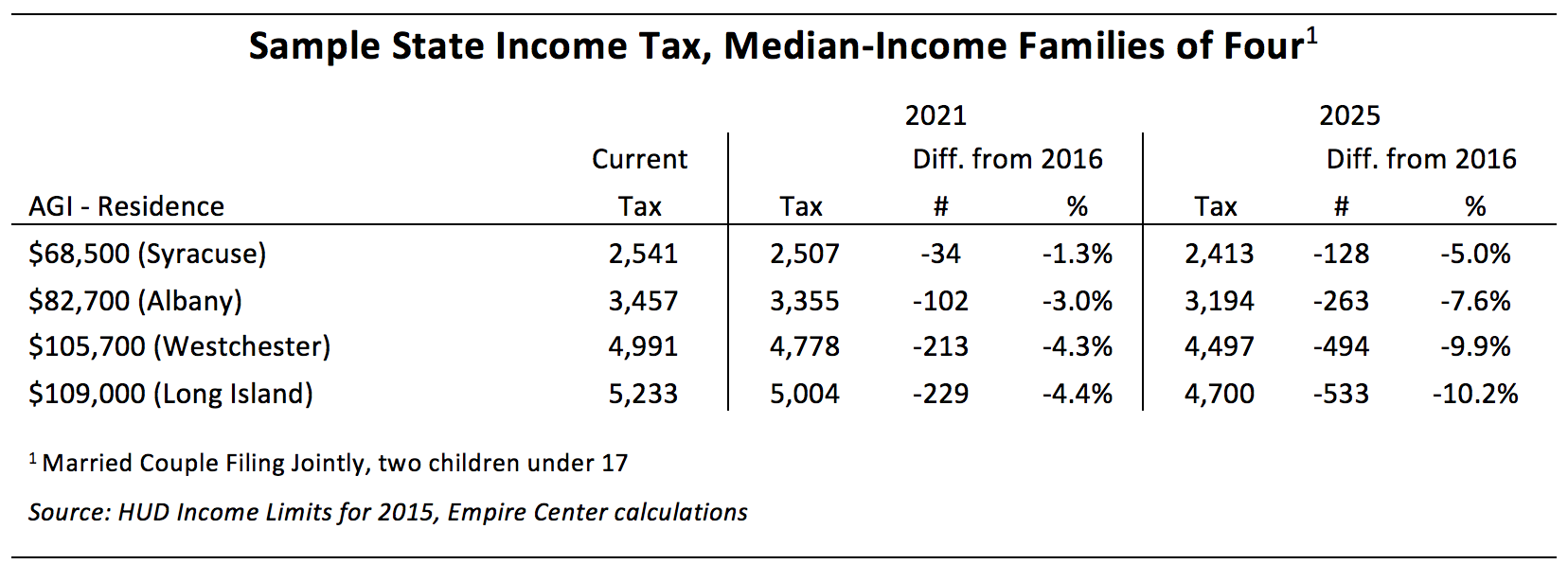
Compared to the 2021 liabilities shown above, roughly adjusting for increases in median family incomes in the last five years, the total 2023 savings under Hochul’s announced proposal will range from roughly $100 for a median-income family of four in Syracuse to just over $300 for a median-income family of four in Long Island.
As those figures would indicate, and as reflected in the percentages in the right-hand column of the table, the tax cut packed a bigger punch for the “middle class” as defined by elevated downstate standards. One of the shortcomings in the 2016 tax plan may soon become more glaringly obvious: that tax cut ended the state’s automatic inflation “indexing” of the income tax code, which adjusted brackets to reflect the rising cost of living. If inflation persists at high levels, it will lead to at least slight tax hikes due to bracket creep, which over time will slowly erode savings from the rate cuts Hochul touted today.
Speaking of tax touts, the governor today also announced she’d propose $1 billion in property tax rebates, offering no further details. Not to be confused (presumably) with the $383 million in property tax credits approved as part of the fiscal 2021 state budget, Hochul’s proposal sounds like the latest resurrection of the check-in-mailbox kickback scheme first concocted by Senate Republicans as the STAR Rebate in 2006, which was allowed to expire during the state fiscal crisis of 2009. A new version of that rebate was resuscitated by Cuomo and the Senate as an end-of-session deal in 2015; it sunset on schedule in mid-2020. (For more background, see my June 2025 blog post, “Another phony tax cut.”)
You may also like
The Attorney General’s MFCU SNAFU
Attorney General Letitia James' latest fight with the Trump administration focuses on New York's Medicaid Fraud Control Unit, a federally funded agency housed in James' office.
On T Read More
Healthcare Revelations in the Enacted Budget Financial Plan
The state financial plan published on June 10 disclosed key information about healthcare revenue and spending that lawmakers had not made public when approving the annual budget two weeks before.
Read More
Federal Suit Traces Medicaid Fraud to the Top of NYS Government
The Trump administration's latest salvo against Medicaid fraud takes aim at a different kind of target – two high-ranking New York officials along with a major state contractor.
A Read More

It Is Time to Rethink the Regional Greenhouse Gas Initiative
Before budget negotiations, Gov. Hochul warned that unless New York changes its climate plans, New Yorkers could face a $2.26-per-gallon increase in gasoline prices. The reason is the so-called “cap-and-invest” scheme, under which energy companies wou Read More

Healthcare Highlights in the New State Budget
Governor Hochul's focus on affordability seems to have skipped over the healthcare portions of the new state budget.
The deal finalized May 27 Read More

Lawmakers Consider Hiking Fees for Filling Prescriptions
UPDATE: The proposal discussed below passed the Assembly Friday evening by an unofficial vote of 133-0. Having previously been approved by the Senate, the bill will head to Governor Hochul's desk for her signature or ve Read More

Lack of Common Sense on Energy in the Budget
Lack of Common Sense on Energy in the Budget
Anyone hoping the governor would make even modest, common-sense changes to New York’s disastrous energy policies will be disappointed. The energy portion of the budget is out, and the nons Read More
Budget Deal Reportedly Earmarks $100M for 1199 and Extends MCO Tax
As Governor Hochul and legislative leaders rush to finalize the overdue state budget, outlines of some healthcare-related deals have begun to emerge from the closed-door negotiations.
Read More