

 New Yorkers are saving billions of dollars a year thanks to the historic 2011 state law capping annual growth in local government and school property tax levies.
The cap, enacted on a temporary basis and extended in 2015, was made permanent as part of the fiscal 2020 state budget, after Governor Andrew Cuomo announced he would not agree to a budget deal without it.
Since its enactment, the cap has weathered near-constant criticism from representatives of government employee unions, municipal governments and school districts, who portray it as improperly hindering their ability to raise taxes. Their (so far) unsuccessful efforts to undermine the cap have ranged from lawsuits challenging its constitutionality, to legislation creating loopholes under which taxes could be increased, to proposals that would eliminate the 60 percent supermajority requirement for overrides of the cap by school district voters and municipal governing boards.
For a comprehensive explanation of how the law works, download the Empire Center’s Citizens Guide to the Tax Cap.
Here is the complete statutory tax cap language.
Background information and tax cap implementation data from the Department of Taxation and Finance is available here.
The Office of the State Comptroller offers links to further information on the property tax cap on this page.
Recent analysis and commentary by the Empire Center:
- Permanent tax cap included in budget – E.J. McMahon statement, March 31, 2019
- The cap that worked – Ken Girardin, The Citizen, March 27, 2019
- Tax cap offers strongest shield to NY’s poorest school districts – E.J. McMahon, Research and Data, March 25, 2019
- Cuomo holding strong on tax cap – Ken Girardin, NYTorch, Feb. 10, 2019
- Assembly GOP wants higher taxes – Ken Girardin, NYTorch, Jan. 29, 2019
- Will Cuomo stand his ground? – E.J. McMahon, New York Post, Dec. 19, 2018
- Suburban Dems’ 1st move should be tax cap extension – E.J. McMahon, New York Post, Dec. 3, 2018
- Tax cap keeps getting grief – Ken Girardin, NYTorch, Nov. 4, 2018
- The tax cap is still working – Ken Girardin, NYTorch, June 20, 2018
- Tax cap wreaks chaos—not – Ken Girardin, NYTorch, May 17, 2018
- Tax cap = budget OKs – Ken Girardin, NYTorch, May 17, 2017
- Pols resume tax cap attacks – Tim Hoefer, NYTorch, Feb. 1, 2017
- Will Albany bust the cap? – Ken Girardin, NYTorch, June 10, 2016
- The tax cap works, again – Ken Girardin, NYTorch, May 18, 2016
- Tax cap survives latest challenge – E.J. McMahon, NYTorch, May 6, 2016
- Tax cap a near-freeze for 2016-17 – E.J. McMahon, NYTorch, Jan. 21, 2016
- Crocodile tears of NY’s tax cap – E.J. McMahon, New York Post, Oct. 5, 2015
- LI towns cry a river on tax cap – E.J. McMahon, NYTorch, Sept. 29, 2015
- “Warning”: taxes might not rise – Ken Girardin, NYTorch, June 11, 2015
- The cap-buster count, 2015 edition – Tim Hoefer, NYTorch, May 20, 2015
- School tax growth sinks under cap – E.J. McMahon & Ken Girardin, Research and Data, May 18, 2015
You may also like

Switching to Electric Home Heating Could Add Thousands to Energy Bills
FOR IMMEDIATE RELEASE: ALBANY, N.Y. that heating an average home from October to March would cost approximately $790 with natural gas, compared with $1,100 with a heat pump and $3,300 with electr Read More
Hochul’s Energy Infrastructure Plan Gets the Diagnosis Right but Offers No Prescription
Editor’s note: Roger Caiazza is an adjunct fellow at the Empire Center. He has a long and deep private industry background in environmental regulatory analysis and compliance. His frequently updated personal blog on New York State environmental poli Read More

Poll: 64% of New Yorkers Back Eliminating the State Income Tax; 67% Say State Taxes Aren’t Delivering
Dissatisfaction spans party and regional lines as broad majorities rally behind sweeping tax reform
FOR IMMEDIATE RELEASE: ALBANY, N.Y. - New Yorkers are delivering a blunt assessment of the state’s tax system: 67% say they ar Read More
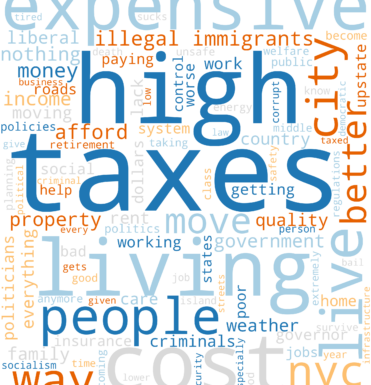
New Yorkers Want to Eliminate the Income Tax
Summary
New Yorkers have reached a clear verdict: The state’s tax system is not delivering. A full 67% say they are not getting good value for their tax dollars, while 64% support eliminating the state income tax. Read More
SUNY Research Foundation Payroll Tops $400 Million
Payroll records for 8,401 employees of the Research Foundation for the State University of New York (RF SUNY) for fiscal year 2026 are , the Empire Center's government transparency website.
The Research Foundation is a private, nonprofit educational co Read More

Newly Retired NYC Firefighters Average Over $177k In Pensions
New York City firefighters and fire officers retiring last year after full careers were entitled to average annual pension benefits of $177,016, according to , the Empire Center's government transparency website.
Among the 499 new retirees with at leas Read More
New York Annual Household Electricity Costs Rise $270
FOR IMMEDIATE RELEASE ALBANY, N.Y. — New York’s average residential electricity price reached 29.90 cents per kilowatt-hour (kWh) in July 2026, the fifth highest in the nation and 63.3 percent Read More
Energy Data Bulletin September 2026
September 2026
Summary and Insights
Electricity. In June 2026, New York had the nation's fifth-highest residential electricity price at 29.49 cents per kilowatt-hour (kWh), 60.8 percent above the U.S. average. Prices d Read More